
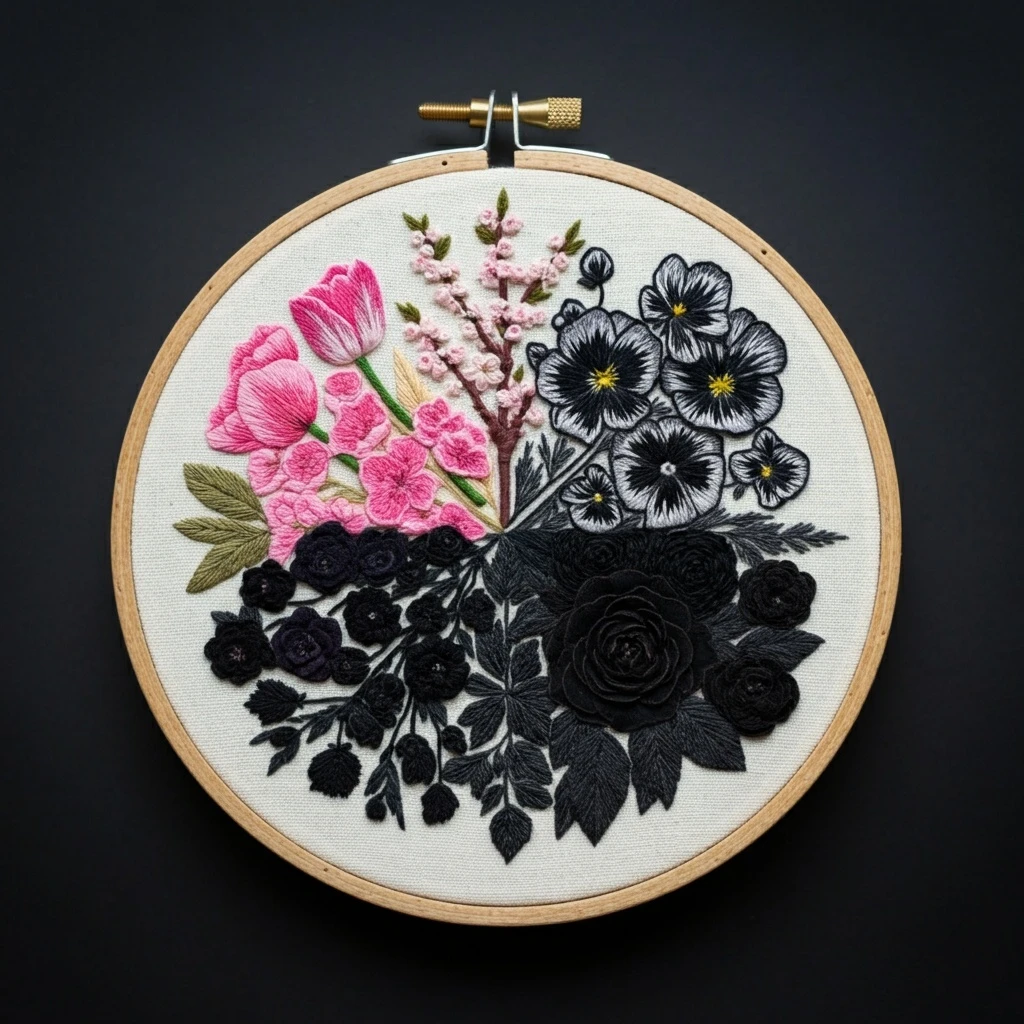
Duality in Bloom Pink Black Floral Arrangement
A high-contrast hoop design split between soft pink garden florals and dramatic black botanicals. The embroidery relies on delicate blush blossoms, saturated rose-pink petals, charcoal foliage, black dimensional roses, and small golden flower centers to create a striking light-versus-shadow effect.
Suggested DMC Color Palette
Choose the full range for a dimensional finish, or simplify by keeping one light, one mid, and one dark shade for each color family.
Stitch Map by Design Element
Keep the pink side airy and luminous, then make the black side denser with layered stitches and darker thread counts.
| Area | Stitches | Thread guidance |
|---|---|---|
| Pink tulips and large petals | Use long-and-short stitch from petal base to tip, following the petal curve. Add a few split-stitch veins with a darker cranberry shade. | 2 strands for fill, 1 strand for fine veins; blend 818 + 603 for soft transitions. |
| Small pink blossom cluster | Satin stitch for open petals, lazy daisy for tiny side flowers, and French knots for round buds. | 2 strands for satin, 1-2 wraps for knots. Mix 819, 818, and 603 for varied blossoms. |
| Black pansies | Outline with split stitch, fill with radiating long-and-short strokes, then add gray highlight lines from the petal edges inward. | 1 strand black for outlines, 2 strands black for fill, 1 strand 413 for delicate highlights. |
| Black roses and lower flowers | Use woven wheel roses or whipped spider-web roses for raised texture. Keep outer petals slightly looser so the flowers read as dimensional. | 3 strands DMC 310 for rich raised roses; add 3799 sparingly where the black needs separation. |
| Charcoal leaves and fern fronds | Fishbone stitch for large leaves, fly stitch for fern sprays, and straight stitch for fine tendrils. | 2 strands 3799 for fill, 1 strand 413 for top veins and leaf tips. |
| Branches and green leaves | Stem stitch for branches, fishbone or satin stitch for leaves, and tiny straight stitches for leaf veins. | 2 strands 315 for stems; 2 strands 730/732 for leaves; 1 strand for veins. |
| Flower centers | French knots or tiny star stitches, especially on the black pansies where yellow centers add contrast. | 1-2 strands DMC 725; use one extra wrap for larger center dots. |
Blending & Shading Ideas
Small color blends make this design feel painterly without requiring many advanced stitches.
Texture & Dimensional Details
The design benefits from contrast in both color and surface height: keep the line-art flowers crisp and make the lower roses tactile.
Raised black roses
Work woven wheels with firm tension and 3 strands of DMC 310. Add one outer round in 3799 if you want the petals to show more definition.
Delicate blossom spray
Use French knots in 819 and 818 along the branch, then add a few 603 knots closer to the center for depth. Random spacing looks more natural than perfect rows.
Graphic pansy lines
After filling petals in black or charcoal, stitch fine 413 lines from the petal edge toward the center. Stop before the yellow center so the flower does not look crowded.
Beginner-Friendly Stitching Order
Working from flat background details to raised foreground elements keeps the hoop clean and avoids snagging textured stitches.
Stabilize and transfer cleanly
Use tightly woven cotton or linen and a sharp pencil, water-soluble pen, or light transfer. Mark only essential petal and leaf lines so the pale pink areas stay clean.
Stitch stems first
Use stem stitch for the central branch lines and green stems. This sets the bouquet structure before petals and leaves cover intersections.
Fill flat leaves and petals
Complete olive leaves, pink tulips, and black pansy fills with 1-2 strand long-and-short or satin stitch. Follow the growth direction of each petal.
Add outlines and veins
Use one strand for black outlines, petal veins, and leaf ribs. Thin outlining is the key to keeping this dense design elegant rather than heavy.
Finish with raised accents
Add French knots, woven roses, and yellow centers last. These stitches sit on top and should not be crushed by later work.
Thread-count guidance
- 1 strand: fine black pansy outlines, gray highlight strokes, leaf veins, and narrow petal creases.
- 2 strands: most satin stitch, long-and-short shading, fishbone leaves, stems, and medium flower fills.
- 3 strands: woven roses, bold black floral masses, and raised knots that need extra presence.
- 6-strand caution: avoid full 6-strand fill except for very large practice samples; it can overwhelm the delicate linework.
Practical tips
- Separate strands and recombine them before stitching to reduce twist and make satin areas smoother.
- Use shorter thread lengths for black floss; dark thread shows fuzz more quickly after repeated fabric passes.
- Keep a lint roller nearby when stitching black areas on pale fabric.
- Test the pinks on a scrap first: choose the brighter shade for the outer left flowers and reserve pale pink for highlights.
- Step back often to check balance between the bright pink half and the dark botanical half.
Finishing note
For the cleanest “duality” effect, leave a little breathing room between the pink florals and black botanicals at the bouquet center. Crisp outlines, varied black textures, and tiny yellow centers will keep the dramatic side detailed rather than flat.