
DMC palette & hand embroidery guide
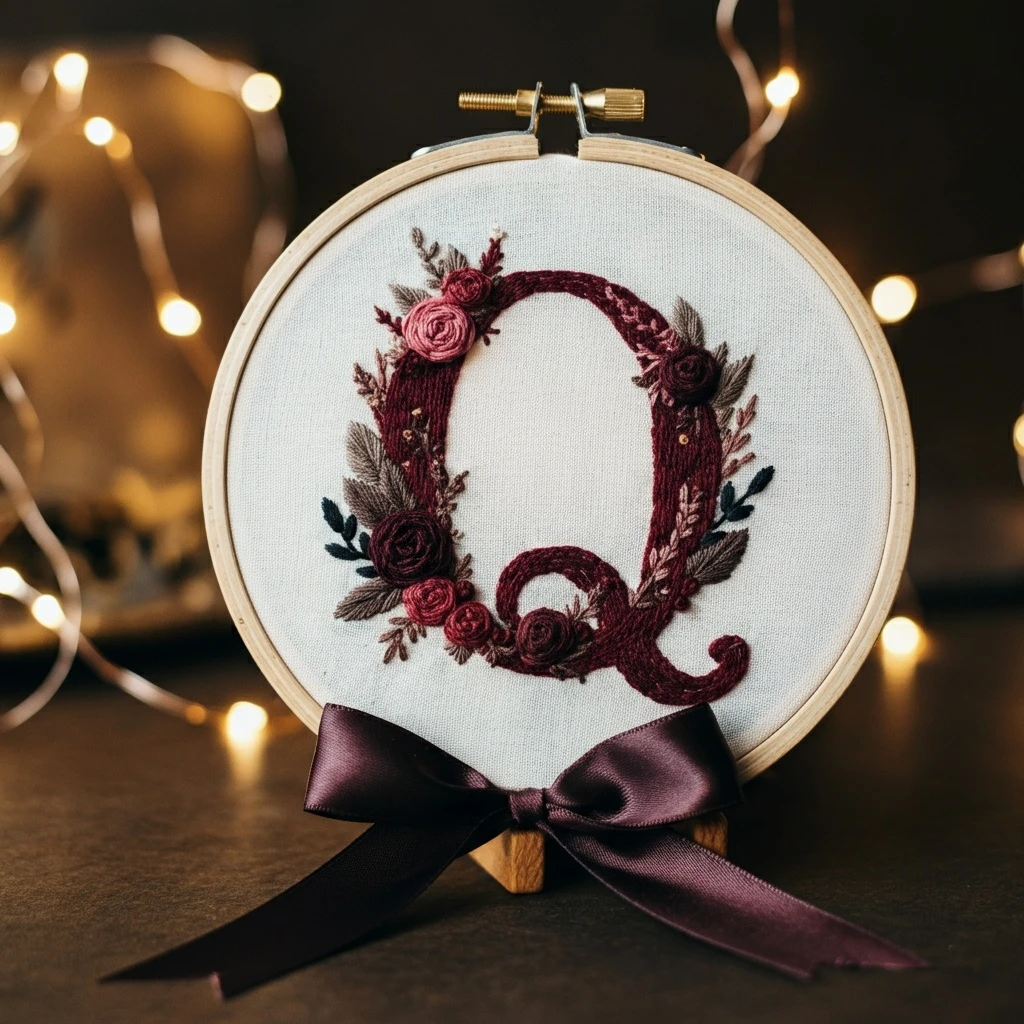
Elegant Monogram Q
A refined monogram hoop with a graceful letterform, soft botanical accents, and a classic heirloom feel. The palette below balances creamy lettering, dusty rose florals, muted greenery, and fine golden-beige highlights for a polished stitched finish.
Suggested DMC Color Palette
Use these flosses as practical matches for the visible design mood: warm ivory and taupe for the monogram, dusty pinks for blossoms, sage greens for leaves and stems, and dark accents for definition.
Main highlight for the monogram. Use 2 strands for smooth satin or padded satin stitches.
Soft shadow along the inner edge of the Q and under overlapping floral elements.
Dusty rose petals, medium blossom shading, and the warmest flower details.
Lighter petal tips and small flower centers blended with 3722 for softness.
Deep petal folds, tiny French knots, and a few anchor points inside fuller blooms.
Primary muted leaf color. Ideal for fishbone leaves or small satin leaf shapes.
Stem lines, underside leaf shading, and areas that need a more antique botanical tone.
Fine dark leaf veins, occasional stem outlines, and depth where florals overlap.
Warm flower centers, seed dots, and tiny golden accents to brighten the monogram.
Use sparingly for crisp eye-catching outlines, deepest flower centers, or final definition.
Thread-count guide
Use 2 strands for most petals, leaves, and monogram fill. Switch to 1 strand for inner Q outlines, thin stems, veins, and delicate curls. Use 3 strands only for raised flower centers or padded areas that should stand forward.
Blending idea
Blend 1 strand 3722 with 1 strand 223 for soft mid-pink petals. For aged greenery, combine 1 strand 522 with 1 strand 3052 in longer leaves so the wreath feels natural rather than flat.
Order of work
Stitch the monogram first, then stems and leaves, then flowers, and finish with knots, seed dots, and outline details. This keeps the Q clean while allowing blossoms to sit visibly on top.
Stitch Suggestions by Design Area
For the monogram Q
- Padded satin stitch: build a soft base with split stitch, then cover with smooth satin stitches using DMC 3865.
- Split stitch outline: use 1 strand 3864 along one side for gentle dimension without making the letter look heavy.
- Long-and-short stitch: helpful on wider curves where satin stitches would become too long and snag-prone.
For flowers and foliage
- Lazy daisy: excellent for small simple petals around the monogram edge.
- Fishbone stitch: gives narrow sage leaves a clean central vein and natural direction.
- French knots: use 729 or 315 for flower centers, seed clusters, and decorative dots.
Shading, Texture & Outlining Notes
| Area | Recommended approach | Practical note |
|---|---|---|
| Letter body | 3865 with tiny 3864 shadow stitches | Keep stitches parallel around curves; rotate the hoop often so the satin direction stays comfortable. |
| Rose-pink petals | 223 on outer tips, 3722 in mid-petals, 315 near folds | Use short long-and-short strokes for a painted petal effect; avoid hard stripes by staggering stitch lengths. |
| Leaves | 522 base, 3052 lower side, 3364 vein | One-strand dark veins are enough. Heavy outlines can overpower the soft monogram style. |
| Centers and dots | 729 French knots with occasional 3371 anchor points | Wrap knots twice for small dots, three times for raised focal centers. |
Beginner-Friendly Practical Tips
- Use shorter satin stitches on tight curves rather than forcing one long stitch across the full width.
- Separate all six strands before recombining; this reduces twisting and gives smoother coverage.
- When stitching flowers over the Q, keep the floral stitches slightly raised so the bouquet feels layered.
- Test dusty rose colors on a fabric scrap: pale linen may need stronger 3722, while bright white cloth may look best with more 223.
- Finish by checking the silhouette of the Q from arm's length; add one-strand outline stitches only where the letter needs clarity.