
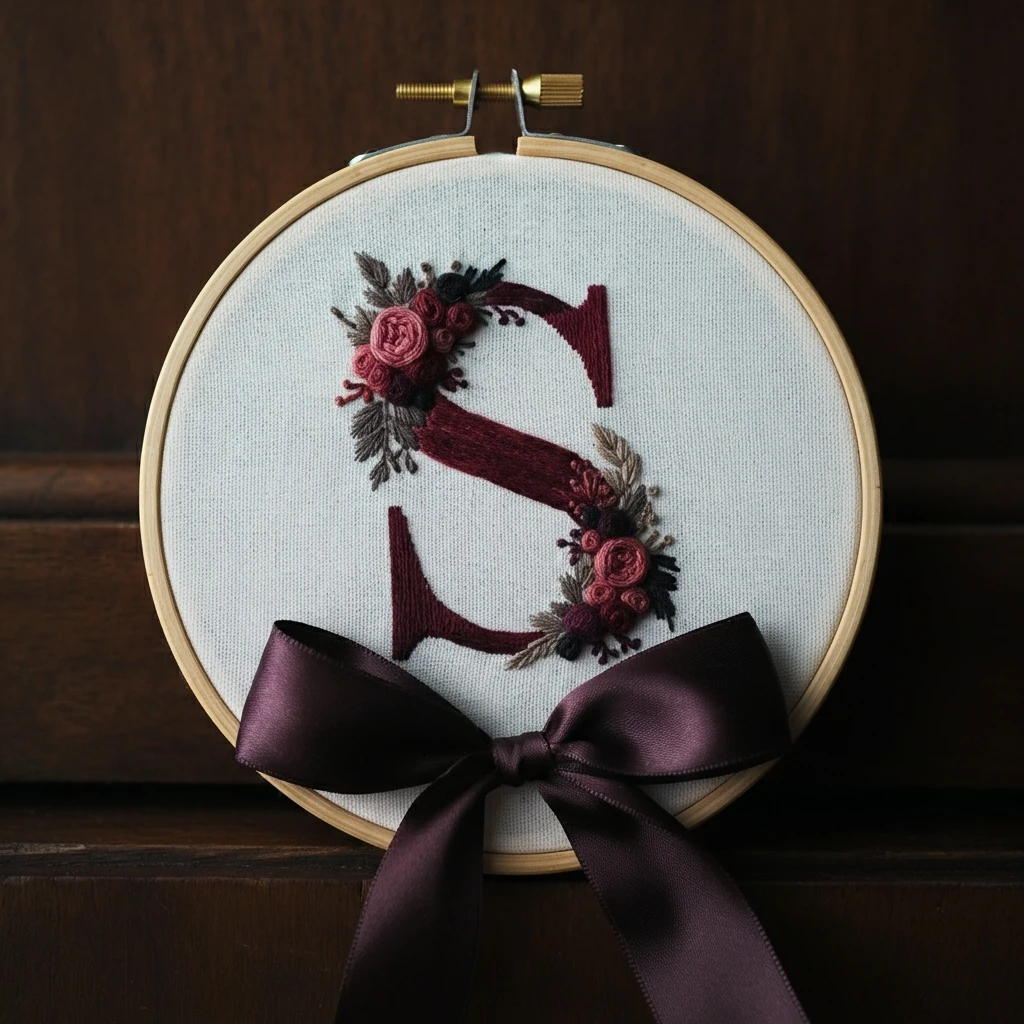
DMC palette & hand embroidery guide
Elegant Monogram S
A graceful heirloom-style monogram with soft floral accents and leafy sprays. This palette keeps the letter crisp and refined while giving the blossoms gentle pink warmth, muted green movement, and a few golden center details.
Suggested DMC Color Palette
Use these flosses as practical matches for an elegant floral monogram: warm whites and beige shadows for the letter, dusty blush-pinks for blossoms, sage greens for leaves, and small dark accents for definition.
Main monogram fill and bright petal highlights. Use 2 strands for satin stitch coverage.
Subtle shadow on the inside curves of the S and under overlapping flowers.
Softest blush petals and tiny buds where the floral accents need a delicate finish.
Mid-tone pink for open petals, lazy daisy flowers, and blended rose accents.
Petal bases, small rose folds, and shaded flower edges for extra depth.
Use sparingly for deepest petal folds, tiny accent knots, and contrast near flower centers.
Primary leaf color. Works beautifully for fishbone leaves and soft leafy sprays.
Stems, shaded leaves, and muted greenery that keeps the design elegant rather than bright.
Fine leaf veins, occasional stem definition, and darker touches where foliage overlaps.
Tiny flower centers, seed dots, and warm highlights that lift the pink-and-cream palette.
Thread-count guide
Use 2 strands for the S fill, petals, and most leaves. Use 1 strand for thin stems, inner letter outlines, leaf veins, and delicate finishing lines. Use 3 strands only for raised flower centers or padded knots.
Blending idea
Blend 1 strand 152 with 1 strand 223 for soft flower transitions. For shaded foliage, combine 1 strand 522 with 1 strand 3052 so leaves look muted and natural without adding too many separate colors.
Best work order
Stitch the monogram outline and fill first, add stems and leaves second, then place flowers over the greenery. Save French knots, gold dots, and dark accent stitches for the very end.
Stitch Suggestions by Design Area
For the monogram S
- Padded satin stitch: outline the S with split stitch, add a light padding layer, then cover with smooth 3865 satin stitches.
- Long-and-short stitch: use on wider curves so no single stitch becomes too long or loose.
- One-strand split stitch: add 3864 along selected inner curves for a soft shadow and cleaner letter shape.
For flowers and foliage
- Lazy daisy stitch: ideal for small floral accents around the S and simple open petals.
- Fishbone stitch: gives leaves a polished central vein while keeping the wreath-like sprays neat.
- French knots: use 729 for flower centers and 315 for occasional darker berry-like accents.
Shading, Texture & Outlining Notes
| Area | Recommended approach | Practical note |
|---|---|---|
| Letter body | 3865 fill with selective 3864 shadow | Keep satin stitches short on tight turns. Rotate the hoop so the S curve stays comfortable to stitch. |
| Blush blossoms | 152 on petal tips, 223 in mid-petals, 3722 or 315 at bases | Stagger long-and-short stitches to avoid stripes; a few darker stitches near the center are enough. |
| Leaves and stems | 522 base, 3052 shadow, 3364 fine veins | Use 1 strand for veins and stems near the letter so the greenery does not overpower the monogram. |
| Centers and details | 729 French knots with occasional 315 accents | Two wraps make small neat dots; three wraps create raised centers for focal flowers. |
Beginner-Friendly Practical Tips
- Separate all six strands before recombining them; this helps the floss lie flatter and reduces twisting.
- Start with the light monogram threads before stitching darker petals or leaves to keep the cream floss clean.
- Use short satin stitches on narrow letter curves instead of stretching one long stitch across the shape.
- Let flowers overlap the letter slightly for a layered look, but keep their outlines light so the S remains readable.
- Step back from the hoop before adding dark 3364 or 315 accents; small details can quickly become too bold.