
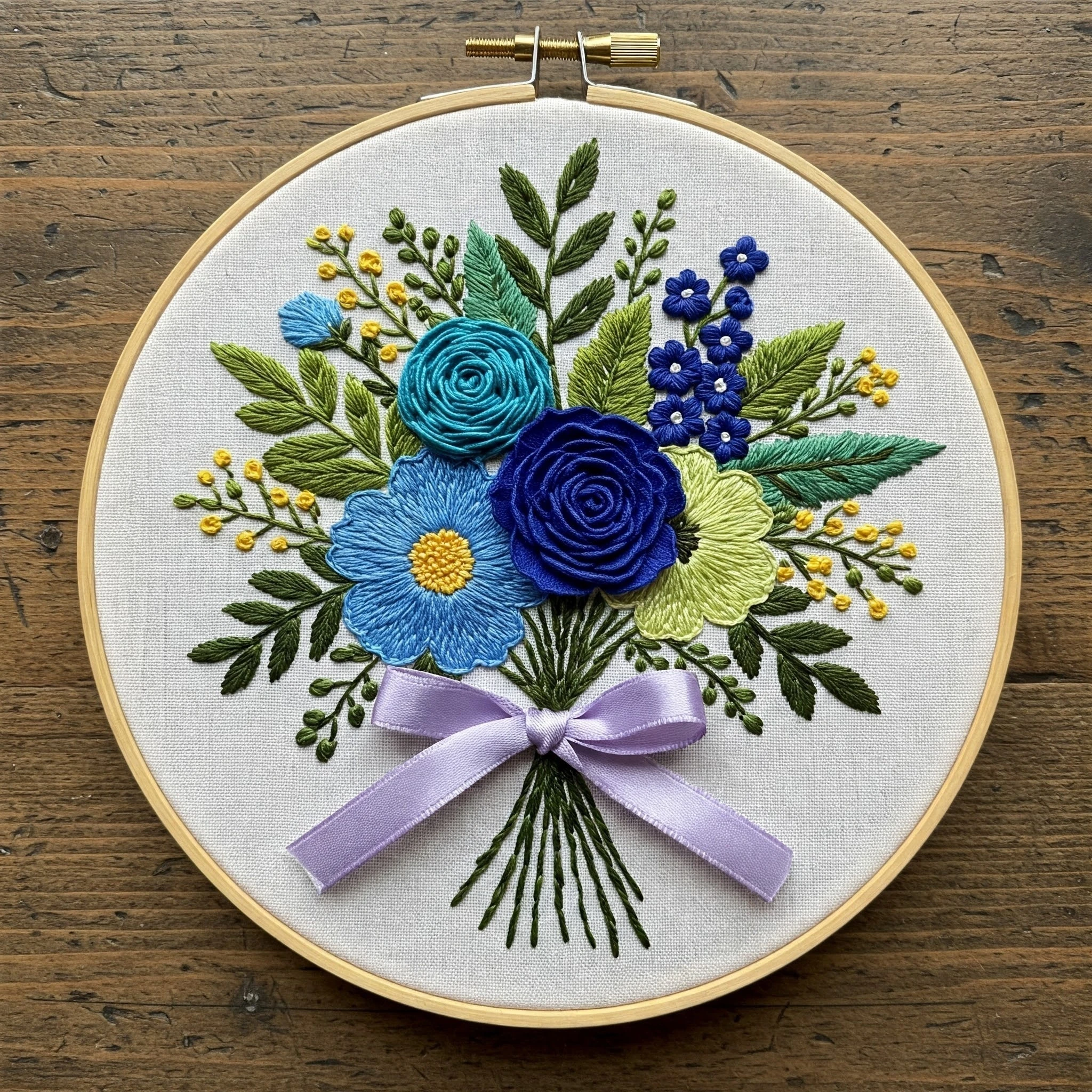
Embroidered Blue Green Floral Bouquet With Lavender Bow
A fresh bouquet design with cool blue-green blossoms, soft sage foliage, and a lavender bow. The embroidery works best with gentle tonal shading, clean botanical outlines, and a satin-soft ribbon finish.
Color Reading & Design Notes
The design is best interpreted as a delicate hand-embroidery bouquet: rounded blue-green blooms, small pale filler flowers, layered sage leaves, slender stems, and a lavender bow tying the arrangement together. Use the deepest colors sparingly for structure, and let the mid-tones carry most of the stitched surface.
Primary mood
Cool, airy, garden-fresh. Keep the bouquet soft rather than high contrast so the bow remains the decorative focal point.
Main visual contrast
Blue-teal petals against muted green foliage, balanced by lavender ribbon folds and a few creamy highlights.
Best fabric base
Natural linen, ivory cotton, or pale oatmeal fabric. Avoid bright white if you want a softer vintage bouquet look.
Suggested DMC Floss Palette
These DMC choices are matched to the likely blue-green floral bouquet, lavender bow, leafy stems, pale fillers, and fine outlines. Substitute nearby shades if your fabric changes the contrast.
Stitch Types & Where to Use Them
| Design area | Recommended stitch | Thread guidance |
|---|---|---|
| Blue-green flower petals | Long and short stitch, fishbone stitch, or satin stitch for small petals. | Use 2 strands for coverage. Blend 926 into 927 at petal tips; reserve 3768 for tucked shadows. |
| Lavender bow | Satin stitch for smooth ribbon faces; stem stitch or split stitch along fold lines. | Use 2 strands of 3042 for the main bow and 1-2 strands of 3041 on top edges. Add a tiny 3864 highlight on the knot if desired. |
| Leaves | Fishbone stitch for almond-shaped leaves; detached chain for tiny leaves; back stitch for narrow sprigs. | Use 3012 as the main fill, 3013 on the upper side, and 3363 at the leaf base or underside. |
| Stems | Stem stitch, whipped back stitch, or split stitch. | Use 1-2 strands depending on scale. Keep stems thinner than petal outlines so the bouquet looks graceful. |
| Small filler flowers | Lazy daisy, colonial knots, French knots, or tiny satin petals. | Use 822 with 928 highlights. Add 3864 or a single 3042 knot for small centers. |
| Outlines and details | Back stitch, split back stitch, or couching for curves. | Use 1 strand of 3799 for crisp details. For softer outlines, use 3768 on blue petals and 3363 on leaves. |
Thread Count, Blending & Shading Plan
Thread-count guide
Use 2 strands for most filled flower petals and bow areas, 1 strand for outlines and interior veins, and 3 strands only for French knots or bold flower centers. On tightly woven fabric, test satin areas first to prevent raised ridges.
Blending ideas
For intermediate shades, blend one strand DMC 926 with one strand DMC 927 for blue-green petals. For the bow, blend one strand 3042 with one strand 3041 on upper loops to create a gentle lavender sheen.
Petal shading
Begin with 3768 at petal bases and under overlapping shapes. Fill the middle with 926, then feather 927 or 928 toward the tips using staggered long-and-short stitches.
Leaf shading
Work leaves from center vein outward. Place 3363 near the stem connection, 3012 through the center, and 3013 on the side facing open space or light.
Texture Suggestions
- Keep the bouquet dimensional: stitch back leaves first, then flowers, then bow folds, and save the darkest outlines for last.
- Add soft floral texture: scatter French knots in 822, 928, and 3864 between the main flowers to imitate small buds and filler blossoms.
- Make the ribbon look tied: angle satin stitches outward on each loop, then add a split-stitch crease line where the fabric would fold toward the knot.
- Use open space: do not overfill every petal. Small fabric gaps between petals help the blue-green flowers feel light and hand-drawn.
Beginner-Friendly Stitching Order
1. Transfer lightly
Use a fine water-soluble pen or pale transfer pencil. Mark only essential petal edges, stems, bow folds, and leaf veins.
2. Start with stems
Work stems in 1-2 strands of 3012 using stem stitch. This anchors the bouquet and helps place leaves accurately.
3. Add leaves
Fill leaves before petals so flower edges can overlap them neatly. Use fishbone stitch for a tidy botanical texture.
4. Stitch flowers
Work from darker centers outward. Keep stitches smooth and consistent, changing direction slightly to follow petal shapes.
5. Finish the bow
Satin stitch the bow in lavender tones after the flowers so it sits visually on top of the bouquet wrap.
6. Outline sparingly
Use one strand for final definition. Outline only the most important contours to keep the result elegant and not too graphic.
Finishing Notes
After stitching, gently remove transfer marks according to the pen instructions, let the piece dry flat, and press from the back on a towel. For hoop display, add a thin layer of batting behind the fabric to give the bouquet a soft raised finish and help the pale blue-green and lavender tones stand out.