
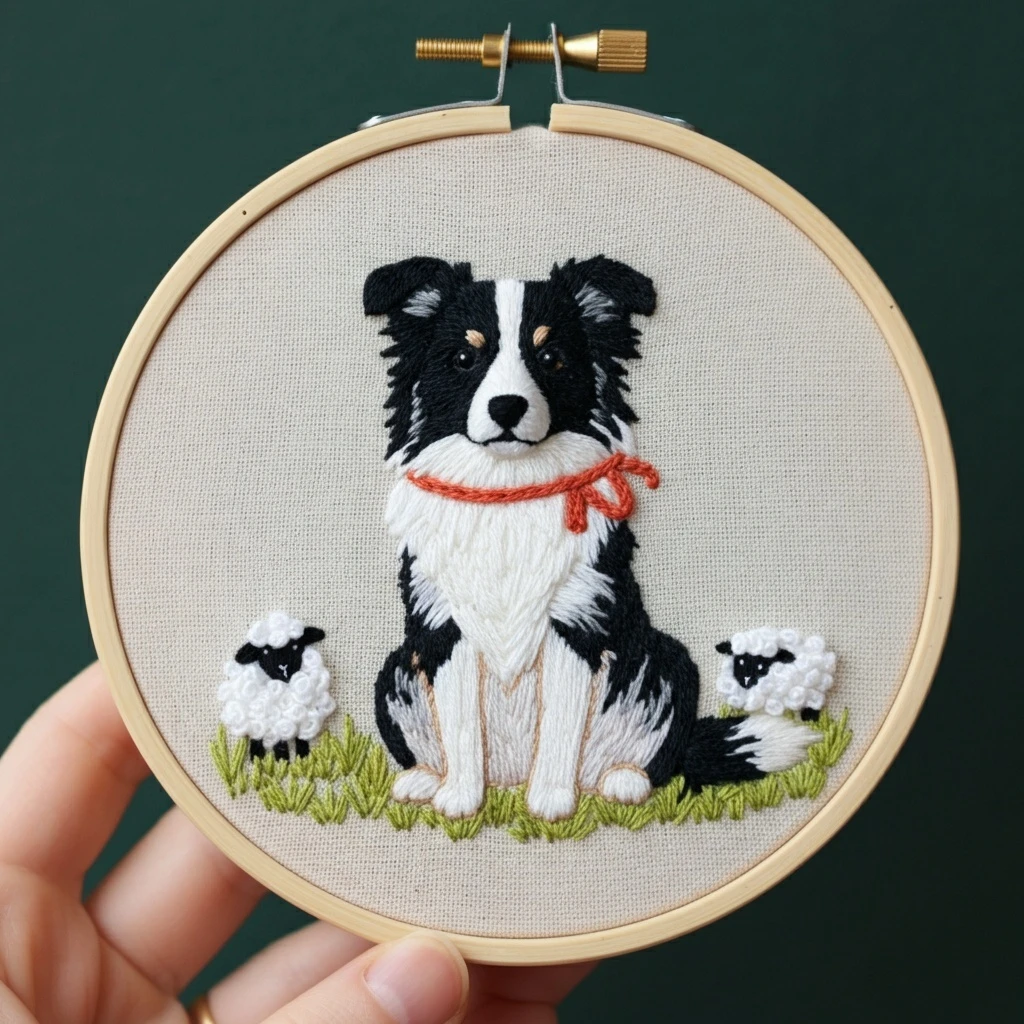
Embroidered Border Collie With Sheep
A calm pastoral design built around a black-and-white Border Collie, soft sheep fleece, field greens, and warm countryside neutrals. The best finish comes from crisp dark outlines, layered fur direction, and cozy textured stitches for the sheep.
Suggested DMC palette
These colors balance the dark Border Collie markings, white chest and muzzle, warm sheep fleece, earthy ground, and gentle outdoor greens. Use exact matches when possible, or substitute one step lighter/darker within the same family.
Thread-count guidance
- Outlines: 1 strand for facial features, legs, sheep faces, and any thin landscape marks.
- Dog fur: 1–2 strands. Use 1 strand near eyes and muzzle; 2 strands for larger black body patches.
- Sheep fleece: 2 strands for soft coverage, or 3 strands only for raised French knots/bullion knots.
- Grass and ground: 2 strands for visible strokes; mix short and long lengths for a natural pasture edge.
- Highlights: 1 strand of 3865 over gray or tan stitches keeps whites dimensional instead of flat.
Blending ideas
- Blend one strand 310 + one strand 3799 for softer black fur that still reads dark.
- Blend one strand 3865 + one strand 318 for shaded white fur and sheep wool transitions.
- Blend one strand 3012 + one strand 3013 for sunlit grass; switch to 730 near feet and shadows.
- For warm wool, place sparse 738 stitches under 3865 curls so the sheep look creamy, not stark white.
Stitch suggestions by design area
| Area | Recommended stitches | Practical notes |
|---|---|---|
| Border Collie outline | Back stitch, split stitch | Use 1 strand of 310 or 3799. Split stitch is smoother around the muzzle and ears; back stitch is easier for beginners on longer body contours. |
| Black fur patches | Long and short stitch, directional straight stitch | Follow the natural fur flow: outward from the face, downward on the chest, and angled along the ears. Break up solid black with 3799 to avoid a heavy block. |
| White chest and muzzle | Long and short stitch, satin stitch for tiny areas | Lay 318 first in shadow pockets, then add 3865 highlights. Avoid overfilling the muzzle so small nose and eye details stay sharp. |
| Eyes, nose, mouth | Tiny satin stitch, single straight stitches, French knots | Work facial details last with 1 strand. Add a single 3865 highlight dot near the eye only if the motif scale allows it. |
| Sheep fleece | French knots, colonial knots, seed stitch, detached chain | Cluster knots unevenly for natural wool. Use 3865 on top, 318 in lower shadows, and a few 738 stitches for warmth. |
| Sheep faces and legs | Back stitch, small satin stitch | Use 3799 or 433 rather than pure black when a softer farm-animal look is desired. |
| Pasture grass | Straight stitch, fly stitch, lazy daisy, couching | Vary greens and stitch height. Keep grass shorter near faces and longer around hooves to frame the animals without hiding them. |
| Ground shadows | Seed stitch, short running stitch | Place 730 and 407 sparingly beneath the dog and sheep to anchor the scene without making the base too dark. |
Best finishing sequence
Start with pale background grass and earth, then stitch the sheep fleece base, then the collie body. Add textured wool knots after the surrounding stitches are complete, and finish with the dog’s eyes, nose, whisker marks, and crisp final outlines.
Shading and texture
For the collie, the key is contrast control. Pure 310 should be reserved for the deepest patches and final facial definition; 3799 and 414 help show fur direction without losing the black-and-white identity. On white areas, shade with 318 first and keep the brightest 3865 stitches on raised planes like the forehead, chest, and top edge of the muzzle.
For the sheep, avoid perfectly even rows. Make the fleece charming by scattering French knots in different densities, leaving tiny fabric gaps, and mixing winter white with light gray and warm tan.
Outlining details
Use a single-strand split stitch around the dog’s face and ears for a refined illustrated look. Where the body overlaps sheep or grass, switch to 3799 or 433 so the outline does not overpower the softer countryside setting. Keep the legs and paws especially clean: short stitches prevent wobbly curves.
For sheep silhouettes, a broken outline can look more natural than a continuous heavy border. Let knots and seed stitches form the fleece edge.
Beginner-friendly practical tips
- Trace the eye, nose, and muzzle marks very clearly before starting; those tiny features give the collie its personality.
- Work dark colors with clean hands and shorter thread lengths to reduce fuzz and lint on the pale sheep and white fur.
- Do not carry black thread behind light fabric areas; it may shadow through. End and restart instead.
- Use a hoop that keeps the fabric firm but not stretched out of shape, especially when adding dense sheep knots.
- If the sheep knots feel bulky, switch some areas to seed stitch so the design remains balanced and easy to frame.
- Step back often: animal designs look best when contrast and expression are checked from viewing distance, not only up close.