
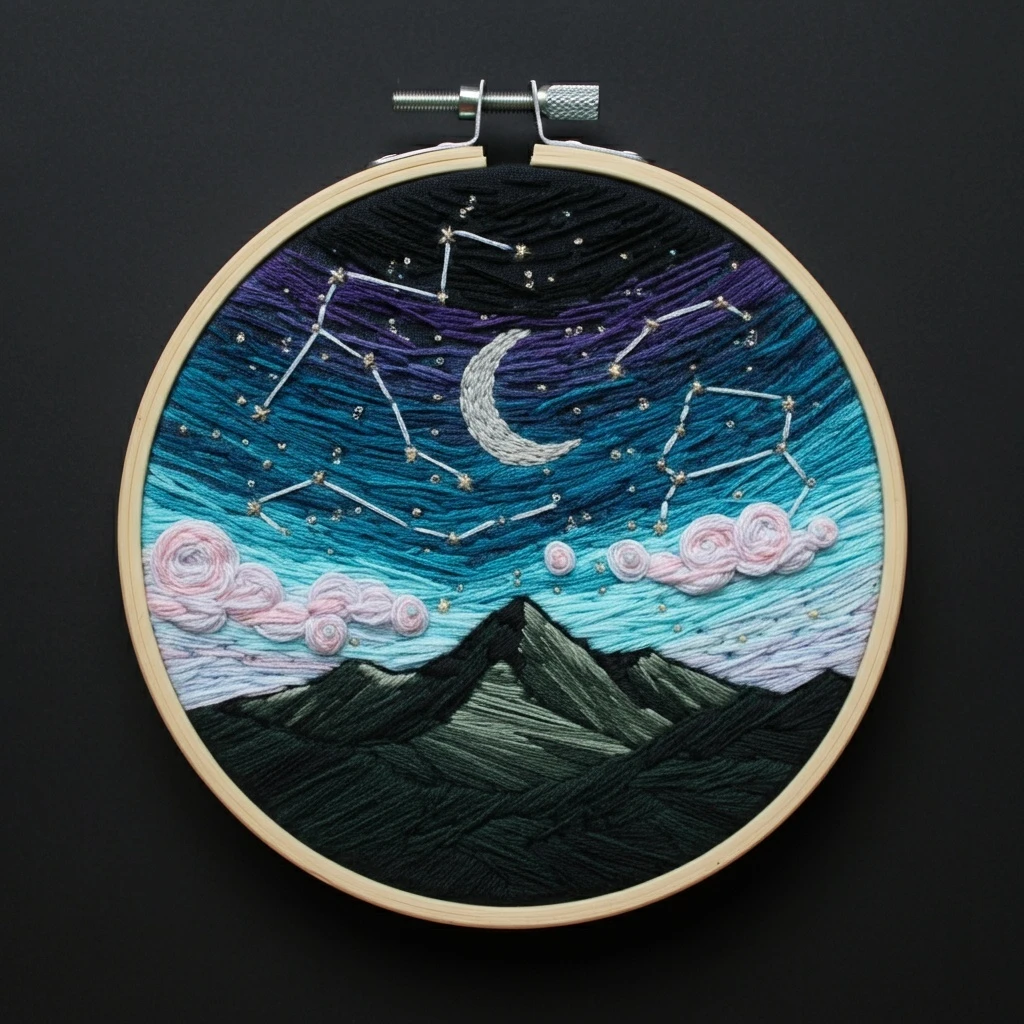
Embroidered Constellation Night Sky Over Mountains
A serene night landscape with deep navy sky, bright stitched constellations, scattered stars, cool violet-blue atmosphere, and layered mountain silhouettes. These DMC matches are estimated from the visible hoop preview and chosen for a clean, luminous embroidery finish.
Likely DMC Color Palette
Matched to the midnight sky, blue-violet glow, constellation stars, pale connector lines, mountain silhouettes, snow highlights, mist, and cool foreground ridges.
Stitching Suggestions
Work the dark landscape first, then sky glow, mountain highlights, star nodes, constellation lines, and final sparkle points.
| Element | Stitch Type | Practical Notes |
|---|---|---|
| Deep night sky | Seed stitch or long and short stitch | If the fabric is already dark, keep sky stitching sparse. Add 823, 336, and 3838 in loose patches to create depth without covering the whole background. |
| Sky gradient | Long and short stitch | Blend 3838, 3042, 3721, and 3761 gently near the horizon or around major star clusters. Keep transitions soft and slightly irregular. |
| Large stars | Star stitch | Use 3865 or 3756 for the rays and add 744 or 3852 at the center for a warm celestial glow. |
| Tiny stars | French knots | Use one-wrap knots for distant stars and two-wrap knots for brighter points. Mix 3865, 3756, 3841, and 744. |
| Constellation nodes | French knots or colonial knots | Stitch the star knots first, then connect selected points with fine backstitch so the layout stays accurate. |
| Constellation lines | Single-strand backstitch | Use 762 or 3841 with very light tension. Avoid pulling tightly, especially on dark fabric, to prevent puckering. |
| Shooting star or comet | Long straight stitch with couching | Use 3865 or 3756 for the main trail, then add a tiny 744 stitch near the head for warmth. |
| Mountain silhouettes | Satin stitch or split-stitch rows | Use 939, 823, and 3799 for the darkest peaks. Follow the slope angle rather than stitching straight across. |
| Mountain snowcaps | Long and short stitch | Use 3865 and 3756 on the brightest edges, then feather 762 and 415 into shadowed snow folds. |
| Rocky ridges | Straight stitch and split stitch | Use 930, 318, 415, and 3799 in broken diagonal strokes. Vary length to suggest natural stone texture. |
| Distant ridgelines | Stem stitch | Use 930 or 924 in one strand for low horizon lines. Keep them soft so the foreground peaks remain dominant. |
| Foreground tree line | Fly stitch and straight stitch | Use 924 and 926 in tiny upward strokes. Cluster them unevenly to imply pine shapes without over-detailing. |
| Mist or cloud bands | Feather stitch | Use 762, 3841, and 3756 in pale horizontal wisps between sky and mountains. |
| Final sky sparkle | Tiny straight stitch | Add a few late-stage 3865 and B5200-like white highlights only near the most important constellations, not everywhere. |
Thread Count, Blending & Texture
Use strand count to contrast quiet dark sky, crisp star knots, delicate constellation lines, and rugged mountain slopes.
Sky restraint
On dark fabric, use mostly open space and sparse seed stitching. On lighter fabric, build the sky with 2-strand long-and-short stitches before adding stars.
Constellation accuracy
Place the star knots first and check the shape before connecting them. Use one strand for all connector lines to keep them fine and celestial.
Star hierarchy
Make only a few stars large. Most should be tiny knots, with larger star stitches reserved for the constellation focus and brightest sky points.
Mountain depth
Keep the closest peaks darkest. Add lighter blue-gray and white strokes only to ridges that would catch moonlight or starlight.
Snow and mist
Use pale stitches sparingly. Too much white can pull attention away from the constellation pattern.
Beginner control
Stitch constellation lines after the mountains are finished so the delicate sky details do not get snagged while filling larger shapes.
Recommended Stitching Order
This order keeps the night-sky details crisp and prevents pale constellation threads from being disturbed.
Helpful Notes for a Polished Finish
A calm, spacious finish makes this mountain nightscape feel expansive and luminous.
- Use short floss lengths for white and pale blue thread on dark fabric; they can pick up lint quickly.
- Do not pull constellation connector lines tight. Gentle tension prevents puckering and keeps the sky smooth.
- Vary star size and brightness rather than spacing every knot evenly.
- Keep dark mountain outlines slightly broken for a natural ridge effect.
- Avoid carrying dark navy thread behind pale snow or star areas where it may shadow through.
- Press the finished hoop face-down on a towel to protect French knots, starbursts, and raised ridge texture.