
DMC palette & stitching suggestions
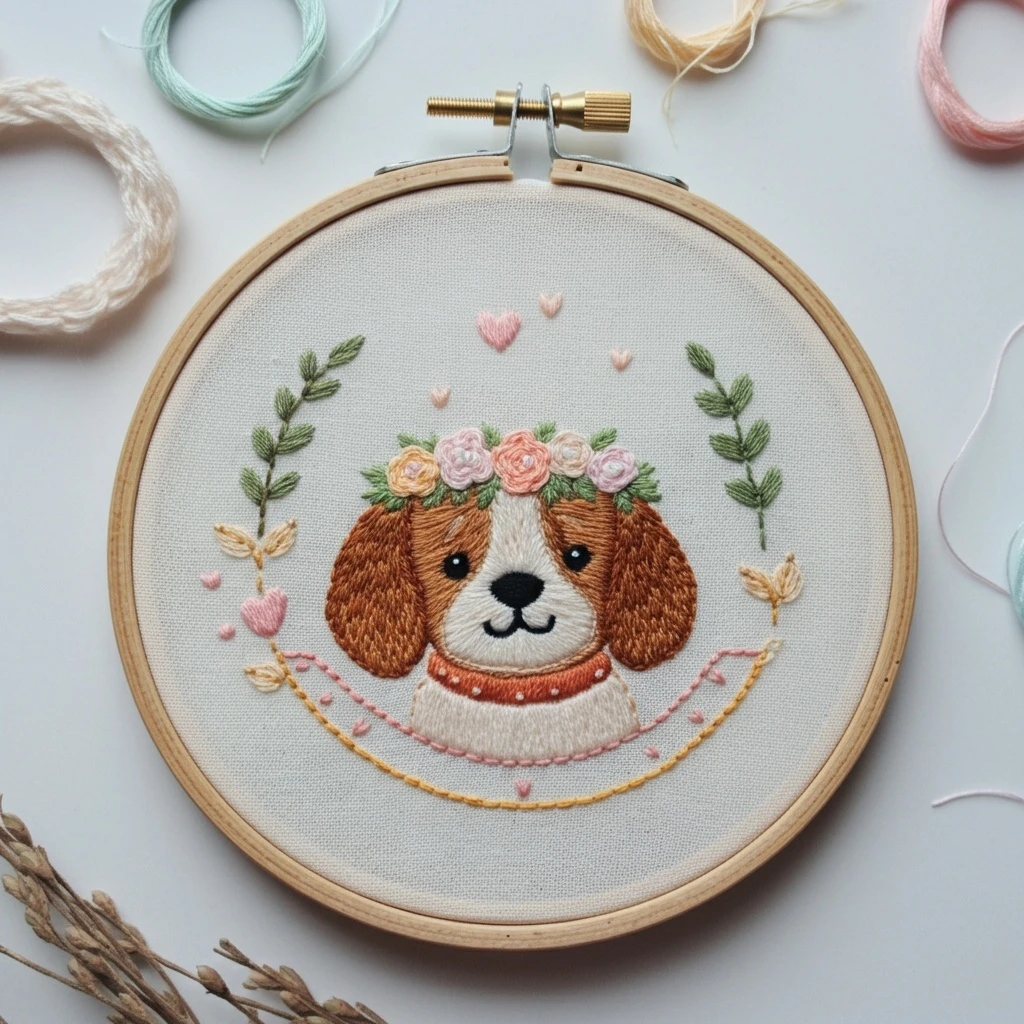
Adorable Puppy Embroidery Hoop Art with Floral Crown
A warm, softly shaded thread guide inspired by the design reference: a sweet puppy face with fluffy fur, darker nose and eyes, and a delicate floral crown built from rosy petals, yellow accents, and leafy greens on a muted cool background.
Design Color Story
The reference artwork combines a soft neutral puppy palette with a romantic floral accent band. The puppy reads as warm beige and honey-brown with deeper cocoa shadows around the ears, muzzle, and facial contours. Small charcoal accents define the nose, pupils, and the deepest shadow breaks. Above the head, the floral crown introduces dusty rose, muted coral, soft yellow, and olive-to-sage greens. The ground fabric appears cool and subdued, which helps the warm dog colors and rosy flowers stand out without feeling harsh.
Suggested DMC Floss Palette
Stitch Plan by Design Area
| Area | Recommended stitches | Thread count | Technique notes |
|---|---|---|---|
| Puppy face and cheeks | Long and short stitch, split stitch guide lines, tiny directional straight stitches | 1 strand for realistic fur; 2 strands only for padding under larger fills | Work the fur in the direction it naturally grows: radiate outward from the nose and muzzle, sweep downward on the cheeks, and curve around the forehead. Blend 3866, 842, 841, and 840 so transitions stay soft and fluffy. |
| Ears and deeper fur shadows | Long and short stitch, satin stitch, layered straight stitches | 1 strand for visible fur texture; 2 strands for compact shadowed patches | Start with 840 or 839, then feather in 838 and a little 3371 near inner ear folds and the lowest shadows. Avoid filling whole ear sections with one flat color. |
| Eyes, nose, and mouth | Satin stitch, split stitch, back stitch, tiny straight stitches | 1 strand for lines; 2 strands for nose satin | Use 3371 for most dark features, then add only a pinpoint of 310 where you want the deepest emphasis. Finish the eyes with one tiny B5200 highlight to keep the expression lively. |
| Floral crown petals | Woven wheel stitch, detached chain, satin stitch, fishbone stitch for pointed petals | 2 strands for petals; 1 strand for fine petal veins | Mix 761, 760, and 3716 within the same flower for more realism. Place darker rose tones at flower bases and underneath overlapping petals. |
| Leaf clusters and stems | Fishbone stitch, lazy daisy, stem stitch, split stitch | 1-2 strands depending on leaf size | Use 471 as the main leaf tone, 472 at the tips for freshness, and 469 where leaves tuck behind blossoms or the puppy's head. |
| Small floral centers and accent details | French knots, seed stitch, tiny satin stitch, couching | 1-2 strands | 744 and 782 work well for small yellow flower centers. Keep these accents crisp and sparse so they brighten the crown without looking bulky. |
Blending, Outlining & Shading Guidance
Blending ideas
- Face fur blend: transition from 3866 into 842 and 841, then shade into 840 for rounded cheeks and forehead depth.
- Deep fur blend: combine 839 with short touches of 838; reserve 3371 for the deepest fur recesses around the nose and under the ears.
- Rosy flowers: blend 761 and 760 in lighter petals, then add 3716 toward the center or underside of petals.
- Leaf dimension: stitch leaves with 471 as the base, add 472 on the sunlit edge, and place 469 near the stem base.
- Cool balance: a touch of 318 or 415 in pale fur shadows prevents the puppy from looking overly orange and helps it sit naturally on a cool-toned fabric.
Outlining details
- Use one strand of 838 or 3371 for soft split stitch or back stitch outlines around the nose, mouth, and selected outer contours.
- Avoid a heavy continuous outline around the entire puppy. Let the fur texture define most edges.
- Outline petals only where overlap needs definition; partial outlining often looks more painterly than full outlining.
- Use 469 or 471 for stem lines and tiny leaf separators in the crown.
- Reinforce only the darkest eye rims with a pinpoint of 310 if the face needs extra contrast.
Practical Embroidery Tips
For the puppy
- Mark the eyes, nose, and central muzzle axis first so the face stays symmetrical.
- Use shorter long-and-short stitches near the muzzle and around the eyes to maintain a neat expression.
- If the fur looks too striped, add a second pass of scattered one-strand stitches in intermediate colors to soften the texture.
- Stitch the eyes and nose early enough to guide the expression, but save final highlights until the surrounding fur is finished.
For the floral crown
- Build the crown from back to front: stitch stems and rear leaves first, then flowers, then tiny knot centers and highlight details.
- Mix stitch families for a richer look: woven wheels for fuller blooms, detached chain for daisy-like petals, and fishbone stitch for leaves.
- Keep the crown slightly airy rather than solidly filled; negative space helps it look delicate and keeps attention on the puppy's face.
- Use 2 strands for most petals and 1 strand for delicate leaf veins and finishing details.
Recommended Stitching Formula
For the most polished result, stitch the puppy mainly with 1 strand long-and-short embroidery for fine fur realism, switching to 2 strands only where you need fuller flower petals or more visual weight. Build the puppy from light to dark, add soft contour outlining only where needed, and keep the floral crown lively by mixing pinks, rosy corals, olive greens, and bright leaf highlights.
- Best core puppy set: 3866, 842, 841, 840, 839, 838, 3371
- Best floral set: 761, 760, 3716, 744, 782, 472, 471, 469
- Best finishing accents: 415, 318, B5200, and tiny touches of 310