
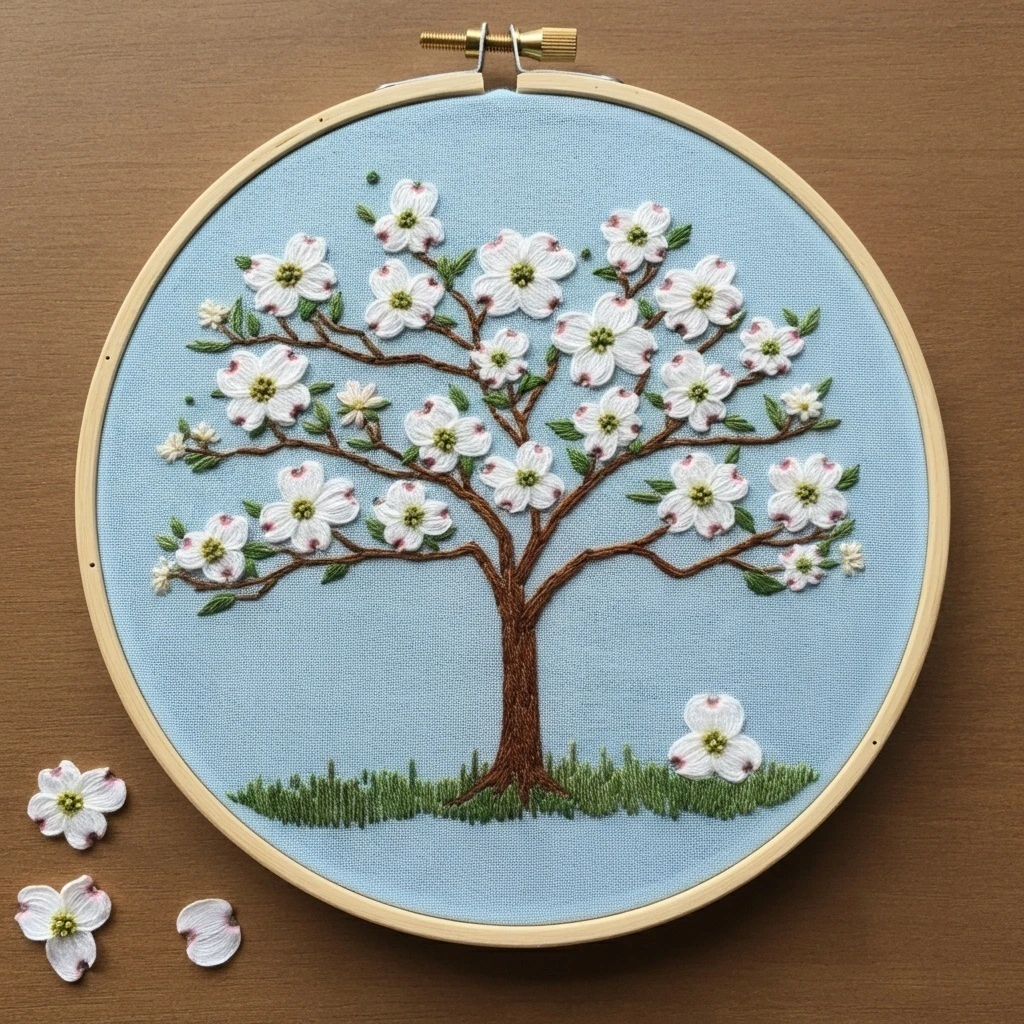
Embroidered Dogwood Tree Blooming In Spring
A fresh spring dogwood scene with creamy white blossoms, blush-pink petal notches, golden flower centers, tender green leaves, warm brown branches, and airy sky-like accents. These DMC matches are estimated from the visible hoop preview and chosen for a light, botanical hand-embroidered finish.
Likely DMC Color Palette
Matched to white dogwood petals, pink notches and buds, golden centers, fresh spring leaves, warm branches, bark texture, and pale sky accents.
Stitching Suggestions
Start with branches and supporting greenery, then layer the dogwood blossoms, centers, buds, sky accents, and final petal highlights.
| Element | Stitch Type | Practical Notes |
|---|---|---|
| Dogwood petals | Long and short stitch | Fill each petal with 3865, feathering 762 or 415 near the base and underside. Keep the tips light and smooth. |
| Petal notches | Tiny satin stitch or straight stitch | Use 151, 3689, 3354, or 3687 at the characteristic dogwood petal tips. Make the marks small and uneven for a botanical look. |
| Blossom centers | French knots | Cluster 744, 728, and 3820 knots in the center after petals are finished. Vary knot size for pollen texture. |
| Overlapping blooms | Split stitch outline | Use one strand of 762 or 151 to separate white petals where they overlap. Avoid dark outlines around the flowers. |
| Spring buds | Colonial knots or tiny satin stitch | Use 3689, 3354, 3348, and 728 for closed buds. Place them along twig tips before filling nearby leaves. |
| Fresh leaves | Fishbone stitch | Use 3362 or 3051 at the base, 3347 through the center, and 3348 toward the tips for new spring growth. |
| Leaf veins | Single-strand straight stitch | Use 3362 or 3052 in very short strokes. Keep veins subtle so they do not compete with the white flowers. |
| Main branches | Stem stitch | Use 801 and 898 for sturdy branch lines, then add 975 on the light-facing side to make the limbs rounded. |
| Bark texture | Short straight stitch | Use 898, 839, and 975 in broken marks along the branch direction. Let the texture vary naturally. |
| Fine twigs | Single-strand backstitch | Use 898 or 3362 for thin twig tips connecting blossoms and leaves. Taper branches as they move outward. |
| Soft background sky | Seed stitch or loose long stitch | Use 3756 and 3841 very lightly if adding background atmosphere. Leave plenty of fabric showing for an airy spring feel. |
| Ground or distant greenery | Fly stitch and seed stitch | Use 3052, 3347, and 3051 in scattered strokes to suggest depth behind the blooming branches. |
| Final highlights | Single straight stitch | Add B5200 or 3865 at the brightest petal edges and tiny 744 dots in flower centers as the last sparkle layer. |
Thread Count, Blending & Texture
Use strand changes to separate smooth petals, raised pollen centers, textured bark, and fresh spring leaves.
Petal softness
Use 2 strands for broad petal fill and 1 strand for final shading. Most petals should stay creamy white, with gray only near overlaps and bases.
Dogwood notches
Place pink marks only at selected petal tips. Tiny rosy stitches are more botanical than outlining the whole flower in pink.
Branch structure
Stitch branches before blossoms so the flowers sit naturally on top. Add dark bark cracks after the main brown fill is complete.
Fresh leaves
Blend yellow-green and gray-green tones. Dark bases and lighter tips make the young leaves look lifted and springlike.
Raised centers
Cluster French knots in yellow and straw tones after the petals are finished so the centers stay crisp and dimensional.
Beginner control
Work one blossom at a time, completing its petals before adding the center. This helps keep the flower shapes balanced and readable.
Recommended Stitching Order
This order keeps the branching structure clear and protects the raised blossom centers from snagging.
Helpful Notes for a Polished Finish
A light touch keeps the dogwood tree fresh, springlike, and cleanly stitched.
- Use firm hoop tension; broad white petals show puckering and tension changes easily.
- Avoid carrying dark branch thread behind pale petals where it might shadow through the fabric.
- Keep petal outlines pale and partial. Heavy dark outlines can make dogwood flowers look flat.
- Vary bloom sizes slightly so the branches feel natural rather than patterned.
- Use only a few B5200 stitches on petal tips; too much pure white can overpower the soft cream palette.
- Press the finished hoop face-down on a towel to protect raised French-knot centers and bark texture.