
DMC Palette & Stitch Guide
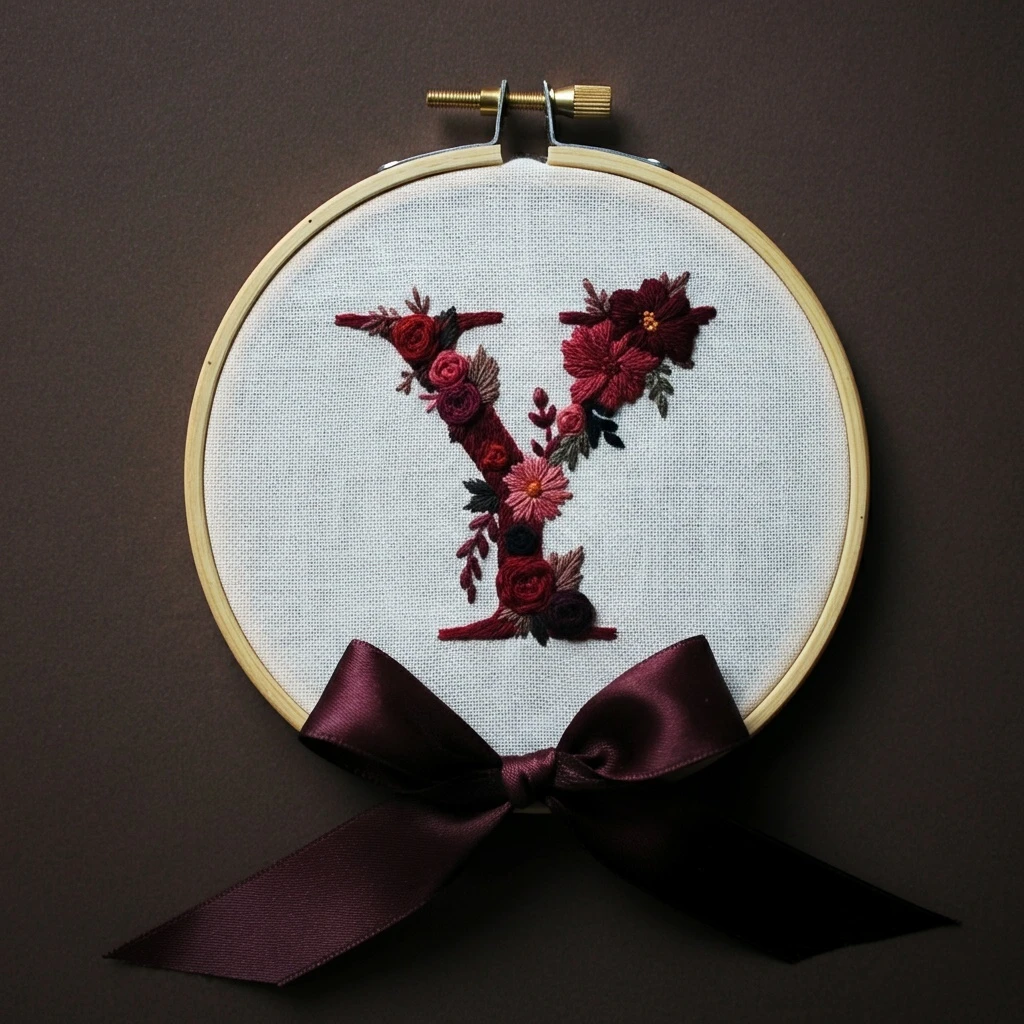
Embroidered Floral Monogram Y in Deep Reds
A polished thread guide for a romantic monogram hoop with velvety burgundy roses, deep red blossoms, plum accents, charcoal foliage, taupe sprigs, golden flower centers, linen ground, and a dramatic wine ribbon finish.
Likely DMC Color Palette
Colors are estimated from the visible hoop preview and matched to close DMC six-strand cotton shades. Coverage percentages are practical planning estimates, not exact thread usage.
DMC 902
Garnet Very Dark
Main monogram shadows, darkest rose folds, lower red flower depth. Use where the Y needs a velvety, wine-red foundation.
DMC 815
Garnet Medium
Primary red petal color, rose spirals, satin stitches along the letter body, and mid-tone bloom shading.
DMC 816
Garnet
Brighter red highlights on rose rims, small berries, and the top horizontal strokes of the monogram.
DMC 326
Rose Very Dark
Pink-red daisy petals, lifted accents on small blossoms, and blended edges where flowers turn toward the light.
DMC 777
Raspberry Very Dark
Plum-red flower centers, deeper buds, and transition stitches between burgundy and brighter rose tones.
DMC 3371
Black Brown
Near-black leaves, deepest petal cuts, undersides of rosettes, and tiny anchors where foliage tucks under blooms.
DMC 3364
Pine Green
Dark green leaf clusters around the flower bases and subtle natural contrast against the red monogram.
DMC 3023
Brown Gray Light
Muted gray-green leaves, soft side sprigs, and desaturated foliage that should stay quiet behind the blossoms.
DMC 3857
Rosewood Dark
Taupe-brown fern sprigs, dry flower details, and warm shadows inside the letter where red meets the linen.
DMC 972
Canary Deep
Tiny golden centers in the pink and burgundy blossoms. Use sparingly so the yellow dots sparkle without dominating.
DMC 782
Topaz Dark
Warm center shadows and single French knots mixed with 972 for more dimensional flower centers.
DMC 822
Beige Gray Light
Optional linen-colored highlights, tiny corrective couching stitches, or very pale lifted edges on the fabric ground.
Stitching Suggestions
The design works best when the monogram feels structured, while the flowers sit raised and dimensional on top of it.
| Design Element | Stitch Type | Practical Notes |
|---|---|---|
| Monogram Y body | Long and short stitch, padded satin stitch, split stitch outline | Start with a split-stitch outline in 902 or 815. Fill along the direction of each letter arm, placing darker stitches along the inner joins and lower curves. |
| Large roses | Woven wheel rose, cast-on rose, or spiral backstitch rose | Use 815 for the main spiral, 902 in the center, and 816/326 on the outer lip. Keep rose wraps snug but not tight so they sit raised. |
| Pink-red daisy blossom | Lazy daisy, satin stitch, straight stitch rays | Work petals from center outward with 326 and shade a few lower petals with 777 for depth. Keep the petal lengths slightly varied for a hand-stitched look. |
| Small buds and berry sprays | Detached chain, French knots, colonial knots | Use 816 and 777 for bud tips, with 902 at the base. One-wrap knots look neat; two wraps create plumper berries. |
| Dark leaves | Fishbone stitch, straight stitch, fly stitch | Use 3364 for visible leaves and 3371 for shadow leaves tucked under the roses. One strand keeps them crisp and prevents black areas from becoming heavy. |
| Taupe fern sprigs | Straight stitch, stem stitch, feather stitch | Work airy strokes in 3857 and 3023. Leave a little linen showing between stitches to mimic the dry, feathery sprigs in the reference. |
| Flower centers | French knots, tiny straight stitches | Cluster 972 knots in the center, then add one or two 782 knots to one side for a natural shadow. |
| Final definition | Backstitch, split backstitch, couching | Add very selective outlines after fills are complete: a few burgundy edges on petals, tiny dark leaf veins, and clean red accents along the letter ends. |
Thread Count, Blending & Shading
1 strand
Use for small leaf veins, fern sprigs, delicate bud stems, and the crispest monogram outline details.
Use for small leaf veins, fern sprigs, delicate bud stems, and the crispest monogram outline details.
2 strands
Best for most flower petals, long-and-short filling, lazy daisy stitches, and controlled red shading on the letter.
Best for most flower petals, long-and-short filling, lazy daisy stitches, and controlled red shading on the letter.
3 strands
Use only where extra lift is wanted: woven roses, padded satin areas, or plump berry knots.
Use only where extra lift is wanted: woven roses, padded satin areas, or plump berry knots.
Suggested blends
- Velvet red blend: 1 strand 902 + 1 strand 815 for the shadowed body of the Y.
- Rose highlight blend: 1 strand 816 + 1 strand 326 for lifted petal tips and the pink-red flower.
- Plum transition blend: 1 strand 777 + 1 strand 815 for buds and rose folds that need richness without going black.
- Muted foliage blend: 1 strand 3364 + 1 strand 3023 for softened leaves near the taupe sprigs.
Shading rule: keep the deepest DMC 902 and 3371 stitches in the center join of the Y and under flower overlaps. Place brighter 816 and 326 only on petal rims, top edges, and outward-facing flower tips.
Texture & Dimension Tips
The reference relies on contrast: smooth satin-like letter strokes, raised roses, tiny knot centers, and fine feathery foliage. Layer the design in this order so the flowers look placed on top rather than swallowed by the monogram.
Transfer lightly. Use a fine removable pen or pale transfer line. Deep reds can cover marks, but open linen spaces around the Y should stay clean.
Outline the Y first. Split stitch the monogram with one strand, then fill with long-and-short stitches using the dark-to-mid garnet shades.
Add large flowers next. Place the major roses and daisy bloom before tiny leaves so the floral balance stays centered on the letter.
Tuck foliage behind blooms. Stitch dark leaves under flower edges, then add gray-taupe sprigs last with airy one-strand strokes.
Finish with sparkle details. Add golden knots, berry sprays, and final dark accents only after the main shapes are complete.
Beginner-Friendly Practical Notes
- Keep the fabric drum-tight in the hoop; satin and long-and-short stitches look smoother on firm fabric.
- Use shorter stitches around the branching point of the Y so the curves do not become bulky.
- Separate floss strands, then recombine them before stitching. This makes the deep reds lie flatter and shine more evenly.
- For roses, practice one woven wheel on scrap fabric first. The goal is a raised spiral, not a flat filled circle.
- Do not outline every petal. A few selective dark red backstitches will look more elegant than heavy full outlines.
- Save the bow or ribbon finishing for after the hoop is stretched and backed, so the ribbon remains clean and crisp.
Encouraging finish: this monogram is forgiving because layered florals hide small inconsistencies beautifully. Work from dark foundation to brighter accents, keep the foliage delicate, and the finished Y will read as rich, romantic, and dimensional.