
Embroidered Irises In Hoop
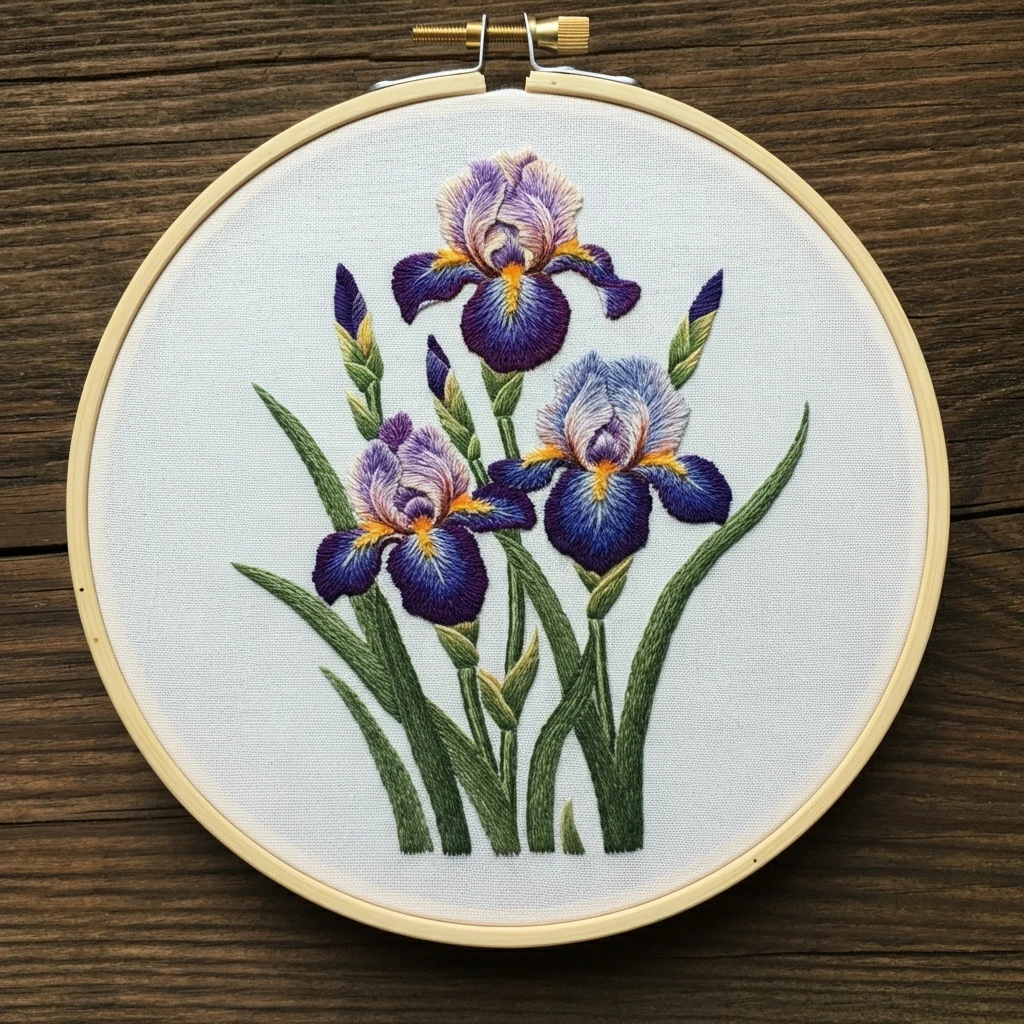
A refined botanical hoop design with three open bearded irises, slim upright buds, and long sword-like leaves. The design relies on dramatic purple-blue petals, pale lavender upper standards, golden throats, and textured green foliage stitched with clear direction.
Color reading from the design
The image is centered on high-contrast iris petals: almost black violet and navy folds at the lower falls, cooler blue-violet highlights through the centers, and soft mauve-lavender shading on the upright standards. Bright golden-orange beard details sit at each flower throat, while the leaves and stems use olive, pine, and gray-green values to keep the bouquet grounded.
deep plum, midnight blue, royal violet, pale lavender, and cream-touched edges
long vertical leaves with darker central shadows and lighter edge highlights
small golden beards and warm yellow buds that make the purples glow
Suggested DMC floss palette
Use the deepest purples and navies for the folded lower petals, then feather lighter lavender and blue-violet stitches outward. Keep the yellow-orange beard colors compact and bright so they remain focal points without overpowering the iris shape.
Tiny catchlights on pale petal tips and the brightest fabric-like highlights on upper standards.
Creamy petal edges and soft blending beside pale lavender; warmer than pure white.
Lightest lavender on the upright petals and soft petal rims.
Main mauve-lavender shading on the upper standards and pale side folds.
Stronger upper-petal shadows and mid-value transitions into the darker falls.
Curved crease lines and deeper purple folds on standards and bud tips.
Cool blue-violet feathering through the centers of lower petals.
Shadowed violet-blue areas where petals curl under or overlap.
Intense petal bases and dark accents on buds, especially against gold throats.
Midnight-blue shadows on the lower falls; blend with 333 for natural depth.
Deep plum folds, edge shadows, and the darkest iris outlines.
Warm purple shadow in the velvety lower petals; excellent beside 550.
Golden beard highlights and yellow touches on closed buds.
Warm orange beard centers; use as small dense stitches at each flower throat.
Muted leaf shadows and darker stem sides without making the foliage too bright.
Primary leaf fill and soft mid-tone stems; very close to the stitched leaf body.
Leaf center veins, darker blade bases, and stems behind the flowers.
Deepest leaf shadows, narrow outlines, and low foliage where blades overlap.
Fresh green leaf edges, bud highlights, and tiny reflected light near yellow accents.
Optional warm shading on the hoop rim if you choose to stitch or accent the frame area.
Stitch map by design area
| Area | Stitches | Strands & notes |
|---|---|---|
| Upper standards | Long and short stitch, split-stitch veins, and light feather stitch where petals flare. | 1-2 strands. Start pale at the petal tips, then pull 210, 209, and 208 downward into the folds. |
| Lower falls | Dense long and short stitch with curved directional shading; tiny satin stitches at the rounded tips. | 2 strands for most fill. Blend one strand 333 + one strand 823 for blue-black depth, or 550 + 154 for warmer plum. |
| Beards & throats | Short straight stitches, turkey work trimmed low, French knots, or tiny bullion knots. | 2-3 strands in 743 and 742. Keep stitches short and radiating from the throat like a fuzzy golden fan. |
| Buds | Satin stitch, split stitch, and small angled straight stitches following the bud curve. | 2 strands. Use dark violet on the tip, green-gray at the base, and a small yellow highlight on opening buds. |
| Stems | Stem stitch, split stitch, or whipped backstitch for clean vertical lines. | 2 strands. Use 3363 on the shadow side and 3052 or 472 on the lit side. |
| Long leaves | Long satin stitch, fishbone stitch, and split stitch down the center vein. | 2-3 strands. Vary the angle along each blade so the leaves look ribbed rather than flat. |
| Final outlines | Fine split stitch, couching, or single-strand backstitch placed only in deepest creases. | 1 strand. Use 550, 333, or 3362; avoid black outlines so the design stays botanical and soft. |
Blending & shading
- Pale petal blend: work B5200 or 746 at the lightest rims, then blend into 211, 210, 209, and 208.
- Velvet lower petals: alternate 550, 154, 333, and 823 in long-and-short rows. Keep stitches curved toward the petal throat.
- Cool highlights: add thin 340 stitches over dark purple areas to create the blue sheen visible on the iris falls.
- Gold throats: place 742 first in the center, then 743 around it. A few raised knots make the beard look dimensional.
Texture suggestions
- Petal veining: use single-strand split stitch lines that taper before the petal edge. Do not outline every vein equally.
- Soft ruffles: make short irregular stitches at the pale petal edges to suggest the crinkled iris rim.
- Leaf ribbing: use one central split stitch vein, then angle satin stitches into it from both sides like a fishbone.
- Depth: stitch rear buds and stems with fewer strands, then use thicker leaves and brighter throats in the foreground.
Suggested stitching order
Beginner-friendly practical tips
Thread-count guide
- 1 strand: fine petal veins, delicate crease shadows, and final outlines.
- 2 strands: most petal shading, stem stitch, and bud fill.
- 3 strands: strong leaf satin stitches and slightly raised beard texture.
- 4 strands: only for bold golden knots or very raised beard areas; avoid bulky petal fill.
Neatness & control
- Use shorter stitches on tight petal curves and longer stitches on broad open falls.
- Keep the fabric drum-tight; satin and long-and-short stitches show puckers quickly.
- Park your needle at the throat often and check that the shading radiates from the same focal point.
- For clean leaf points, bring the last stitch exactly into the tip instead of crossing over it.
Outlining details
Use outlines only where they create depth: under folded lower petals, along the darkest bud tips, and at the shadow side of stems. A single strand of 550, 333, or 823 is enough for the iris petals; a single strand of 3362 is enough for foliage. Let the color transitions, not heavy borders, define the flower shape.