
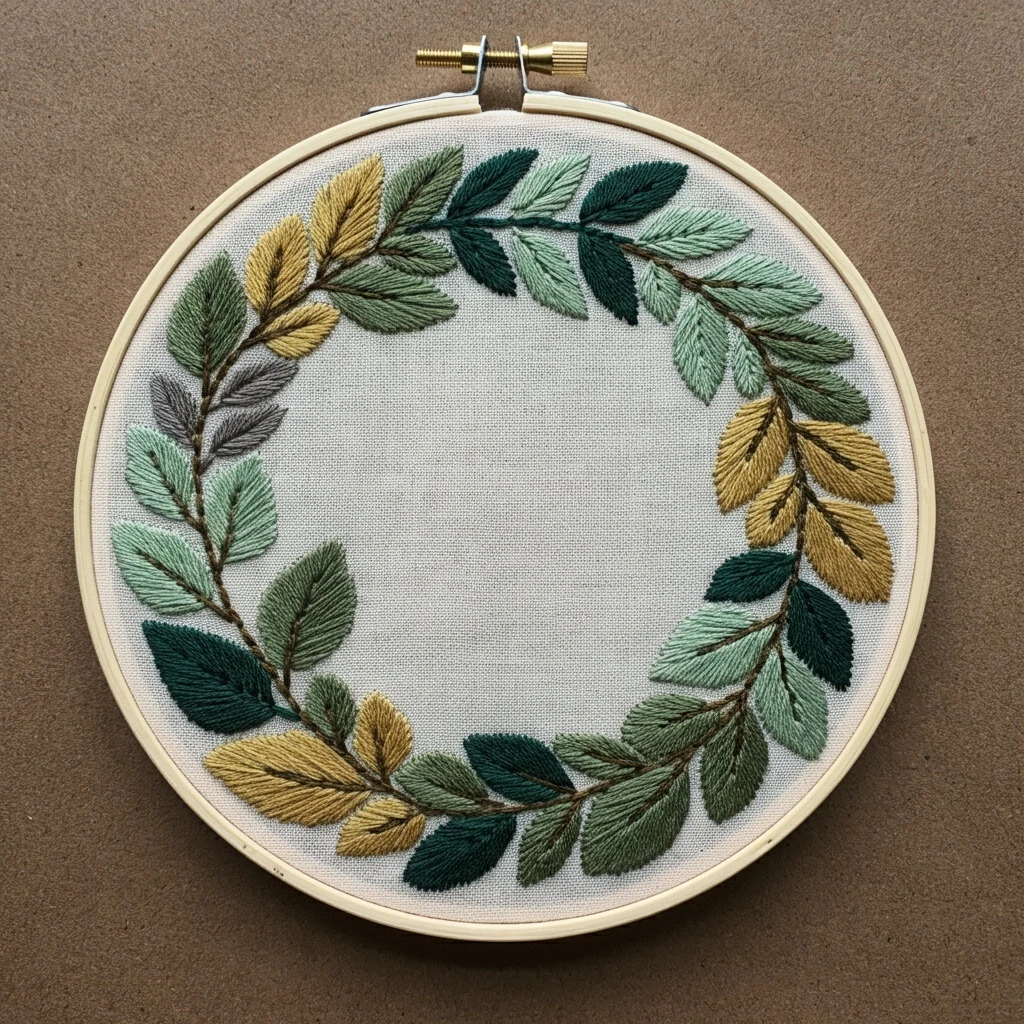
Embroidered Leaf Wreath Hoop Art
A calm botanical wreath worked in layered greens, muted gold leaves, soft gray accents, and dark brown branching. The design relies on directional leaf stitches, delicate midribs, and varied thread counts to make a simple circular composition feel full and dimensional.
Observed color story
The wreath is built around a natural linen ground, a dark branching vine, and clusters of leaves that alternate between deep blue-green, cool pine, dusty sage, pale mint, gray-green, and warm straw-gold. The strongest contrast appears in the dark teal leaves and brown stems; the softer mint and sage leaves keep the hoop from feeling heavy.
For best results, keep the center open and calm. Let the outer ring carry the detail, with each leaf angled toward the wreath curve so the eye moves smoothly around the hoop.
Suggested DMC floss palette
These DMC choices are matched to the visible tones in the reference: deep evergreen leaves, cool sage foliage, pale mint highlights, gray leaf clusters, golden ocher leaves, and dark woody stems.
Stitch types by design area
Thread-count guidance
1 strand: fine veins, tips, leaf outlines, and any correction stitches near the wreath center.
2 strands: default for most filled leaves. This gives the smooth raised texture visible in the reference without becoming bulky.
3 strands: use sparingly for the darkest teal leaves or the thickest part of the vine if your hoop is larger than 6 inches.
On tightly woven linen or cotton, a sharp size 7–9 embroidery needle usually keeps the thread smooth. On looser linen, use a smaller needle and shorter stitches to avoid snagging the weave.
Blending, shading & texture notes
Blend 1 strand DMC 500 + 1 strand DMC 501 for deep leaves. Add a few 3363 stitches near the base to connect them to the rest of the wreath.
Use DMC 3052 as the base, then add DMC 522 through the center or tip. Avoid strong outlines here; soft edges make these leaves look airy.
Fill with DMC 680, then add DMC 729 in short strokes along one side of the midrib. This creates a warm, dry-leaf highlight.
Beginner-friendly order of work
- Transfer the wreath lightly, marking the circle, main vine, and each leaf midrib.
- Stitch the main vine in brown stem stitch before filling leaves.
- Fill the largest leaves first, spacing dark, medium, pale, and gold tones around the hoop.
- Add smaller leaves and gray-green accents to balance empty spots.
- Finish with midribs, tiny twig forks, and selective highlights.
Practical hoop tips
- Keep fabric drum-tight; fishbone leaves look uneven if the linen slackens.
- Use shorter stitches on curved leaves so the fill follows the leaf shape.
- Rotate the hoop as you work. Pulling stitches toward your body helps maintain consistent tension.
- Separate all six floss strands, then recombine only the number needed. This reduces twisting and makes satin areas smoother.
- Pause after every cluster and check the wreath from arm’s length to keep the color spacing balanced.
Finishing suggestion
Mount the finished piece in a natural wood hoop to echo the warm gold leaves and brown stems. Trim excess fabric to about 1 inch behind the hoop, gather it with running stitch, and cover the back with felt if the piece will be gifted. A plain linen background suits this wreath best because the open center is part of the design’s quiet, modern look.