
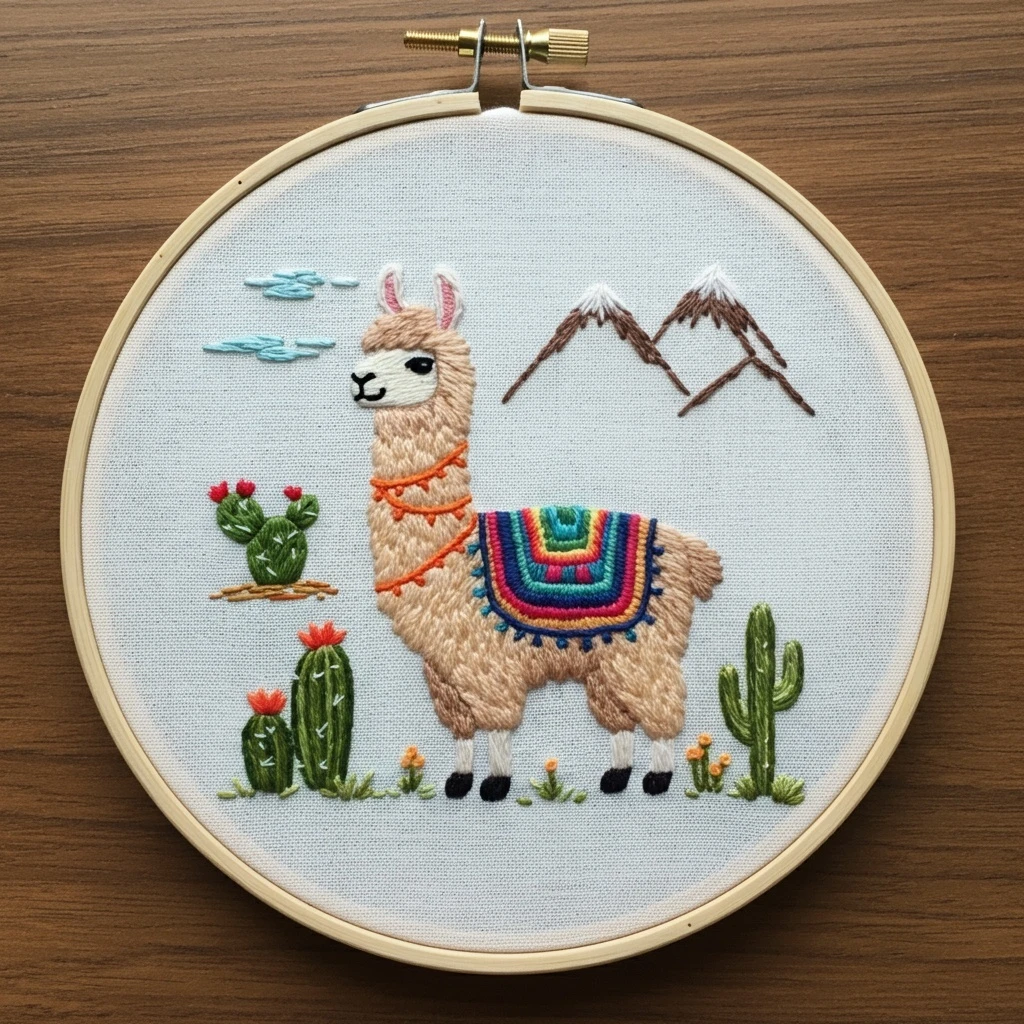
Embroidered Llama in a Mountain & Cactus Landscape
A warm desert-folk embroidery plan for a fluffy tan llama, colorful saddle blanket, snow-tipped mountains, turquoise sky clouds, bright cactus blooms, and small stitched meadow details.
Carefully Matched DMC Color Palette
The reference design reads as a soft neutral llama on pale linen, with earthy mountain browns, olive cactus greens, red-orange blossoms, aqua cloud accents, and a vivid woven blanket. Use the darker shades sparingly so the llama remains light and plush.
DMC 712 - Cream
Llama face highlights, lightest chest tufts, and soft leg tops. Blend with ecru for a natural wool finish.
DMC 738 - Very Light Tan
Main llama coat. Work short, uneven stitches in the direction of the body to suggest fleece.
DMC 437 - Light Tan
Mid-shadows under the belly, neck edge, tail, and lower leg fluff.
DMC 433 - Medium Brown
Deepest llama texture, mountain slopes, and a few grounding stitches beneath the feet.
DMC Blanc - White
Snowcaps, white socks, ear highlights, and bright catch-stitches on cactus spines.
DMC 310 - Black
Eye, nose, mouth, and hooves. Use one strand for the face to avoid a heavy expression.
DMC 898 - Very Dark Coffee Brown
Mountain outlines and the strongest slope shadows; excellent for thin backstitched ridges.
DMC 958 - Seagreen
Small sky/cloud strokes. Keep stitches horizontal and airy, leaving fabric gaps between lines.
DMC 3345 - Dark Hunter Green
Cactus bodies and darker plant shadows. Pair with 3346 or 3363 for ribbed cactus volume.
DMC 3346 - Hunter Green
Cactus highlights, grass tufts, and rounded leaf sections on the small paddle cactus.
DMC 472 - Ultra Light Avocado
Tiny grasses and plant highlights around the base. Use single lazy daisies or straight stitches.
DMC 606 - Bright Orange-Red
Cactus flowers and the warm llama harness. Use satin stitch for petals and backstitch for cords.
DMC 720 - Dark Orange Spice
Harness shadows, flower bases, and small knots on the decorative lead lines.
DMC 3801 - Very Dark Melon
Magenta saddle blanket band and tiny accent stitches for a bold folk-art pop.
DMC 3844 - Bright Turquoise
Main teal blanket stripe. Use close rows of stem stitch or satin stitch for a woven look.
DMC 823 - Navy Blue
Blanket border, tassels, and the coolest outline accents. One strand is enough for fringe.
DMC 742 - Light Tangerine
Golden blanket stripe and small desert flowers. Also useful for tiny French knots near grass.
DMC 3812 - Seagreen
Central blanket stripe and bright plant notes; blend with 3844 for a turquoise-green transition.
Stitch Map & Texture Suggestions
Llama coat and face
- Use short-and-long stitch with 2 strands of 738, then add scattered 437 and 433 stitches where the neck, belly, tail, and legs tuck under.
- Keep the stitch direction vertical on the neck, curved on the chest, and slightly diagonal on the body to imitate fluffy wool.
- Use 1 strand of 310 for the eye, nose, and smile; add a tiny Blanc stitch beside the eye for sparkle.
Colorful saddle blanket
- Outline the blanket shape first with split stitch in 823 so the curved edge stays crisp.
- Fill colored bands with satin stitch for clean stripes, or use rows of stem stitch for a handmade woven texture.
- For dimensional stripes, blend one strand 3844 with one strand 3812 in the teal area and one strand 3801 with one strand 606 for the warm magenta-red band.
Mountains and snowcaps
- Backstitch the ridgelines using 898 with occasional 433 stitches for warmer broken-rock variation.
- Use small straight stitches in Blanc for snow, following the downward angles of the peaks.
- Leave some fabric visible inside the mountains; the design feels lighter and more modern when the peaks are not overfilled.
Cacti, flowers, and grasses
- Fill cactus forms with vertical satin stitch or split stitch rows in 3345, then add 3346 along one side as a highlight.
- Stitch cactus spines with tiny single-strand Blanc straight stitches, spaced irregularly.
- Use 606 satin stitch or detached chain for red blooms; add 742 French knots for tiny yellow flowers at the base.
Thread Count, Blending & Outlining Guide
Recommended strand counts
- 1 strand: face details, cactus spines, blanket tassels, mountain cracks, tiny grasses.
- 2 strands: main llama fill, saddle blanket bands, cactus bodies, cloud strokes, most outlines.
- 3 strands: only for raised llama fluff, red flower heads, or extra-bold decorative harness knots.
Helpful blends
- 738 + 712: soft cream highlights on the llama throat and cheek.
- 738 + 437: natural tan midtone for the body and tail.
- 3345 + 3346: dimensional cactus green without harsh contrast.
- 3844 + 3812: vibrant turquoise blanket center.
Outlining details
- Use split stitch for the llama silhouette so the edge looks soft rather than cartoonish.
- Backstitch the mountains and the harness cords; couch the orange harness with tiny 720 stitches if the curve feels uneven.
- Finish hooves in 310 with compact satin stitch and avoid over-large black areas.
Shading placement
- Add darker tan beneath the saddle blanket, under the belly, along the back leg, and at the base of the tail.
- Keep the face lighter than the body so the expression stays gentle.
- Reserve bright colors for the blanket and flowers; too much saturated color elsewhere will compete with the focal point.
Practical Stitching Order
Transfer and stabilize
Trace the design lightly onto linen or cotton. If the fabric is loose or pale, add a lightweight backing so dense blanket stitches do not pucker.
Stitch background elements first
Work clouds, mountains, ground line, and grasses before the llama. These are lighter, open elements and are easier to place while the hoop is uncluttered.
Build the llama fleece
Fill the coat with short-and-long tan stitches. Add darker accents in small clusters rather than solid blocks for a fuzzy, dimensional texture.
Add blanket, harness, and face
Stitch the colorful saddle in clean bands, then add orange harness cords and the delicate black face details last for the neatest finish.
Finish with tiny landscape details
Add cactus spines, flower knots, tassels, and final grass stitches. Steam lightly from the back after removing hoop marks.
Extra Notes for a Polished Result
Fabric and hoop
Choose a pale oatmeal, ivory, or light blue-gray fabric to echo the airy sky in the reference. A 6-inch hoop suits a compact pattern; an 8-inch hoop gives more negative space around the mountains and cacti.
Needle choice
A size 7 or 8 embroidery needle handles two strands comfortably. Switch to a size 9 for single-strand facial details and cactus spines.
Avoiding bulk
Do not carry dark mountain or black hoof threads across open fabric. End and restart threads to keep the pale background clean.
Texture upgrade
For an extra tactile llama, add a few turkey-work loops or loose detached chain stitches on the chest and tail, then trim only slightly so it stays plush.
DMC suggestions are practical close matches based on the visible reference colors; adjust one step lighter or darker if your fabric color changes the overall contrast.