
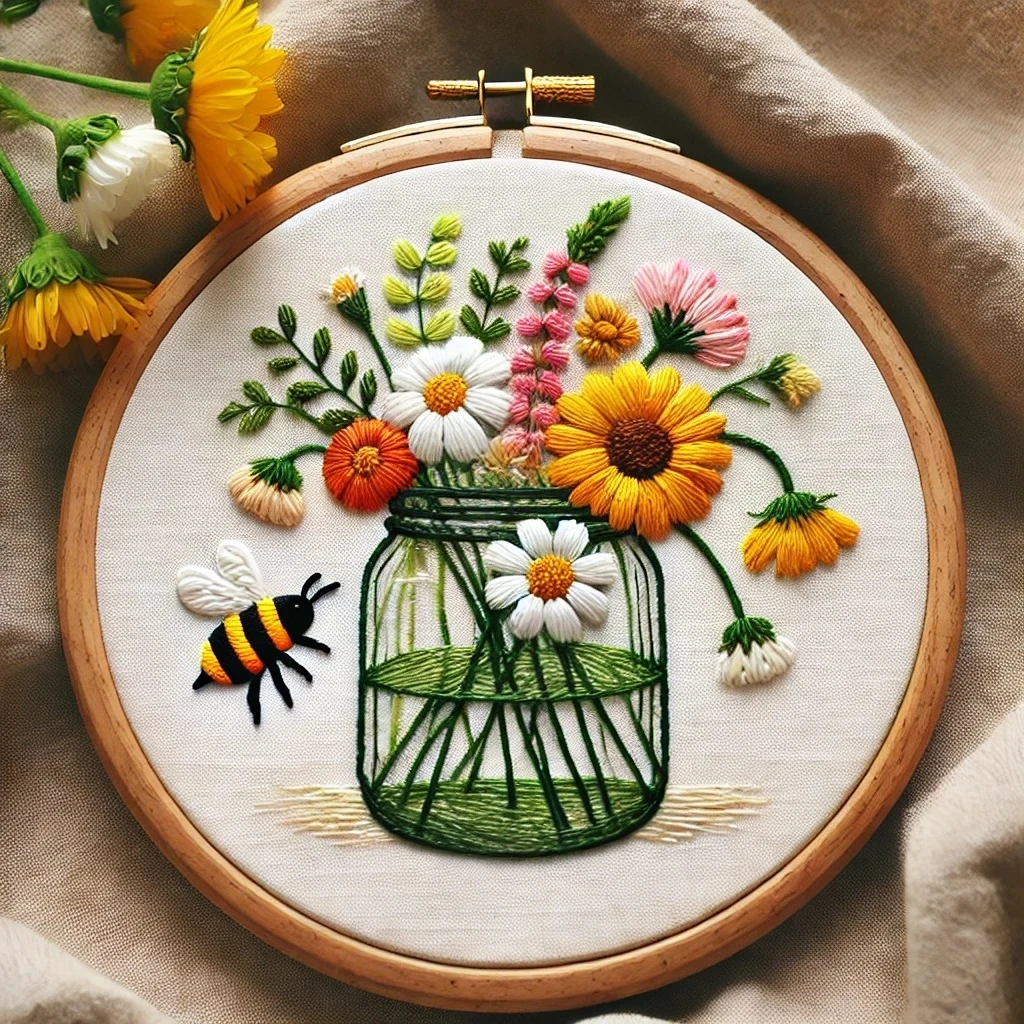
Embroidered Mason Jar Floral Bouquet with Bee
A cheerful garden-hoop design built around a dark green mason jar, airy stems, daisies, sunny yellow blooms, pink floral spikes, an orange accent flower, and a small striped bee. The palette below keeps the bouquet bright while preserving the soft handmade linen feel.
Suggested DMC floss palette
Use the darker greens and browns sparingly for structure, then let the whites, yellows, pinks, and orange carry the flower shapes.
Thread-count guidance
- Jar outline and rim: 3 strands for a bold mason-jar silhouette; reduce to 2 strands for inner glass lines.
- Flower petals: 2 strands for satin stitch on small petals, 3 strands for the large yellow bloom to create plush coverage.
- Fine stems and bee legs: 1 strand keeps lines clean and prevents the bouquet from looking crowded.
- Centers and knots: 2 strands for French knots; use 3 strands only on the large sunflower center.
- Ground texture: 1-2 strands in DMC 738 with long, loose straight stitches.
Blending and color transitions
- Blend 973 + 742 in the needle for sunflower petal bases, then switch to pure 973 at the tips.
- Blend 699 + 905 for leafy areas where stems overlap inside the jar.
- Use 604 + 605 together for the pink plume so it looks soft but still dimensional.
- Add tiny touches of 964 or 955 over green jar lines to suggest clear glass without filling the jar heavily.
- Keep the bee high contrast: pure 310 for black sections and 973 for yellow bands.
Stitch map by design area
Choose stitches that match the visual texture: smooth jar glass, structured stems, fluffy centers, and lively petals.
Use back stitch or whipped back stitch in DMC 890. Work the mouth in parallel rows so it reads like a thick glass rim.
Use long straight stitches and stem stitch in 699/905. Let some stems cross naturally to create the gathered bouquet effect.
Use long-and-short stitch from 742 at the base into 973 at the tips. Add 898 French knots or dense seed stitch in the center.
Satin stitch each petal from base to tip with 746; add B5200 on upper edges and 742/973 French knots in the center.
Build buds with detached chain stitches or small satin ovals, alternating 604 and 605 for a soft floral spike.
Use radiating satin stitches in 947, then add 742 near the center for warmth and 898 knots for seed detail.
Use fishbone stitch for larger leaves and detached chain for tiny pairs. Highlight one side with 704 or 955.
Satin stitch the striped body with 310 and 973. Use 1 strand for legs/antennae and airy satin or split stitch for white wings.
Use loose horizontal straight stitches in 738, keeping them uneven and sparse so the jar remains the focus.
Beginner-friendly stitching order
Outlining and shading notes
- Keep the jar rim darkest at the top and sides; this anchors the bouquet visually.
- Do not fully fill the jar. The open fabric space helps it feel like clear glass.
- Shade yellow petals with the darkest tone near the center and the brightest tone at the outer petal tips.
- Use black on the bee only after the yellow stripes are complete so the edges stay crisp.
- For white petals, outline only where needed; too much dark outline can make daisies look heavy.
Practical tips for a neat finish
- Shorten strands to 14-16 inches to reduce fraying in dense flower centers.
- Separate all six floss strands first, then recombine the number needed for smoother satin stitch.
- When stitching the bee wings, avoid heavy tension so the white stitches stay soft and slightly raised.
- Rotate the hoop while stitching petals; keeping the needle angle consistent gives a cleaner floral fan.
- Press the finished piece face down on a towel so French knots and satin petals stay dimensional.