DMC Color Palette & Stitch Guide
Embroidered Monarch Butterflies & Wildflowers
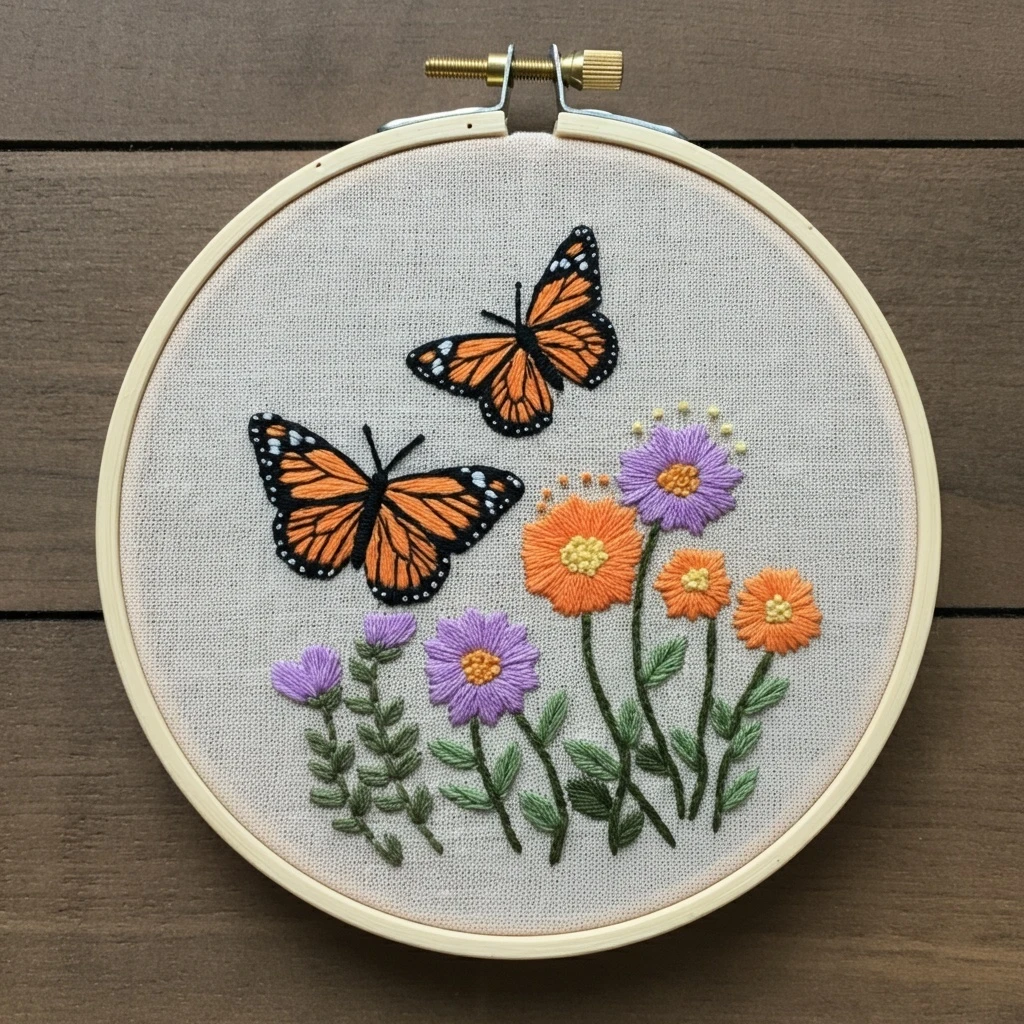
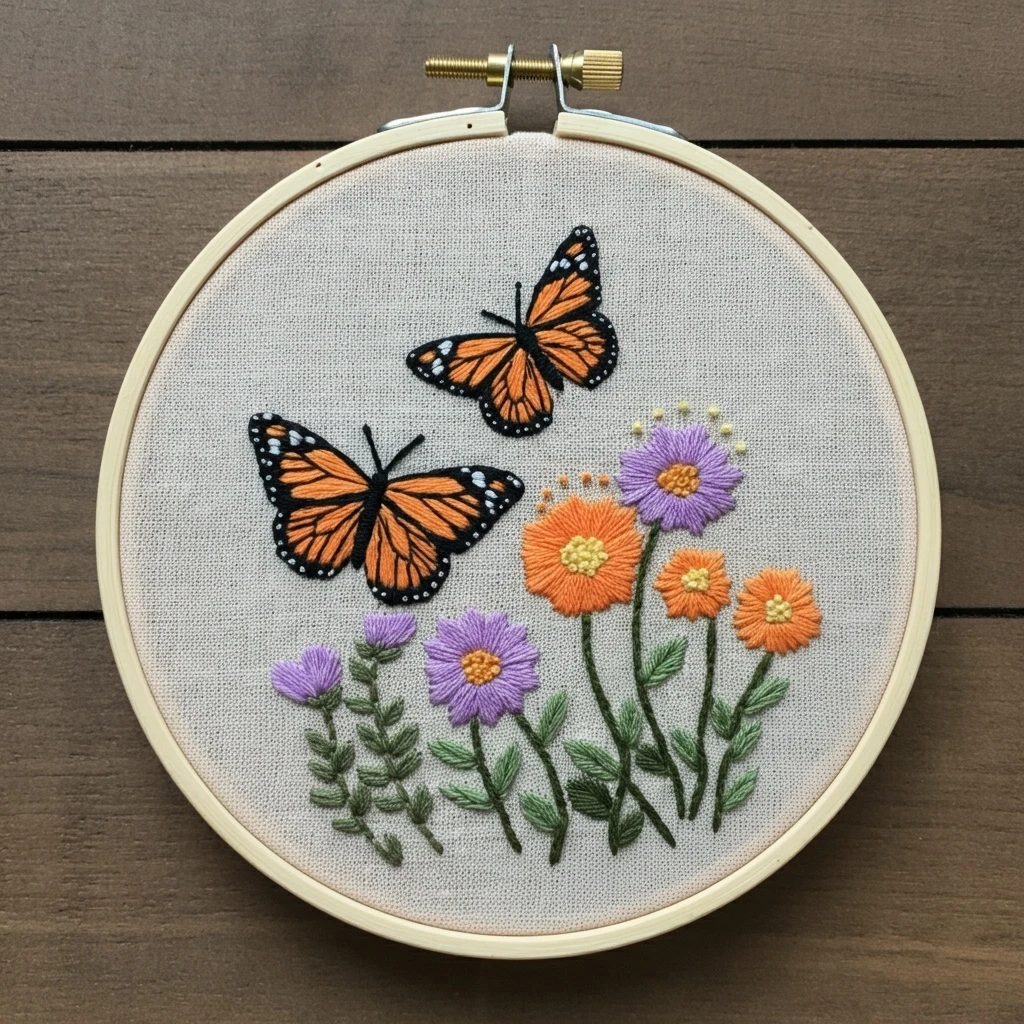
A cheerful hoop design built around warm monarch wings, crisp black vein work, creamy white wing spots, and a meadow of small wildflowers. Use this guide to choose floss colors, plan thread counts, and stitch the design with dimensional but beginner-friendly texture.
Design Color Read
The reference has the classic monarch contrast: glowing orange and golden wing panels locked inside bold black outlines, with small white highlight dots along the wing edges. The wildflower base adds sunny yellows, soft pinks, lavender-purple accents, muted sage leaves, and fine green stems. Keep the butterfly the highest-contrast area and let the flowers stay lighter, airy, and garden-like.
DMC 310
Black
Wing outlines, veins, body, antennae, and final definition.
DMC 741
Tangerine Medium
Main monarch orange fill; excellent for satin or long-and-short stitch.
DMC 970
Pumpkin Light
Bright center highlights in wing panels and warm flower accents.
DMC 742
Tangerine Light
Golden upper-wing glow and lighter tips of orange petals.
DMC 922
Copper Light
Shadow at lower wing edges; blend with 741 for realistic depth.
DMC 920
Copper Medium
Deepest orange-red wing shading next to black veins.
DMC B5200
Snow White
Wing dots and tiny daisy petals; use sparingly for crisp sparkle.
DMC 725
Topaz
Wildflower centers, pollen dots, and the brightest French knots.
DMC 728
Golden Yellow
Secondary yellow for flower centers and butterfly highlights.
DMC 3722
Shell Pink Medium
Pink wildflower petals; blend with 818 for soft petal tips.
DMC 818
Baby Pink
Petal highlights and tiny buds; keeps the bouquet delicate.
DMC 552
Violet Medium
Lavender sprigs and cool accents among the warm flowers.
DMC 340
Blue Violet Medium
Tiny purple blossoms; alternate with 552 for lively variation.
DMC 580
Moss Green Dark
Main leaf shadows, stem bases, and deeper foliage edges.
DMC 3012
Khaki Green Medium
Soft sage leaves, secondary stems, and blended leaf centers.
DMC 3348
Yellow Green Light
Leaf highlights and fresh new shoots around the wildflowers.
Thread Count & Blending Plan
Butterfly Wings
Use 2 strands for long-and-short fill. Add a single strand of 742 or 970 in the center of orange panels for glow. Work 310 with 2 strands for sturdy outlines, then add 1-strand vein lines on top if the design is small.
Wildflowers
Use 2 strands for petals and 1 strand for fine stems. French knots can be 2 wraps with 2 strands for small pollen dots, or 3 wraps where you want raised yellow clusters.
Foliage
Use 2 strands for detached chain or fishbone leaves. Blend one strand 580 with one strand 3012 for natural sage variation, then add 3348 with 1 strand for the top highlight line.
Stitch Suggestions by Area
Monarch outlines: stitch the outer wing contour in split stitch or stem stitch with DMC 310. For a padded edge, work one foundation row first, then cover it with satin stitch.
Wing panels: use long-and-short stitch following the direction of each wing section. Start near the black body with 920/922 shadows, move through 741, then finish with 970 and 742 toward the warm centers.
White spots: use small satin stitches, colonial knots, or tight French knots in B5200. Keep them clean and rounded so they read as monarch markings rather than flowers.
Body and antennae: fill the body with padded satin or close split stitch in 310. Antennae look best in 1-strand back stitch with a tiny knot at each tip.
Daisies and pink blooms: work lazy daisy petals in 818/3722, then place 725 French knots in the centers. Vary petal lengths slightly for a hand-picked wildflower look.
Yellow sprays: scatter 725 and 728 French knots along fine green stems. Cluster knots closer at flower heads and loosen them toward the tips.
Lavender sprigs: use 552 and 340 in small detached chain stitches or stacked French knots. Keep stems very fine so the purple accents do not overpower the butterfly.
Leaves: use fishbone stitch for larger leaves and detached chain for tiny leaflets. Mix 3012, 580, and 3348 rather than stitching every leaf the same color.
Order of Work
Transfer lightly. Use a fine washable pen or heat-erasable pen. Mark the wing vein map clearly, but keep flower stems thin so they disappear under the stitches.
Stitch the stems first. Work all greenery foundations with 1-strand back stitch or stem stitch. This keeps flowers anchored and prevents raised knots from catching your thread later.
Fill the butterfly next. Complete orange wing panels before adding final black veins. This gives cleaner edges and lets you correct the shape with the dark outline.
Add florals and dots last. Lazy daisies, French knots, white wing spots, and pollen clusters should be the finishing texture because they sit on top of the design.
Shading, Texture & Finishing Notes
Natural shading
For the monarch, shade each wing panel from dark at the vein or body edge to bright near the middle. A simple blend is 920 at the deepest edge, 922 for the transition, 741 for the main orange, and 970/742 for the highlight. Avoid perfectly symmetrical color placement; tiny differences make the butterfly feel hand-rendered.
Outlining details
After the fills are complete, couch or back stitch over key black veins with one strand of 310. If the design is larger than 6 inches, use 2 strands for the primary vein lines and 1 strand for secondary lines. Keep the antennae thin and graceful.
Beginner-friendly tip
Do not start with the French knots. They are tempting, but they catch the working thread while you stitch nearby areas. Save knots, white wing dots, and tiny highlight stitches until the end for a much cleaner finish.
Practical Embroidery Tips
Fabric & hoop
Light gray, oatmeal, cream, or natural linen will flatter the orange wings and garden colors. Keep the fabric drum-tight; wing satin stitches look much smoother when the fabric does not flex.
Needle choice
A size 7 or 8 embroidery needle works well for 2-strand areas. Switch to a size 9 or 10 needle for 1-strand outlines, antennae, and tiny stems.
Thread length
Cut floss around 14–16 inches. Shorter lengths reduce fuzzing, especially with black floss, which can look dull if pulled through fabric too many times.
Clean contrast
Wash hands before stitching B5200 and pale pinks. If black fibers travel into light spots, place the white stitches last and use a fresh needle if needed.