
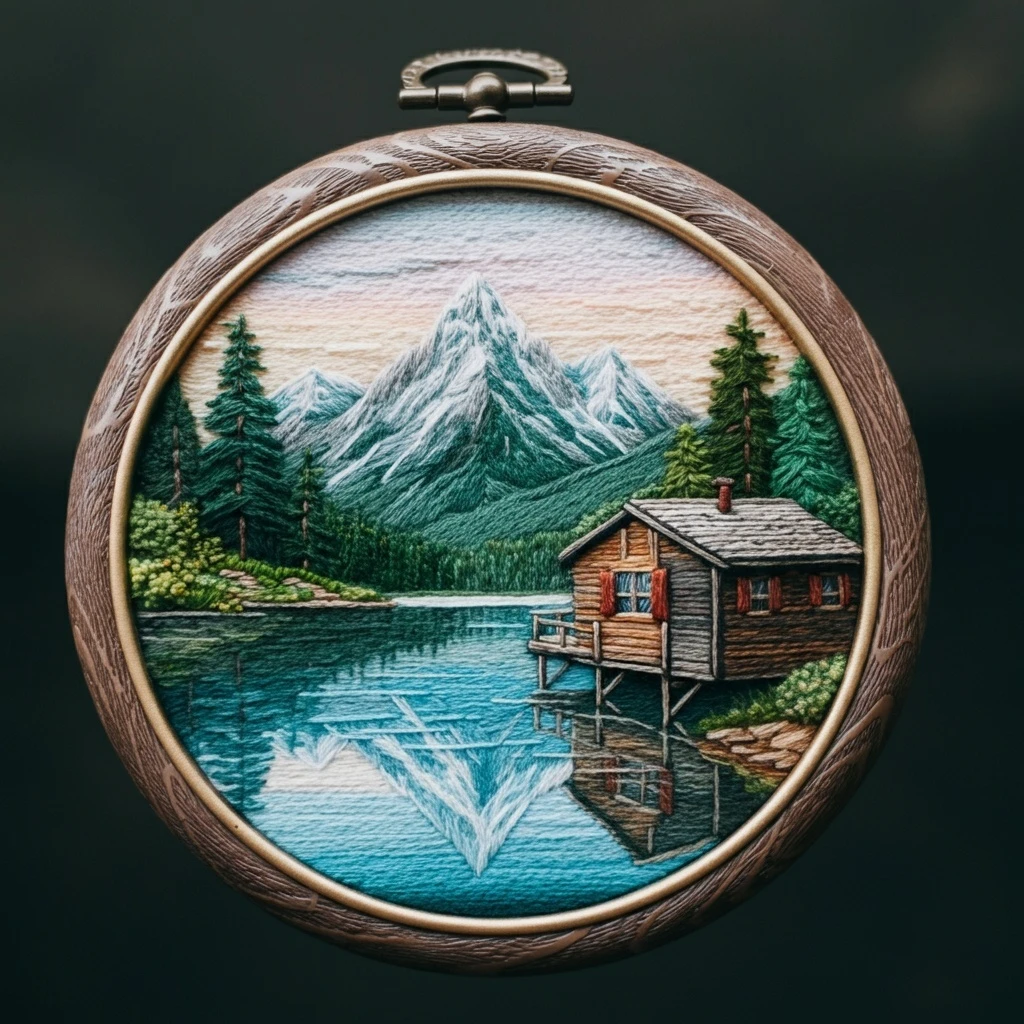
Embroidered Mountain Lake Cabin in Hoop
A calm alpine hoop design with snowy peaks, deep evergreen forest, turquoise lake water, a rustic lakeside cabin, and delicate reflections. Use layered thread direction and soft blending to keep the scene painterly while still beginner-friendly.
Suggested DMC Color Palette
The reference image is built around cool teal water, blue-green mountains, dark pine silhouettes, warm cabin wood, rusty shutters, pale snow highlights, and a softly peach-tinted sky. These DMC choices keep the contrast clear without making the scene look harsh.
Stitch Map by Design Area
Mountains & Snow
Use long and short stitch following the slope direction. Keep stitches diagonal, not vertical, so the peaks look carved.
- 2 strands for main slopes.
- 1 strand B5200 for snow ridges.
- Blend 1 strand 502 + 1 strand 762 for misty ridgelines.
Evergreen Forest
Build trees from the trunk outward with small angled fly stitches or stacked fishbone stitches.
- Use 500 at the base and center.
- Add 501/502 on branch tips.
- Vary stitch length so the tree line stays natural.
Lake & Reflection
Work water in horizontal satin or split stitches. Reflections should be broken and slightly wavy rather than solid blocks.
- 2 strands for lake body.
- 1 strand for bright ripple lines.
- Use 3809 below the cabin and shore.
Cabin & Dock
Short straight stitches make the log cabin feel wooden. Let each plank have a slightly different direction or color.
- Use 898 for seams and outlines.
- Use 977 and 842 for lit planks.
- Backstitch pier posts with 3371 only at the darkest points.
Sky & Atmosphere
The sky should stay quiet so the mountains remain the focus. Scatter very light horizontal stitches rather than filling heavily.
- Use 1 strand 948 near the horizon.
- Feather 762 into the pale upper sky.
- Leave small fabric gaps for airiness.
Shoreline & Rocks
Use seed stitch, tiny detached chains, and short straight stitches to create uneven grasses and stones.
- 580 for shaded greenery.
- 734 for leaf tips and dots.
- 842 for stones and path edges.
Thread Count, Blending & Shading Guidance
Recommended Strand Counts
- 1 strand: distant mountain snow, roof lines, water sparkles, window detail, and reflection breaks.
- 2 strands: most satin, split stitch, long and short shading, cabin planks, and lake fill.
- 3 strands: foreground pine boughs, dense shrubs, and the darkest shoreline if more coverage is needed.
- 6 strands: avoid for most of this design; it can make the fine landscape details bulky.
Useful Blends
- Mountain haze: 1 strand 502 + 1 strand 762.
- Deep alpine green: 1 strand 500 + 1 strand 501.
- Lake glow: 1 strand 3846 + 1 strand 502.
- Weathered wood: 1 strand 898 + 1 strand 842.
- Soft roof gray: 1 strand 646 + 1 strand 762.
Outlining, Texture & Finishing Details
Outlining
Use split backstitch for cabin edges, windows, and dock rails. Use a broken 1-strand outline on distant mountains so they do not look cartoonish.
Texture
For pine needles, layer small V-shaped fly stitches. For water, keep every mark horizontal; this instantly makes the lake read as calm and reflective.
Highlights
Add B5200 last. Place it only on snow tips, a few lake ripples, and the brightest roof strokes to avoid over-whitening the design.
Beginner-Friendly Practical Tips
- Start in the background: sky first, then distant mountains, forest, lake, shoreline, and finally the cabin details.
- Mark major direction lines: lightly draw mountain slope arrows and horizontal lake guides before stitching.
- Use shorter threads: 14–16 inch lengths prevent fuzzing, especially with dark greens and browns.
- Do not overfill reflections: leave gaps between cabin reflection stitches so the water stays believable.
- Check contrast often: step back from the hoop; add 500/3371 only where an edge truly needs more depth.
- Press from the back: after finishing, place the embroidery face-down on a towel and press gently to keep raised stitches safe.