
Embroidered Peacock Display In Hoop
This peacock hoop design is all about jewel-tone drama: a deep emerald fan, electric blue neck and chest, golden tail-eye rings, crisp pale feather ribs, and a warm wooden hoop frame. The most polished result comes from controlled stitch direction, thin highlight lines, and layered greens that let every tail feather feel separate without becoming busy.
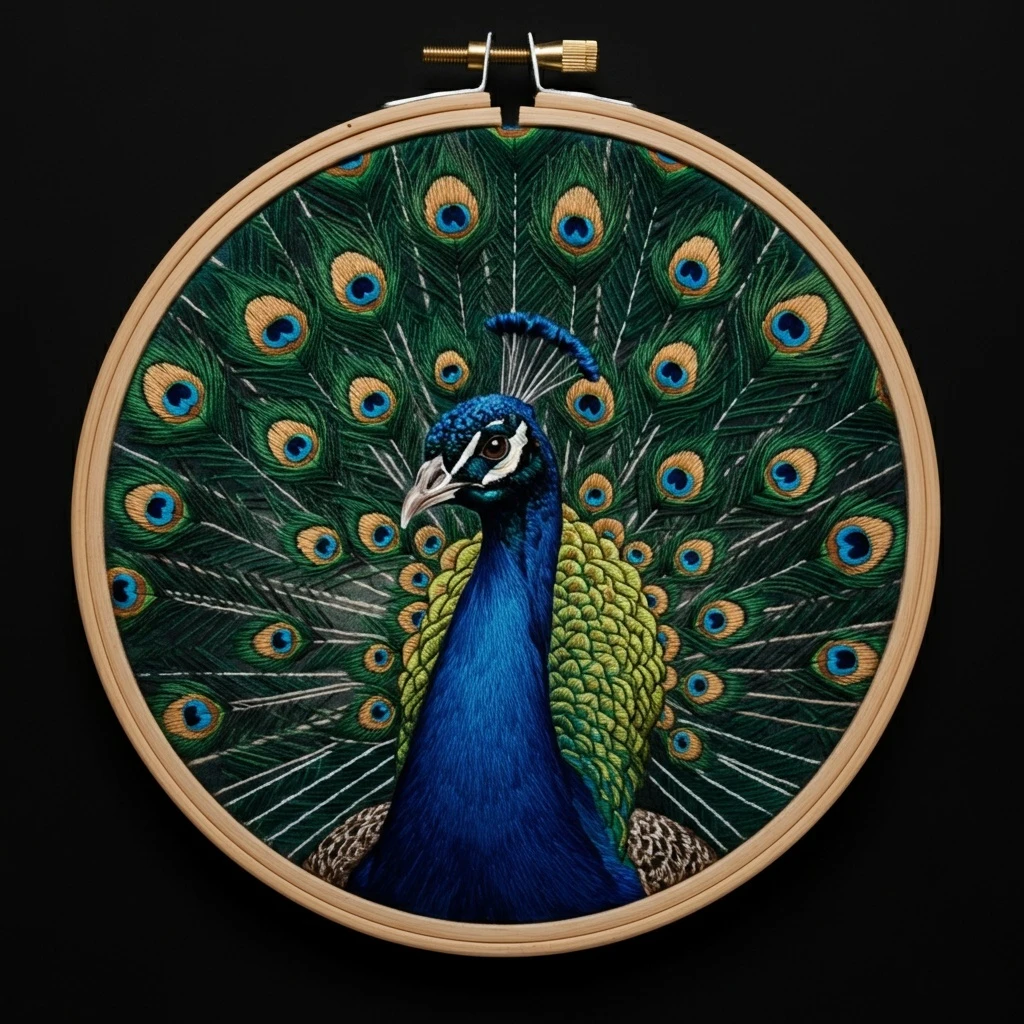
Project snapshot
Plan the peacock like a layered illustration: background fan first, feather eyes second, body last, then final rib lines and sparkle highlights.
Suggested DMC color palette
These shades match the design’s dominant visual groups: blue body plumage, deep green fan feathers, gold-and-blue eye spots, pale feather ribs, and warm hoop accents.
Recommended stitches by area
- Peacock neck and chest: Use long and short stitch in vertical, slightly curved rows. Blend 939, 820, 995, and 3843 so the body looks glossy and dimensional.
- Tail fan feathers: Work long, directional straight stitches or fishbone stitch from each feather shaft outward. Keep the stitches slim and angled to mimic real barbs.
- Feather eyes: Use satin stitch for gold ovals, then smaller blue satin or padded satin circles for the centers.
- Body scales: Use detached chain, small scalloped satin stitches, or layered fly stitches to create the green scale texture beside the blue neck.
- Fine white ribs: Use one-strand backstitch or couched straight stitches so the pale rib lines stay clean and delicate.
- Hoop and earthy base: Use satin or stem stitch in tan and brown shades, following the circular curve of the hoop.
Thread-count guidance
- 1 strand: face markings, feather ribs, tiny eye-spot outlines, beak highlights, and the thinnest silver-white streaks.
- 2 strands: most outlines, eye spots, crest details, and controlled fill work in smaller feathers.
- 3 strands: main peacock neck, chest, and larger green fan areas when stronger coverage is needed.
- 4 strands: optional padded body texture or raised gold eye rings, especially on a larger hoop design.
- Best practice: keep the feather ribs thinner than the fan fill; if both are the same weight, the display can look crowded.
Blending ideas
Peacock embroidery is strongest when the color changes are layered rather than flat. Let the colors overlap with varied stitch length instead of forming hard bands.
- For the body, blend 939 → 820 → 995 → 3843, placing the brightest blue on the center of the neck and chest.
- For deep feathers, blend 500 → 501 → 3818 to create a dark evergreen base with visible movement.
- For scale-like side feathers, alternate 367 and 3348, adding 3818 at the lower edge of each scale.
- For tail eyes, layer 3820 as the golden body, 783 as the lower shadow, then 995 and 310 in the center.
- For white ribs, use mostly 3865, but touch in 414 where the rib passes behind darker feathers.
Outlining and definition
The design has many small shapes, so outline selectively. Too much black around every feather will flatten the fan.
- Use DMC 310 only for pupils, the strongest face definition, and occasional dark gaps between crowded feathers.
- Use DMC 939 for body outlines so the blue form stays rich without becoming harsh.
- Outline gold eyes with DMC 783 or a single dark green strand rather than black when you want a softer finish.
- Use whipped backstitch around the neck curve and beak for a smooth, illustrated line.
- Keep feather rib lines broken in places; tiny gaps help them look like natural strands instead of rigid spokes.
Shading and texture guide
| Area | Color handling | Texture suggestion |
|---|---|---|
| Blue neck and chest | Deepen the lower and side edges with 939 and 820; reserve 995 and 3843 for the centerline and crest highlights. | Use long, tapered stitches that follow the neck curve so the bird looks sleek and upright. |
| Green tail fan | Build dark 500 as the base, then add 501 and 3818 in feather-shaped strokes for depth. | Use directional straight stitches radiating outward from each feather shaft. |
| Tail eye spots | Work gold rings with 3820 and shade the lower side with 783; add blue centers with 995 and dark pupils with 310. | Padded satin stitch gives each eye a raised, jewel-like finish. |
| Green body scales | Alternate 367 and 3348 with small dark touches of 3818 to separate the scale rows. | Detached chain or scalloped satin stitches create a rounded feather-scale effect. |
| White feather ribs | Use 3865 for highlights and 414 for subdued rib shadows where the fan is dense. | One-strand backstitch keeps the lines crisp without overpowering the fan. |
| Wood hoop | Use 739 for highlights and 433 for shaded edges if you choose to stitch the hoop motif. | Follow the circle with stem stitch or split stitch to preserve the rounded wooden feel. |
Suggested stitching order
Beginner-friendly practical tips
- Use a sharp needle and smooth fabric tension; the many small feather eyes look best when the fabric does not pucker.
- Stitch repeated eye spots in batches: all gold ovals first, then blue centers, then dark pupils. This keeps the spacing consistent.
- Do not carry dark threads across light areas on the back; they can shadow through pale ribs and beak highlights.
- For a cleaner fan, trim thread tails often and avoid bulky knots behind dense feather areas.
- If the green fan feels too dark, add extra 501 or 3818 strokes near the feather tips instead of brightening every section equally.
- If the blue body lacks shine, place a few short 3843 stitches along the central chest and crest only.
- Step back from the hoop regularly; peacock feathers need balance from a distance more than perfect detail up close.