
Embroidered Peacock Feathers On Teal Fabric
This design centers on peacock feather eyes glowing against a teal fabric ground. The strongest finish comes from pairing cool teal and emerald feather barbs with concentrated blue centers and warm golden rings. Keep the feather lines airy, let the teal fabric show through in places, and use the brightest blues and golds only where you want the eye spots to sparkle.
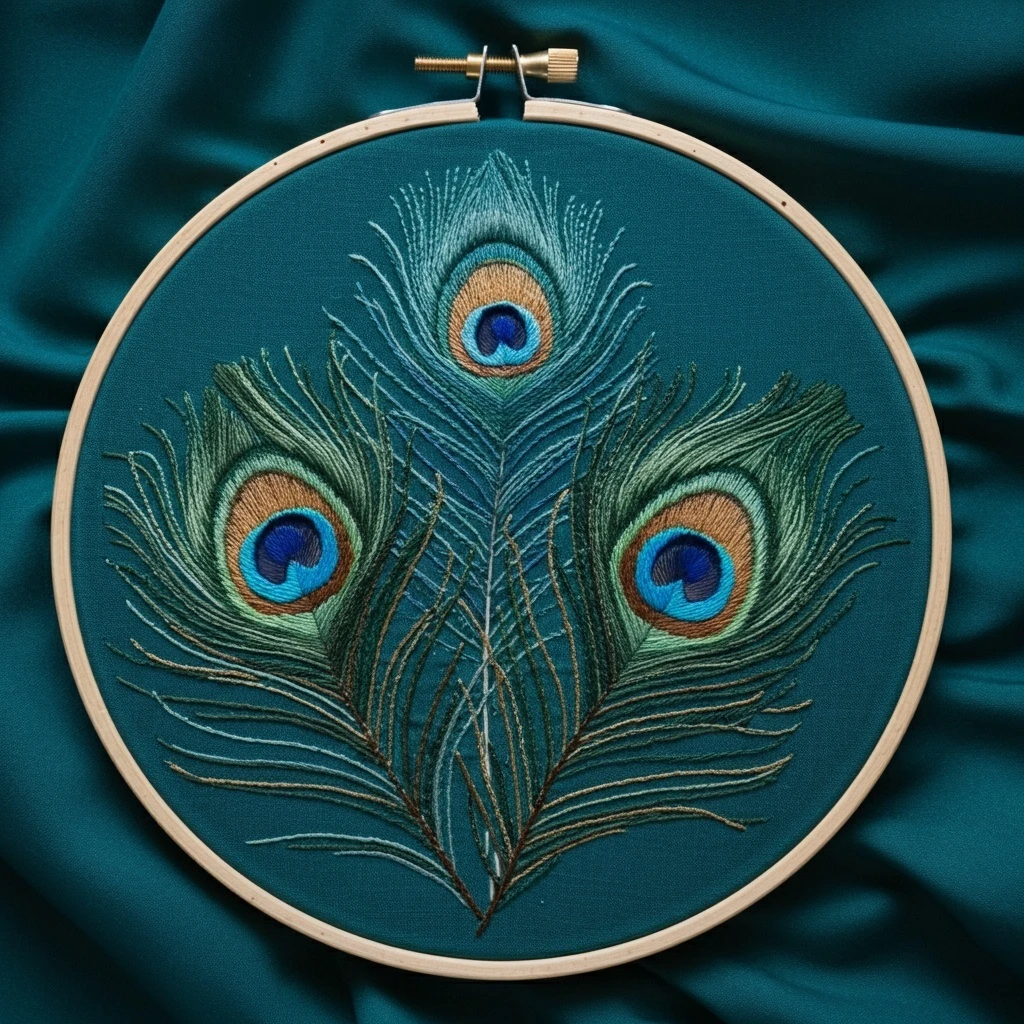
Project snapshot
Plan the piece as layered feather movement: first the long ribs, then green barbs, then bright eye spots, and finally fine highlights.
Suggested DMC color palette
These DMC suggestions emphasize the design’s teal fabric base, emerald feather strokes, jewel-blue centers, and golden eye rings.
Recommended stitches by area
- Feather shafts: Use one-strand backstitch, stem stitch, or couched straight stitches so the ribs stay clean and slightly raised.
- Feather barbs: Work long, tapered straight stitches or fishbone stitch radiating from the shaft. Leave small gaps for the teal fabric to show.
- Eye rings: Use satin stitch or padded satin stitch for the gold oval, then layer the blue and green centers on top.
- Eye centers: Use tight satin stitch with 820, 995, and 3843; a tiny 310 or 898 center makes the eye spot crisp.
- Background sparkle: Add a few seed stitches or tiny straight stitches in 3811 or metallic E3852 for subtle shimmer.
- Soft outer edges: Use feather stitch or loose straight stitches for the wispy outer plume tips.
Thread-count guidance
- 1 strand: feather ribs, delicate outer wisps, tiny glints, and any short broken outline lines.
- 2 strands: most feather barbs, eye-ring outlines, and medium-width green/teal strokes.
- 3 strands: bold satin eye centers and denser gold rings when the pattern is larger.
- 4 strands: optional only for raised padded eye rings; avoid using it for the feather barbs on small designs.
- On teal fabric: use fewer strands for pale highlights so they look elegant rather than chalky.
Blending ideas
Peacock feathers look most natural when the color shifts along the barb direction. Blend by alternating stitch lengths and spacing, not by making solid blocks.
- For teal ground accents, move from 3809 → 3810 → 3811, keeping the pale shade only on the brightest rib edges.
- For green feather barbs, layer 500 → 501 → 502, then add selective 699 or 702 where the feather needs a lively emerald flash.
- For the blue centers, place 820 in the deepest oval, brighten with 995, and add tiny 3843 highlights near the top curve.
- For golden rings, use 3820 as the main shade and 783 along the lower edge for a raised, dimensional look.
- For a luxury finish, use a very small amount of E3852 as a final accent, not as a full fill color.
Outlining and definition
Because the fabric is already teal, the outlines should separate shapes without boxing them in too heavily.
- Use 500 or 3809 instead of black for most feather outlines to keep the look soft and elegant.
- Reserve 310 for the tiniest eye centers or the deepest shadow, where a strong focal point is needed.
- Outline gold eye rings with 783 or 898 for definition that still feels warm.
- Use broken backstitch around the outer feather shapes so the teal fabric can breathe through the design.
- Keep the central ribs consistent in weight; uneven rib thickness is more noticeable than uneven feather wisps.
Shading and texture guide
| Area | Color handling | Texture suggestion |
|---|---|---|
| Teal fabric base | Let the fabric remain visible and add 3809 or 3810 only where shadow or stitched depth is needed. | Use open stitching instead of full coverage so the fabric color supports the design. |
| Long feather barbs | Start dark at the shaft with 500 or 501 and fade outward with 502, 3848, or 3810. | Vary stitch length to create airy movement and avoid comb-like stiffness. |
| Golden eye rings | Use 3820 as the main ring, 783 at the lower edge, and a small metallic or pale stitch at the upper edge. | Padded satin stitch makes the rings look rounded and jewel-like. |
| Blue eye centers | Build from 820 at the darkest center to 995 and 3843 on the highlighted side. | Keep stitches snug and smooth so the centers look glossy. |
| Pale ribs and glints | Use 3811 sparingly; too much pale thread can compete with the gold and blue centers. | One-strand backstitch or tiny straight stitches give a crisp, refined shimmer. |
| Outer wisps | Use 502, 3848, and 3810 in loose single stitches, with darker green only near the base. | Feather stitch, fly stitch, or separated straight stitches create a soft plume edge. |
Suggested stitching order
Beginner-friendly practical tips
- Use a hoop that keeps teal fabric drum-tight; loose fabric makes long feather stitches sag.
- Test pale colors on the teal fabric first. Some light floss shades look brighter on dark fabric than they do on the skein.
- Keep eye spots similar in size by stitching all gold rings before moving to blue centers.
- Avoid long thread carries behind open feather areas; they may show through or create shadows on the front.
- When using metallic floss, stitch with shorter lengths and a slightly larger needle to reduce fraying.
- If the design feels too busy, remove some outer wisps rather than simplifying the central eye spots.
- Step back often. Peacock feathers should read as graceful movement from a distance, not just tiny details up close.