
Embroidered Peacock In Golden Glory
This peacock design reads as a warm, regal display: a jewel-blue bird surrounded by a radiant gold fan, antique amber shading, emerald accents, and small high-shine details. Treat the gold areas as layered light rather than one flat color. The most polished result comes from deep amber shadows, pale old-gold highlights, controlled metallic touches, and a glossy blue body that remains the focal point.
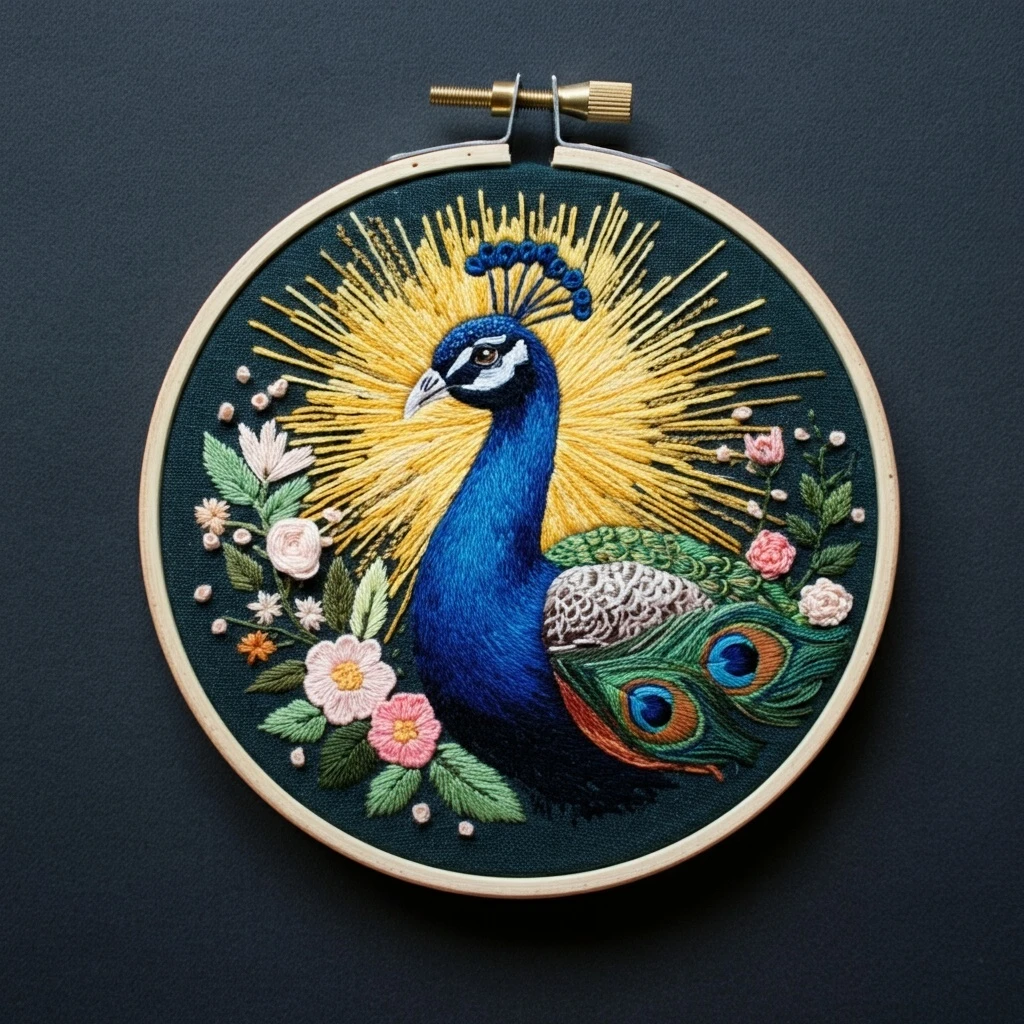
Project snapshot
Build the design like a jeweled fan: gold structure first, blue peacock body second, then emerald details and bright glints at the end.
Suggested DMC color palette
These floss choices balance the design’s warm gold fan with jewel-blue body tones and emerald peacock accents.
Recommended stitches by area
- Golden tail fan: Use long and short stitch in radiating rows. Follow each feather’s curve so the fan feels sunlit and dimensional.
- Gold feather ribs: Use stem stitch, split stitch, or couched straight stitches in 676 or 3820 for clean, elegant lines.
- Eye-feather ornaments: Use padded satin stitch for the gold ring, then smaller satin stitches for blue and green centers.
- Peacock body: Work smooth long and short stitch from dark royal blue into electric blue highlights.
- Crest and face: Use one-strand backstitch for delicate lines and tiny French knots for crown-like tips.
- Metallic accents: Couch metallic E3852 with matching cotton floss, or add only a few short straight stitches to reduce fraying.
Thread-count guidance
- 1 strand: face markings, feather rib highlights, eye details, and delicate metallic spark points.
- 2 strands: most outlines, gold feather ribs, smaller eye rings, and controlled satin details.
- 3 strands: main gold fan fills, blue neck fill, and larger emerald accents where fuller coverage is needed.
- 4 strands: optional for raised padded gold rings or decorative knots on a larger hoop.
- Metallic rule: use short lengths and fewer strands. Metallic floss is beautiful, but too much can overpower the cotton shading.
Blending ideas
For the golden glory effect, blend warm shades by value. The blue body should be glossy and concentrated, while the tail fan should feel like layered light.
- For the fan, blend 676 → 3820 → 729 → 3852 → 783, placing 676 on the upper light edges and 783 under overlapping feathers.
- For dramatic gold eye rings, use 3820 as the main tone, 3852 at the middle shadow, and 783 along the lower rim.
- For the body, shade 820 → 995 → 3843, with 820 at the deepest side and 3843 as tiny highlights along the chest curve.
- For green accents, blend 500 → 501 → 699 → 702, using the brightest green only on the eye-feather glints.
- Use E3852 only after all cotton floss is complete, adding small highlights where light would catch the feather tips.
Outlining and definition
Gold embroidery can lose shape if every area is similar in value. Use warm dark outlines and selective blue-green shadows to keep the design readable.
- Use 783 or 433 for most golden outlines; they define the fan without looking as stark as black.
- Use 820 or 500 around the peacock body where you need a crisp jewel-tone edge.
- Reserve 310 for pupils, the deepest gaps, and tiny high-contrast facial details only.
- Use broken backstitch around the outer fan so the gold rays remain light and airy.
- Whipped backstitch works well for the peacock neck curve because it creates a smooth illustrated silhouette.
Shading and texture guide
| Area | Color handling | Texture suggestion |
|---|---|---|
| Radiant gold fan | Use 676 and 3820 for light-facing edges, 729 for mid-tone body, and 3852 or 783 for deeper undersides. | Radiating long and short stitches create the feeling of feathers catching warm light. |
| Tail eye ornaments | Build gold rings first, then place green and blue jewel centers on top with darker outlining only where needed. | Padded satin gives each eye a raised, gem-like finish. |
| Peacock neck and chest | Shade with 820 at the outside curve, 995 as the main blue, and 3843 as the highlight ridge. | Smooth vertical long-and-short stitches make the body look glossy. |
| Emerald accents | Use 500 and 501 for shadow, then add 699 and 702 only at the brightest feather-eye flashes. | Small satin stitches or detached chain stitches create a jewel-like scale effect. |
| Face, beak, and crest | Use 3865 for light markings, 433 for warm beak shading, and tiny 310 points only for sharp definition. | One-strand detail stitching keeps the expression refined. |
| Metallic highlights | Add E3852 last to the top of gold rings, the brightest feather tips, or crown-like crest points. | Couch metallic thread instead of dragging it through dense stitches whenever possible. |
Suggested stitching order
Beginner-friendly practical tips
- Use a fresh needle for metallic floss and keep metallic lengths short to reduce twisting and fraying.
- Do not use metallic thread for every gold area; cotton gold shades create smoother coverage and easier blending.
- Stitch repeated tail eyes in batches: all gold rings first, all green accents second, all blue centers third.
- Keep the brightest blue highlights small. A few well-placed stitches will look more elegant than filling large areas with electric blue.
- If the fan looks flat, add more 783 or 3852 under overlapping feathers rather than adding extra bright gold everywhere.
- Use a hoop or frame with firm tension, especially for long gold stitches, to prevent puckering.
- Step back often. The gold fan should read as a glowing shape from a distance, with details rewarding closer viewing.