
Embroidered Pink Lotus Flowers And Leaves In A Hoop
This lotus hoop design has a peaceful botanical feel: layered pink petals, rounded green leaves, soft watery shadows, and delicate central highlights. The polished result comes from smooth petal shading, directional leaf veins, and careful contrast between warm pink blossoms and muted cool greens. Keep the flowers luminous and let the leaves provide calm structure underneath.
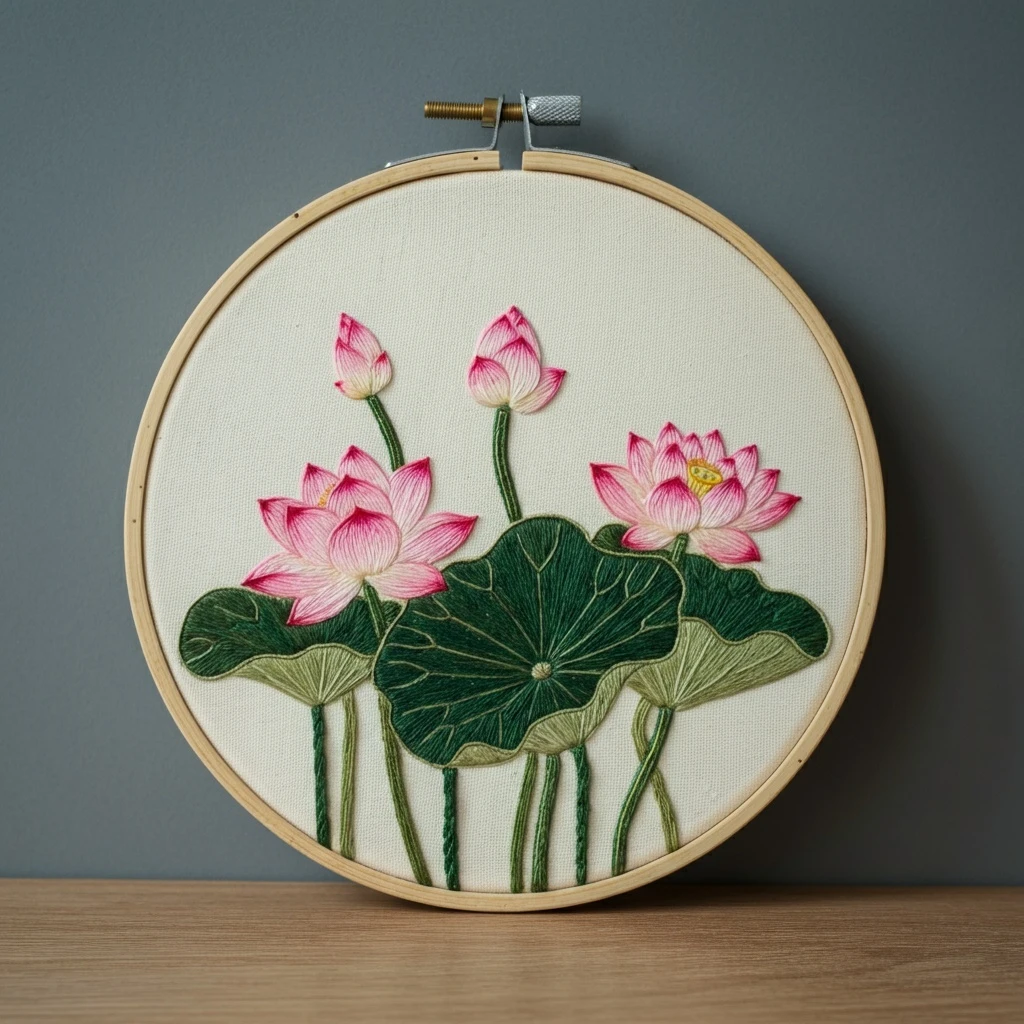
Project snapshot
Plan the hoop as layered blossoms above rounded leaves: back leaves first, flower petals second, center details and fine outlines last.
Suggested DMC color palette
These DMC shades support soft pink lotus blooms, stronger rose shadows, broad green leaves, cool water-toned accents, and tiny yellow center details.
Recommended stitches by area
- Lotus petals: Use long and short stitch from the petal base toward the tip, keeping stitches slightly curved to follow each petal’s shape.
- Petal tips: Use soft satin stitch or short long-and-short rows in B5200, 3865, 819, and 818 for a smooth lifted edge.
- Petal folds and overlaps: Use one-strand split stitch or backstitch in 761, 760, or 3688, tapering the line before it reaches the tip.
- Leaves: Use fishbone stitch or long-and-short stitch so the leaf veins radiate outward from the center.
- Stems: Use stem stitch in 3347 or 3363, with a darker underside line for depth.
- Flower centers: Add tiny French knots, seed stitches, or short straight stitches in 725 for warm pollen details.
Thread-count guidance
- 1 strand: petal veins, flower center dots, delicate outlines, and small highlight marks.
- 2 strands: most petal fills, leaf veins, stems, and clean linework around the blossoms.
- 3 strands: larger leaf fills and broad lotus petals when stronger coverage is needed.
- 4 strands: optional for raised flower-center knots or padded satin on large focal petals only.
- Tip: if the design is small, use 1–2 strands for petals so the layered shapes stay crisp and elegant.
Blending ideas
Lotus petals look best when the color deepens near the base and fades toward pale tips. Use irregular stitch lengths to avoid visible stripes.
- For pale petals, blend B5200 → 3865 → 819 → 818, reserving pure white for the highest petal tips.
- For warmer inner petals, blend 225 → 761 → 760, with 760 placed where petals overlap.
- For deeper rose shadows, use 3688 and tiny touches of 3685 only near bases, folds, and hidden edges.
- For leaves, blend 3348 → 3347 → 3363 → 3051, placing darker greens near the center and under the flowers.
- For watery atmosphere, add soft accents of 3813 and 3768 around cool leaf shadows or background ripples.
Outlining and definition
Use gentle outlines for lotus flowers. Harsh dark lines can overpower the soft, layered petals.
- Use 818, 761, or 3688 for petal definition rather than black.
- Use 3685 only in the deepest flower creases, not around the entire bloom.
- Use 3363 or 3051 for leaf outlines and vein emphasis.
- Use broken backstitch on outer petal edges so the line stays light and natural.
- Outline after filling for a clean polished edge, especially where petals overlap leaves.
Shading and texture guide
| Area | Color handling | Texture suggestion |
|---|---|---|
| Outer lotus petals | Use B5200 and 3865 at the tips, then blend into 819 and 818 toward the base. | Long, smooth stitches should radiate with the petal curve for a soft satin-like surface. |
| Inner petals | Use 225 and 761 as the warm mid-tones, deepening with 760 or 3688 at overlaps. | Shorter stitches near the base help the petal layers look folded and dimensional. |
| Deep flower folds | Add small touches of 3685 only in tight creases or behind front petals. | One-strand split stitch creates precise shadow lines without bulk. |
| Lotus leaves | Use 3348 on light edges, 3347 as the main fill, 3363 for veins, and 3051 for underside shadows. | Fishbone stitch or radiating long-and-short rows mimic natural leaf veining. |
| Water or background accents | Use 3813 for pale cool glints and 3768 for muted teal-gray shadow. | Loose straight stitches or small seed stitches suggest gentle water movement. |
| Flower centers | Use 725 sparingly, with a few pale highlights nearby so the center glows without becoming too bright. | Tiny French knots or seed stitches make a delicate pollen texture. |
Suggested stitching order
Beginner-friendly practical tips
- Use a pale transfer method so guide marks do not show through light pink and white petals.
- Separate floss strands before stitching; smooth separated strands make petal fills look cleaner.
- Keep the darkest pinks close to the base of the flowers. Too much dark rose at the tips can make the lotus look heavy.
- Stitch leaves with a consistent vein direction so they frame the flowers naturally.
- If petals look flat, add deeper shadow under overlaps rather than adding more outline around the whole flower.
- Use shorter stitches on tight petal curves and longer stitches on broad open petals.
- Step back often. The lotus should read as soft layered pink flowers from a distance, with details visible up close.