
Embroidered Rose Garden Arch Pillow
This rose garden arch pillow design combines romantic clustered roses, climbing vines, soft leafy greens, warm arch or trellis lines, and gentle pillow-fabric neutrals. The most polished result comes from rounded rose shading, layered greenery, and stable stitches that will hold up on a decorative pillow surface.
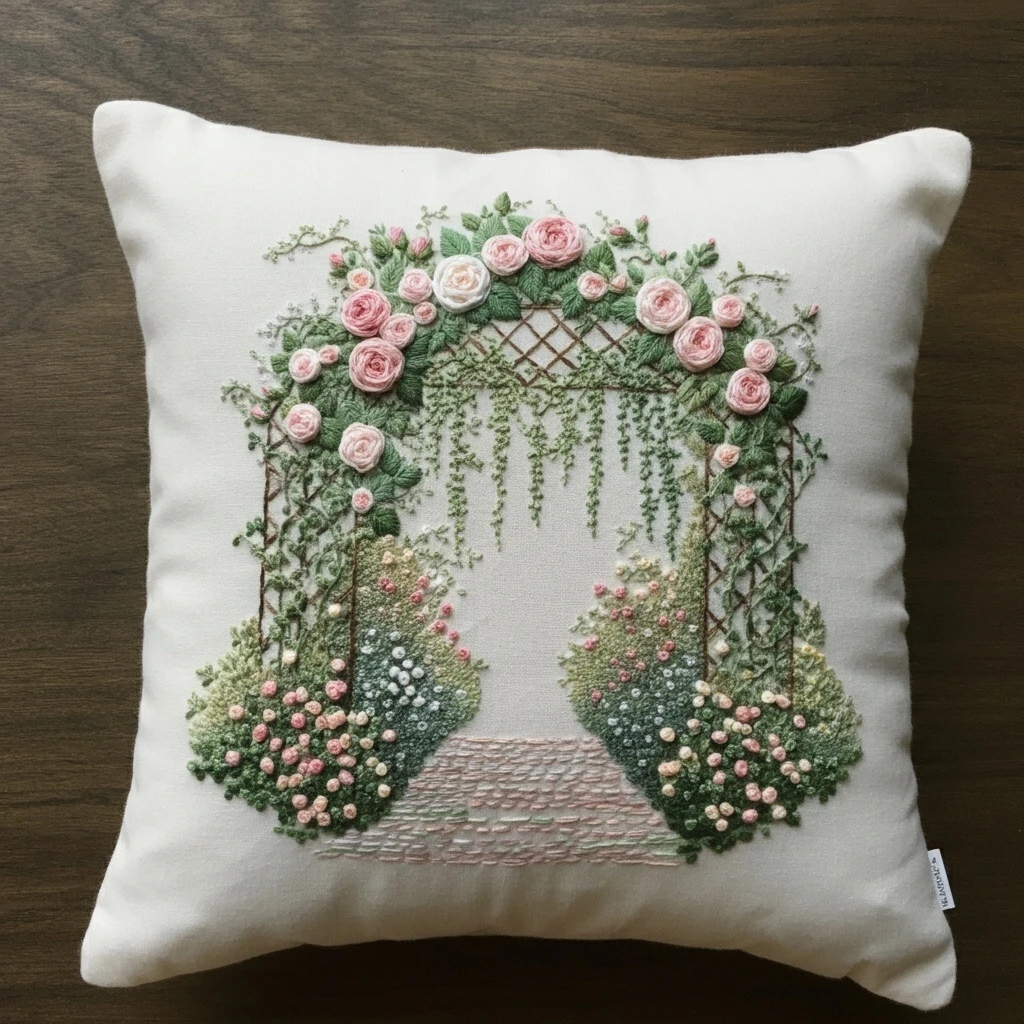
Project snapshot
Plan the pillow as a decorative garden frame: arch structure first, foliage second, rose clusters third, and final highlights last.
Suggested DMC color palette
These colors support soft garden roses, deep floral shadows, climbing foliage, warm arch or trellis details, and subtle pillow-fabric shading.
Recommended stitches by area
- Large roses: Use woven wheel roses for dimensional blooms, or layered satin stitches if the pattern is more illustrative.
- Small buds: Use bullion knots, colonial knots, or tiny detached-chain petals in pink and rose shades.
- Petal shading: Use long and short stitch with irregular lengths so rose petals blend naturally from light edge to darker center.
- Leaves: Use fishbone stitch or lazy daisy leaves, with darker stitches at the base and lighter stitches at the tips.
- Vines and arch lines: Use stem stitch for curved vines and split stitch for trellis or arch definition.
- Pillow fabric texture: Use sparse seed stitches or very light running stitches in 739, 642, or 3865 if the design includes cushion shading.
Thread-count guidance
- 1 strand: fine petal creases, pillow seam detail, delicate vine tendrils, and tiny highlights.
- 2 strands: most leaves, vines, arch lines, smaller roses, and controlled satin work.
- 3 strands: fuller rose petals, broad leaf fills, and visible pillow motifs on heavier fabric.
- 4 strands: optional for woven roses, raised flower centers, or decorative pillow accents where texture is desired.
- Pillow note: if the pillow will be handled often, keep raised stitches low and secure long floats with couching or shorter stitch lengths.
Blending ideas
Rose embroidery looks best when each bloom has a clear light edge and a deeper center. Use small overlaps rather than hard stripes.
- For pale roses, blend B5200 → 3865 → 225 → 818, keeping the lightest shades on upper petal edges.
- For pink rose clusters, use 761 → 760 → 3712, deepening toward the inner spiral of each rose.
- For vintage rose shadows, add 3688 and tiny touches of 3685 inside tucked petals.
- For foliage, blend 3348 → 3347 → 3363 → 3051, placing dark greens behind flower clusters and under the arch.
- For arch and pillow neutrals, blend 739 → 642 → 433 → 801 depending on whether the area is fabric, wood, or deep vine shadow.
Outlining and definition
Keep outlines romantic and soft. Use darker versions of the same color family instead of black unless the design requires a strong graphic line.
- Use 3712, 3688, or 3685 for rose-petal creases and inner spiral definition.
- Use 3363 or 3051 to define leaves and separate foliage from rose clusters.
- Use 433 or 801 for trellis, arch, or thick vine shadows.
- Use broken backstitch on outer flowers so the edges stay soft and painterly.
- Outline after filling so petal edges and leaf tips look clean, especially on textured pillow fabric.
Shading and texture guide
| Area | Color handling | Texture suggestion |
|---|---|---|
| Open roses | Use 818 and 761 on outer petals, 760 and 3712 toward the center, with 3685 only for deepest folds. | Woven wheel roses give raised texture; long-and-short stitch gives a flatter pillow-safe finish. |
| Rosebuds | Use 761 as the main bud shade, 3688 at the base, and 225 or 818 on the highlighted tip. | Bullion knots or detached-chain petals make compact buds with natural shape. |
| Leaves and vines | Use 3348 on light tips, 3347 for the main green, 3363 for underside shade, and 3051 in dense recesses. | Fishbone leaves and stem-stitch vines create a clear climbing-garden structure. |
| Garden arch or trellis | Use 739 or 642 for pale arch highlights, then 433 and 801 for warm wood or vine shadows. | Stem stitch follows curves smoothly; couching can secure longer arch lines on pillow fabric. |
| Pillow base | Use 3865, 739, and 642 sparingly to show soft folds, seams, or cushion shadows. | Light running stitch or seed stitch suggests fabric texture without making the pillow look busy. |
| Dense flower clusters | Alternate light and dark rose shades so individual blooms remain visible within the arch. | Mix woven roses, lazy daisy petals, and French knots for a rich cottage-garden surface. |
Suggested stitching order
Beginner-friendly practical tips
- Use a stable pillow-weight fabric or add interfacing so dense floral stitching does not pull the surface out of shape.
- Keep woven roses moderate in height if the pillow will be used, not just displayed.
- Stitch flower clusters in odd groupings of three or five for a more natural garden look.
- Do not place all dark rose shades in one area; distribute deeper tones around the arch for balance.
- If leaves look flat, add 3051 behind flower clusters before adding more bright green.
- Use shorter thread lengths for rose work because repeated petal stitching can fuzz the floss.
- Step back before final details. The arch silhouette should read clearly even before tiny highlights are added.