
Embroidered Saturn And Stars Night Sky
This design reads as a dreamy celestial hoop: a deep indigo-to-navy sky, bright stars, a softly shaded Saturn in warm tan, peach, and gold, plus pale ring highlights that stand out against the dark background. The strongest result comes from smooth planet shading, crisp ring definition, and varied star textures so the sky feels alive rather than flat.
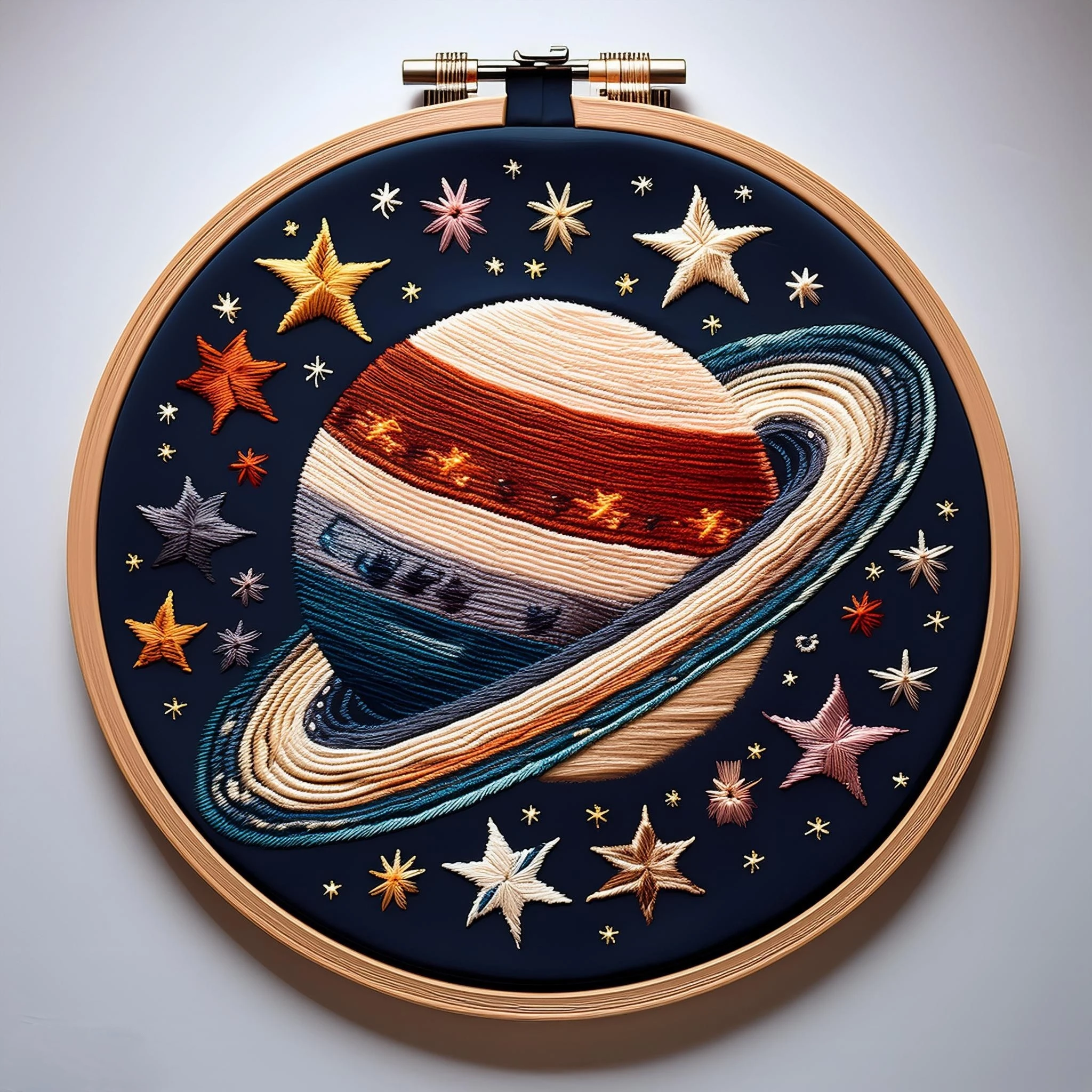
Project snapshot
Think of the hoop in three layers: night sky foundation, Saturn and ring as the focal element, then scattered stars and sparkle accents.
Suggested DMC color palette
These DMC choices match a dark night-sky background, a warm golden-beige Saturn, cool ring highlights, and bright stars.
Recommended stitches by area
- Saturn body: Use long and short stitch in mostly horizontal bands so the planet looks softly rounded.
- Planet outline: Use one-strand split stitch or backstitch in 782, 3799, or 932 depending on how graphic the design is.
- Ring: Use satin stitch, short laid stitches, or neatly aligned long-and-short rows following the ring direction.
- Stars: Mix French knots, seed stitch, short straight stitches, and a few tiny cross or sparkle motifs for variety.
- Sky accents: Use sparse seed stitches and tiny detached stitches in blues and creams if the background needs more cosmic texture.
- Glow effects: Add a few scattered stitches in 745, 3865, or 797 around larger stars for a subtle halo rather than a dense circular fill.
Thread-count guidance
- 1 strand: ring edges, planet contour lines, tiny stars, sparkle rays, and final highlights.
- 2 strands: most star motifs, small celestial details, and the ring if the design is delicate.
- 3 strands: Saturn body fills and medium stars that need solid coverage on dark fabric.
- 4 strands: optional for padded star centers or bold planetary fills on a larger hoop.
- Tip: dark fabric often shows through more than light fabric, so test 2 versus 3 strands for the planet before stitching the full body.
Blending ideas
For the most convincing result, let the sky stay deep and simple while Saturn carries the smoothest gradients in the piece.
- For Saturn, blend 950 → 3772 → 729 → 782, keeping 950 toward the light-facing top edge and 782 toward the lower shadow.
- Add small warm highlights with 727 across the brightest band or ring edge if the design feels too muted.
- For the ring, blend 3865 → 3752 → 932 → 640, then deepen only the far underside with a touch of 3799.
- For the sky, use 939 → 820 → 797 only in selected areas; leaving some fabric visible keeps the night sky clean and airy.
- For star glows, layer 745 → 3865 → B5200, using B5200 only at the brightest point.
Outlining and definition
Celestial embroidery usually looks best with selective definition. Over-outlining can make the piece look stiff instead of dreamy.
- Use 782 or 3799 to define Saturn’s outer edge instead of black wherever possible.
- Use 932 or 640 to separate ring bands and create soft depth.
- Use 310 only for the tiniest high-contrast details, if the design needs extra sharpness.
- For stars, let the stitch shape create the form rather than outlining every sparkle.
- If Saturn blends too much into the sky, add a narrow backstitch shadow only behind the lower half of the planet.
Shading and texture guide
| Area | Color handling | Texture suggestion |
|---|---|---|
| Night sky | Use 939 as the main dark, with 820 and a touch of 797 for optional halos or cool depth. | Minimal seed stitch keeps the sky soft; too much coverage can reduce the dramatic dark background. |
| Saturn body | Blend 950, 3772, 729, and 782 in horizontal bands, keeping the darkest tones at the lower edge. | Long-and-short stitch in slightly curved horizontal rows makes the planet feel rounded. |
| Planet highlights | Add 727 on the brightest band and small 3865 stitches only where strong reflected light is needed. | Use short highlight stitches rather than a large white area to keep Saturn warm and natural. |
| Ring | Use 3865, 3752, 932, and 640, then deepen the far edge with 3799 for depth behind the planet. | Neat satin or laid stitches make the ring look crisp and smooth. |
| Stars | Use 745, 3865, and B5200, mixing warm cream and bright white so the sky doesn’t look monotonous. | Mix French knots, seed stitches, and tiny straight-stitch starbursts for a lively star field. |
| Glow and sparkle accents | Use small halos of 797 or 820 around selected stars and keep them sparse. | Short radiating stitches make larger stars feel twinkly without overwhelming the composition. |
Suggested stitching order
Beginner-friendly practical tips
- Use a sharp needle and a taut hoop if you are working on dark fabric; precise stitches stand out more cleanly.
- Test light floss on a scrap first. Dark fabric may need an extra strand for solid coverage.
- Keep the sky simple. Too many stars can compete with Saturn instead of framing it.
- When stitching the ring, always follow the same direction so it looks smooth and intentional.
- If the planet looks flat, deepen the underside shadow before adding more highlight.
- Use short thread lengths for pale colors on dark fabric to reduce fuzz and keep stars crisp.
- Step back frequently. The hoop should read clearly as Saturn first, stars second.