
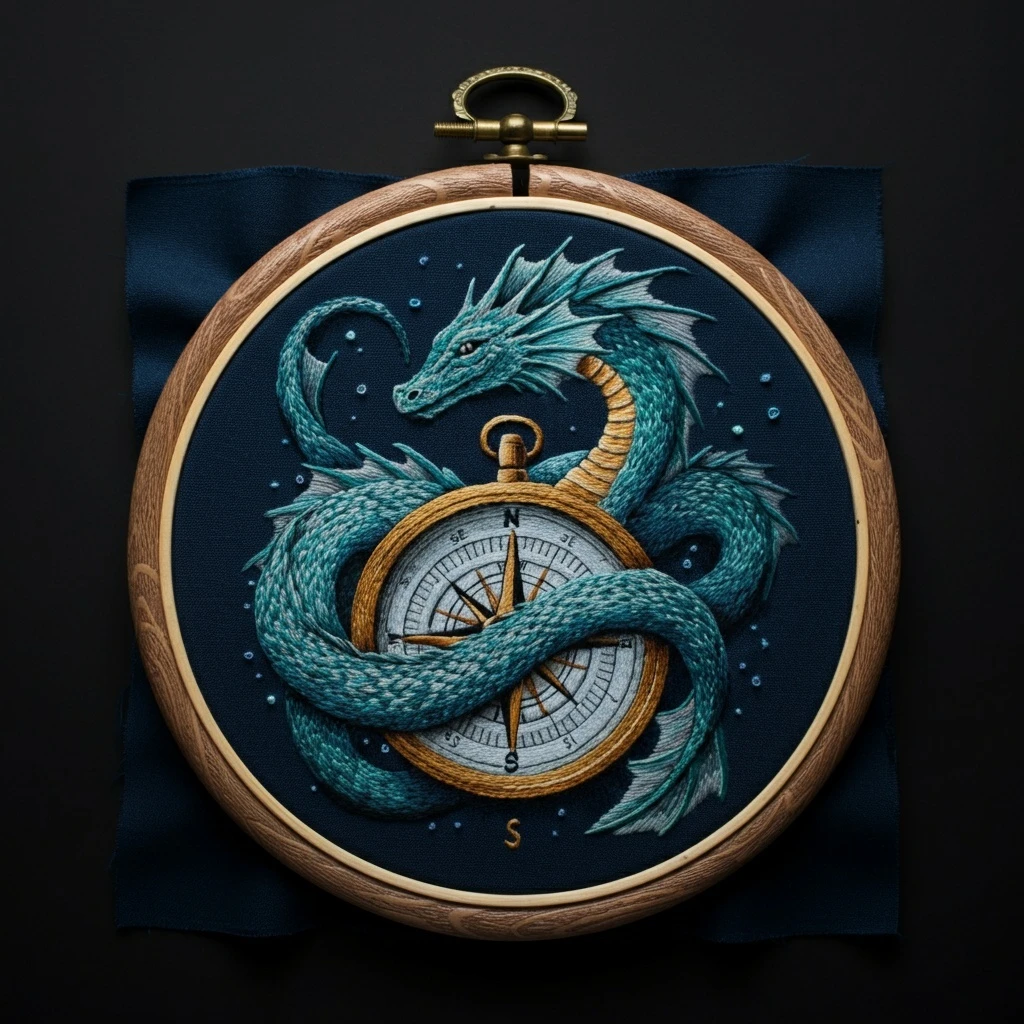
Embroidered Sea Dragon And Compass
A dramatic nautical design built around a turquoise sea dragon curling through a warm brass compass on deep navy cloth. The palette below keeps the dragon luminous, the compass antique-gold and readable, and the background bubbles crisp without overpowering the central creature.
Design Color Read
The reference image uses strong contrast: a nearly midnight-blue fabric, cool blue-green dragon scales, pale aqua highlights on fins and face, muted grey-blue compass glass, warm ochre metal rims, and tiny blue bubbles. Treat the dragon as the brightest subject and keep the compass slightly warmer so both motifs remain separate.
Polished DMC Floss Palette
Use the full palette for a detailed version, or simplify by choosing one dark, one mid, and one light shade from each color family.
Dragon shadow bands, underside curves, deepest scale clusters.
Main dragon body, neck and tail base color.
Face highlights, scale sparkle, crest edges and ridge tips.
Sharpest glints on muzzle, bubbles, fin membranes.
Low-light shadows where the body disappears behind the compass.
Soft shadowing in fins and muted scale transitions.
Pale fin webbing, jaw plane, compass glass reflections.
Compass face, tiny highlight flecks, pale bubble centers.
Compass rim shadows, old brass depth, shaded needle edges.
Main brass rim, ring, north-south needle fill.
Bright metal catches on rim and hanging loop.
Thin separators, aged rim grooves, hoop-like dark accents.
Highest sparkle in bubbles and compass glass, used sparingly.
Compass dial shading and circular tick marks.
Fine compass lettering, needle shadows, eye outline.
Tiny eye pupil, deepest separations, final selective outlining.
Thread Count & Blending Plan
- Dragon body: 2 strands for most fills. Work rows of short-long stitch with 3844/3845, then add 1-strand scale highlights in 3846 and 3811.
- Fine face details: use 1 strand for nostril, mouth line, eye, brow ridges, and narrow crest spikes.
- Compass rim: use 2 strands for padded satin or split stitch rings. Add 1-strand 676 highlights along the upper-left arcs.
- Compass dial: use 1 strand for tick marks, letters, and needle outlines so the circle stays readable.
- Bubbles: use 1 strand for French knots or tiny detached chain; add a dot of 3865 only to the largest bubbles.
Beginner-Friendly Order
- Start with the compass circles so the central geometry is stable.
- Fill large dragon curves next, following the direction of the body rather than stitching straight across.
- Add fins, crest spikes, and facial details after the body so they sit crisply on top.
- Finish with bubbles and tiny sparkle knots last to keep them clean.
- Press from the back over a fluffy towel to protect textured knots and raised stitches.
Stitch Suggestions by Design Area
| Area | Recommended stitches | Practical notes |
|---|---|---|
| Dragon body coils | short-long stitchsplit stitchseed stitch | Shade with curved rows. Place darker turquoise in recessed bends and under overlaps; scatter tiny 1-strand seed stitches for scale texture. |
| Head, muzzle & eye | split backstitchsatin stitchstraight stitch | Keep the eye very small: 310 pupil, 3799 outline, one dot of 3865. Use 3811 on the nose bridge and cheek planes. |
| Crests, spines & fins | fishbone stitchfly stitchlong straight stitch | Work from base to tip with 3845, then overlay 1-strand 927 or 3811 to make translucent fins. |
| Compass rim | padded satinstem stitchcouching | Use 782 for the lower-right shadow, 783 for the main brass, and 676 for narrow highlights. Couch a golden outline if you want a raised metal edge. |
| Compass face & markings | backstitchstraight stitchwhipped backstitch | Fill the dial lightly with 762/415. Use single-strand 3799 for cardinal letters and tick marks; avoid heavy black except for the strongest points. |
| Water bubbles & stars | French knotscolonial knotstiny detached chain | Vary bubble sizes with one or two wraps. Keep spacing irregular so the background feels underwater rather than patterned. |
Shading, Texture & Outlining Details
Sea dragon shading
Think of the light hitting the dragon from the upper left. Place 3811 and 3846 along the top of the head, crest, upper tail loop, and the visible edge of each body coil. Use 3809 and 3844 where the dragon tucks behind the compass or under its own body.
Scale texture
Do not outline every scale. Instead, use staggered 1-strand seed stitches and short diagonal marks in alternating turquoise shades. This keeps the dragon detailed but not crowded.
Compass definition
For the compass, contrast is more important than heavy fill. Keep the dial pale, make the brass ring warm, and use a fine dark backstitch only where the needle points, letters, and tick marks must read clearly.
Final outlining
Use 1 strand of 3799 for most outlines and reserve 310 for the eye, a few deepest gaps, and the sharpest compass intersections. A lighter outline in 3846 on the dragon’s lit edge will look more natural than black.
Extra Practical Tips
- On dark fabric, transfer with a white water-soluble pencil or light-colored transfer paper; test removal first.
- Use a sharp embroidery needle for tight compass marks and a slightly larger needle for 2-strand filled areas.
- Keep satin stitches on the compass short; long satin stitches snag and distort round geometry.
- Rotate the hoop while stitching dragon curves so your hand naturally follows the body direction.
- Step back often: the dragon should read as turquoise from a distance, with scale texture appearing only up close.