
DMC Palette & Embroidery Notes
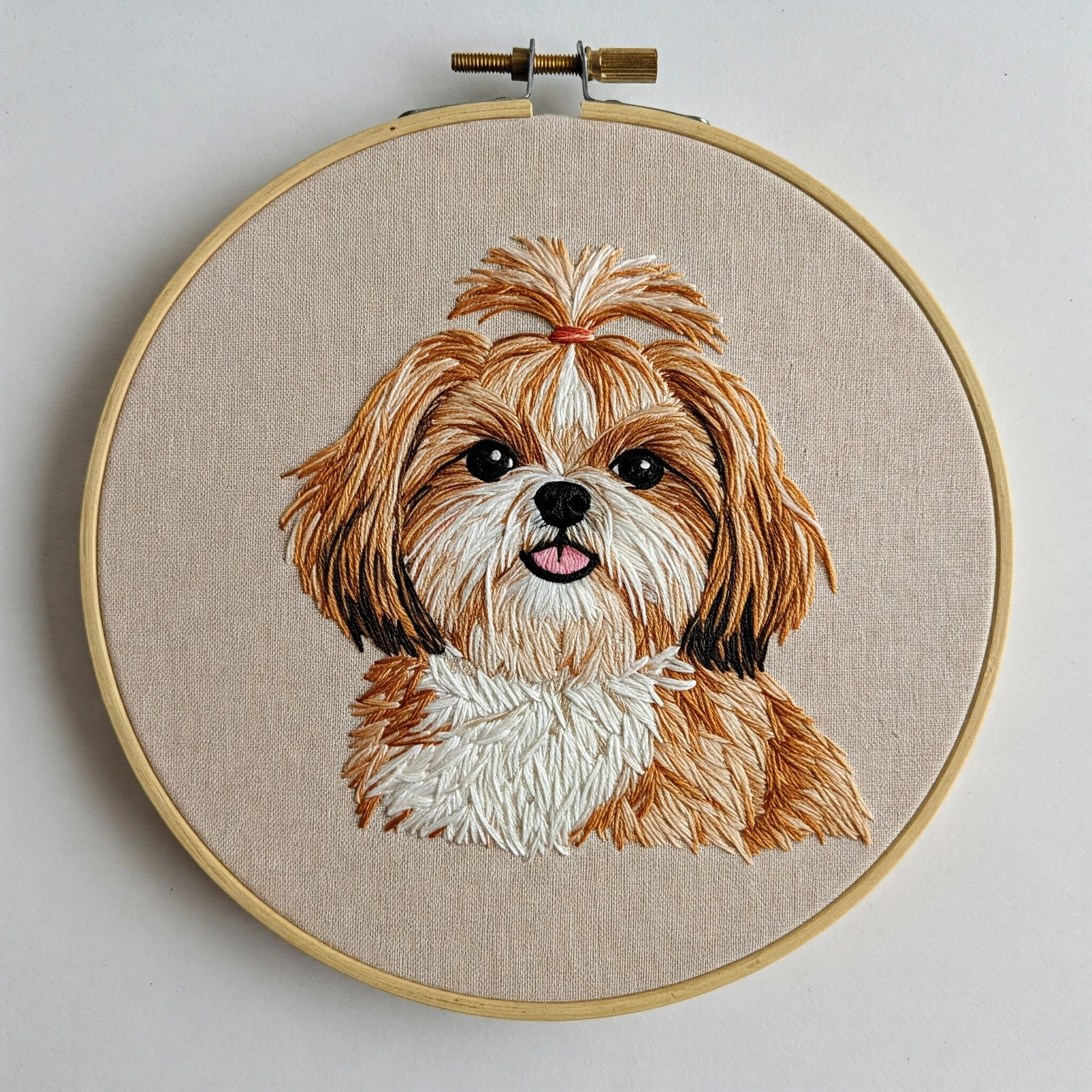
Embroidered Shih Tzu Portrait
A sweet pet-portrait hoop with a fluffy Shih Tzu face, long caramel ears, creamy white muzzle, shiny black eyes, a rounded black nose, pink tongue, and a tiny topknot tied with a red bow. The palette and stitch plan below focus on layered fur texture, soft cream-to-tan shading, and beginner-friendly facial details.
Design Color Read
Fur & face
The portrait is dominated by warm caramel, honey brown, ivory, and cream. Fur stitches flow downward from the topknot, outward across the ears, and gently down the muzzle. Keep the white and tan strokes interlaced rather than separated into hard blocks.
Features
The dark eyes and nose create the strongest contrast in the design. A few carefully placed white highlights make the eyes glossy, while the mouth and tongue add a soft playful accent.
Topknot & ears
The raised top hair fan uses pale cream and golden tan strokes, gathered by a narrow red tie. The ears are darker at the inner folds and lighter along the outer wispy edges.
Suggested DMC Floss Palette
These DMC suggestions are chosen to match the pictured hoop: creamy whites, warm biscuit tans, deeper ear shadows, crisp black facial features, and a small pink-red accent range for the bow and tongue.
DMC B5200 — Snow White
Brightest muzzle strokes, forehead highlights, topknot shine, and tiny eye sparkle dots.
DMC 3865 — Winter White
Main white-fur base where pure white would feel too stark on beige linen.
DMC 739 — Ultra Very Light Tan
Soft cream transitions in the chest, muzzle edge, and pale topknot strands.
DMC 642 — Dark Beige Gray
Gentle shadows between white fur clumps and under the chin.
DMC 3826 — Golden Brown
Main honey-tan coat color for ears, cheek patches, shoulders, and top hair warmth.
DMC 977 — Light Golden Brown
Lighter tan fur strands and sunlit edges around the ears and face.
DMC 976 — Medium Golden Brown
Mid-to-dark fur strokes along ear folds, cheeks, and lower shoulder edges.
DMC 975 — Dark Golden Brown
Deepest caramel shadows under floppy ears and around the sides of the face.
DMC 898 — Very Dark Coffee Brown
Inner ear definition and warm dark outlines where black would look too harsh.
DMC 310 — Black
Eyes, nose, nostril shape, mouth line, and a few strongest facial accents.
DMC 3716 — Very Light Dusty Rose
Tongue highlight and soft pink mouth detail.
DMC 335 — Rose
Tongue shadow or stronger center line, used sparingly.
DMC 815 — Medium Garnet
Tiny topknot tie or bow band, with enough depth to stand out from the tan fur.
DMC 347 — Very Dark Salmon
Warm highlight on the bow tie and optional mouth warmth.
DMC 646 — Dark Beaver Gray
Cooler separation lines in white fur, especially around the muzzle and chest.
DMC 3856 — Ultra Very Light Mahogany
Golden glints at the tips of tan fur strands and a soft bridge between ivory and caramel.
Stitch Plan by Design Area
| Area | Best stitches | Practical notes |
|---|---|---|
| Silky ears | Long-and-short stitch, straight stitch, split stitch guide lines | Use mostly 1 strand. Vary stitch length so the ears look wispy and layered. Place darker browns underneath, then add lighter tan strands over the top. |
| White muzzle | Long-and-short stitch, short straight stitch, tiny split stitches | Work from the nose outward and downward. Use 3865 and 739 as the base, then add B5200 highlights and 642/646 shadows between clumps. |
| Topknot | Long straight stitch, split stitch, couching for the tie | Stitch the hair fan in directional strands that meet at the red tie. Add the red tie after the hair so it sits clearly on top. |
| Eyes | Padded satin stitch, satin stitch, tiny straight stitch highlight | Use black with very neat edges. Add the white sparkle last; a single stitch or tiny knot is enough. |
| Nose | Padded satin stitch, satin stitch, small split-stitch outline | Pad the nose with one underlayer, then cover with smooth black satin. Leave or add a tiny highlight to suggest shine. |
| Tongue and mouth | Satin stitch, backstitch, split stitch | Keep the tongue small and rounded. Use light rose for the fill and a darker rose or black for the center and mouth separation. |
| Chest and shoulders | Long-and-short stitch, staggered straight stitch | Let white strokes overlap tan shoulder strokes to avoid a cut-out look. Keep chest stitches fluffy and slightly uneven. |
Thread Counts, Blending & Shading
Thread-count guide
- 1 strand: realistic fur texture, facial shaping, fine ear strands, and most muzzle shading.
- 2 strands: nose fill, tongue, red hair tie, stronger outlines, and larger chest strokes.
- 3 strands: reserve for a very bold nose or decorative bow only; heavy thread can overwhelm the delicate fur.
Blending ideas
- Blend one strand DMC 3826 with one strand DMC 977 for the warm main ear color.
- Blend one strand DMC 3865 with one strand DMC 739 for creamy white fur that still feels soft.
- Blend one strand DMC 642 with one strand DMC 3865 for muted shadows under the muzzle.
- Use DMC 975 in single-strand strokes only at the deepest ear folds so the portrait stays gentle.
Texture & Finishing Suggestions
Layered fur
Start with mid-tones, add dark shadow strands, then finish with the lightest highlight stitches. This keeps the long fur dimensional without needing complicated thread painting.
Soft outlining
Use dark brown for most fur boundaries and save black for eyes, nose, and mouth. Brown outlines keep the face warm and prevent the portrait from looking cartoon-heavy.
Facial focus
Complete the eyes and nose near the end. Once these are in place, you can add tiny corrective fur stitches around them to balance expression and symmetry.
Practical hoop advice
- Use medium-weight linen or cotton-linen in a warm neutral shade; it supports dense fur while complementing the tan palette.
- Keep the hoop drum tight, especially while stitching the muzzle and chest where many light stitches overlap.
- Stitch from background fur zones toward the face details: ears first, chest and muzzle next, then eyes, nose, tongue, topknot tie, and final highlights.
- Trim thread tails carefully behind pale areas so dark carry threads do not show through the white muzzle.
- Press from the back on a folded towel and avoid crushing the padded nose or raised hair-tie stitches.