
Embroidered Sunset Landscape Hoop

Embroidered Sunset Landscape Hoop - DMC Palette & Stitching Guide
DMC palette & stitching notes

Embroidered Sunset Landscape Hoop

A calm stitched landscape with a golden half-sun, radiating straight-stitch beams, pale horizon marks, layered green hills, and a soft winding valley shape. The palette is warm and earthy, designed to keep the sunset luminous while the fields retain the natural, thread-painted texture of the reference hoop.
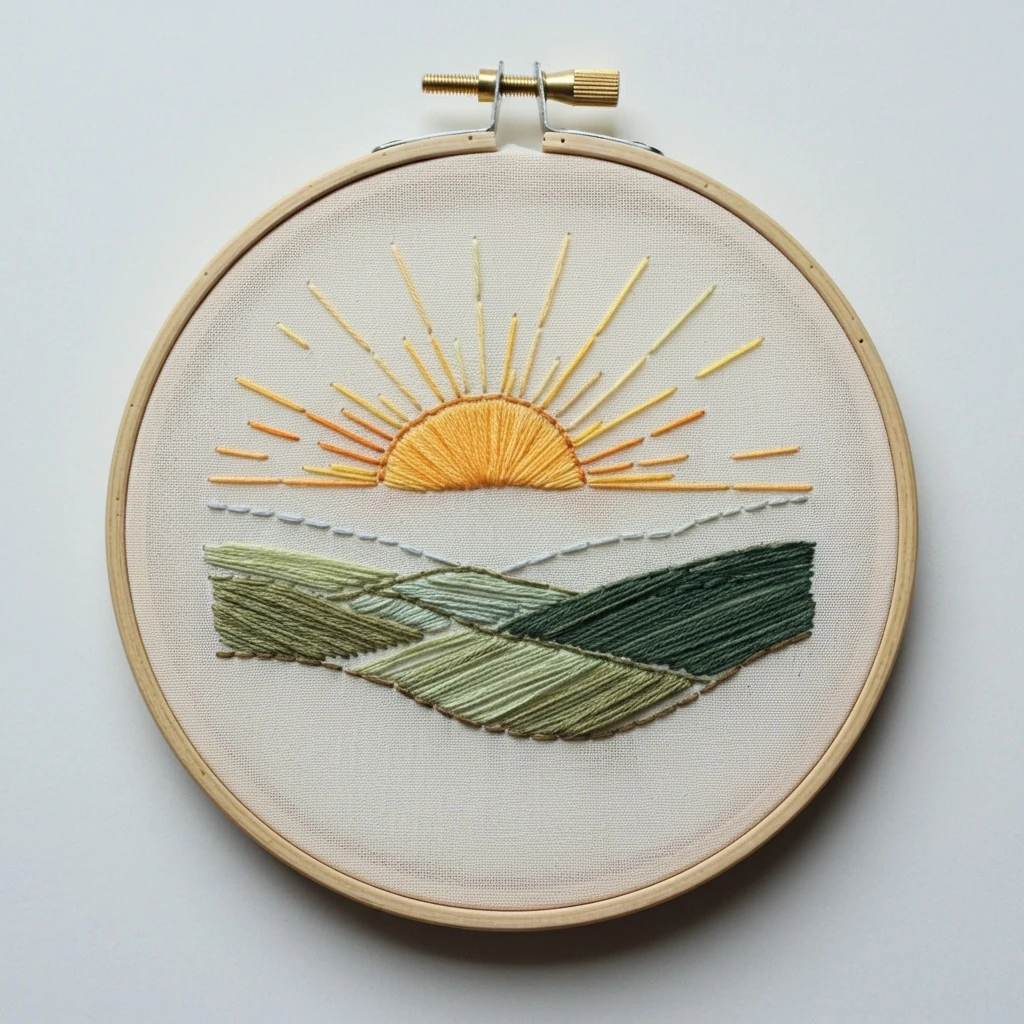
Skill level: confident beginnerBest fabric: natural linen or cottonFocus: satin sun, straight rays, directional hill fills
Embroidered Sunset Landscape Hoop

Suggested DMC Color Palette

Use the yellows in the sun and rays first, then move into muted greens for the hills. The darker greens give the landscape depth; the pale grays and creams keep the sky and valley quiet rather than busy.

DMC 307
Lemon
Lightest sun rays and a few airy sky dashes; use 1 strand for delicate glow.
DMC 726
Topaz, Light
Main sun highlight and upper rays; excellent for the bright stitched center.
DMC 725
Topaz
Warm midtone inside the half-sun and thicker beams near the horizon.
DMC 977
Golden Brown, Light
Lower sun edge and orange shadow lines where the sunset touches the hills.
DMC 3823
Yellow, Ultra Pale
Soft ray blending, tiny highlight stitches, and a subtle glow around the sun.
DMC 762
Pearl Gray, Very Light
Distant dashed horizon line and the palest separation between sky and hills.
DMC 3013
Khaki Green, Light
Light-facing hill fill and the soft foreground meadow plane.
DMC 3012
Khaki Green, Medium
Middle hill rows; blends naturally with pale sage for layered fields.
DMC 3011
Khaki Green, Dark
Shadow side of olive hills and lower edges where slopes overlap.
DMC 3363
Pine Green, Medium
Deep green field sections and directional long stitches on the back hills.
DMC 3362
Pine Green, Dark
Darkest right-hand hill and stitched contour accents; use sparingly for contrast.
DMC 522
Fern Green
Cool pale valley/stream shape and gentle transitions between hill layers.
DMC 927
Gray Green, Light
Misty central valley, distant land lines, and muted highlights that should not compete with the sun.
DMC 420
Hazelnut Brown, Dark
Fine hill outlines, lower curve of the landscape, and small grounding stitches.
DMC 422
Hazelnut Brown, Light
Softer path/earth touches and warm outlines where brown should look sunlit.
DMC 3865
Winter White
Tiny gleams in the sky and optional highlight on the valley channel.

Stitch Map

  • Sun: use satin stitch or tight long-and-short stitches radiating upward from the bottom edge of the semicircle. Keep the lower edge slightly darker with DMC 725 or 977.
  • Rays: work detached straight stitches in 1-2 strands. Start at the sun and stitch outward, varying length so the rays feel natural and hand drawn.
  • Horizon: use short running stitches or tiny back stitches in DMC 762. Leave visible fabric gaps to keep the distant line light.
  • Layered hills: fill each hill with long diagonal stitches that follow the slope. Change the angle for every land section so the planes separate clearly.
  • Central valley: use soft stem stitch rows or laid stitches in DMC 522 and 927. Keep this area lighter than the surrounding hills.
  • Lower outline: finish with split stitch or couching in DMC 420, following the gentle curve at the bottom of the landscape.

Thread Count Guide

  • 1 strand: horizon dashes, far mountain line, the thinnest rays, and any tiny highlight stitches.
  • 2 strands: most sun rays, hill outlines, valley rows, and medium field texture.
  • 3 strands: the half-sun fill and bold dark-green foreground/hill sections if you want raised texture.
  • Blending: pair one strand 726 + one strand 725 for sun depth; one strand 3012 + one strand 3013 for soft meadow transitions; one strand 3362 + one strand 3363 for the dark right hill.

Shading, Texture & Practical Tips

Keep the sun clean

Outline the semicircle with 1 strand of DMC 725 before filling. This gives beginners a neat edge and prevents the satin stitches from spreading unevenly.

Stitch rays last near the sky

Work hill fills first, then add the rays and pale sky dashes on top. This prevents later green stitches from catching or distorting the light beams.

Use stitch direction as shading

The reference landscape depends on directional texture. Slant stitches down the slope on each hill and change direction where one field overlaps another.

Leave breathing space

Do not overfill the sky. The linen background is part of the design, especially around the rays where empty space makes the yellow thread glow.

Dark green needs restraint

DMC 3362 gives strong contrast. Use it mainly on the right-hand hill and lower shadow strokes, not across every field section.

Press texture gently

After stitching, press from the back on a folded towel. This smooths the fabric while preserving the raised sun and textured hillside rows.

Beginner-Friendly Working Order

Transfer only the essentials. Mark the sun, ray endpoints, hill borders, valley curve, and bottom outline. Avoid drawing every thread line.
Stitch the sun first. Fill the semicircle from the lower edge upward, blending pale yellow at the top and deeper gold near the base.
Fill distant hills. Start at the back with lighter greens and pale gray-green, then layer darker hills toward the front.
Add the central valley. Use light, slightly curved rows so the valley or stream pulls the eye inward without becoming too bright.
Finish with rays and outlines. Add long yellow rays, pale horizon dashes, and the brown lower curve after the main fills are complete.
Practical tip: For a 6-inch hoop, keep most landscape stitches to 2 strands and reserve 3 strands for the sun or the darkest foreground hill. If your fabric is loosely woven, shorten long stitches or couch them with a matching 1-strand stitch so the fields stay secure.
Designed as a polished DMC palette and stitching guide for the Embroidered Sunset Landscape Hoop.

Leave a Reply

Your email address will not be published. Required fields are marked *