
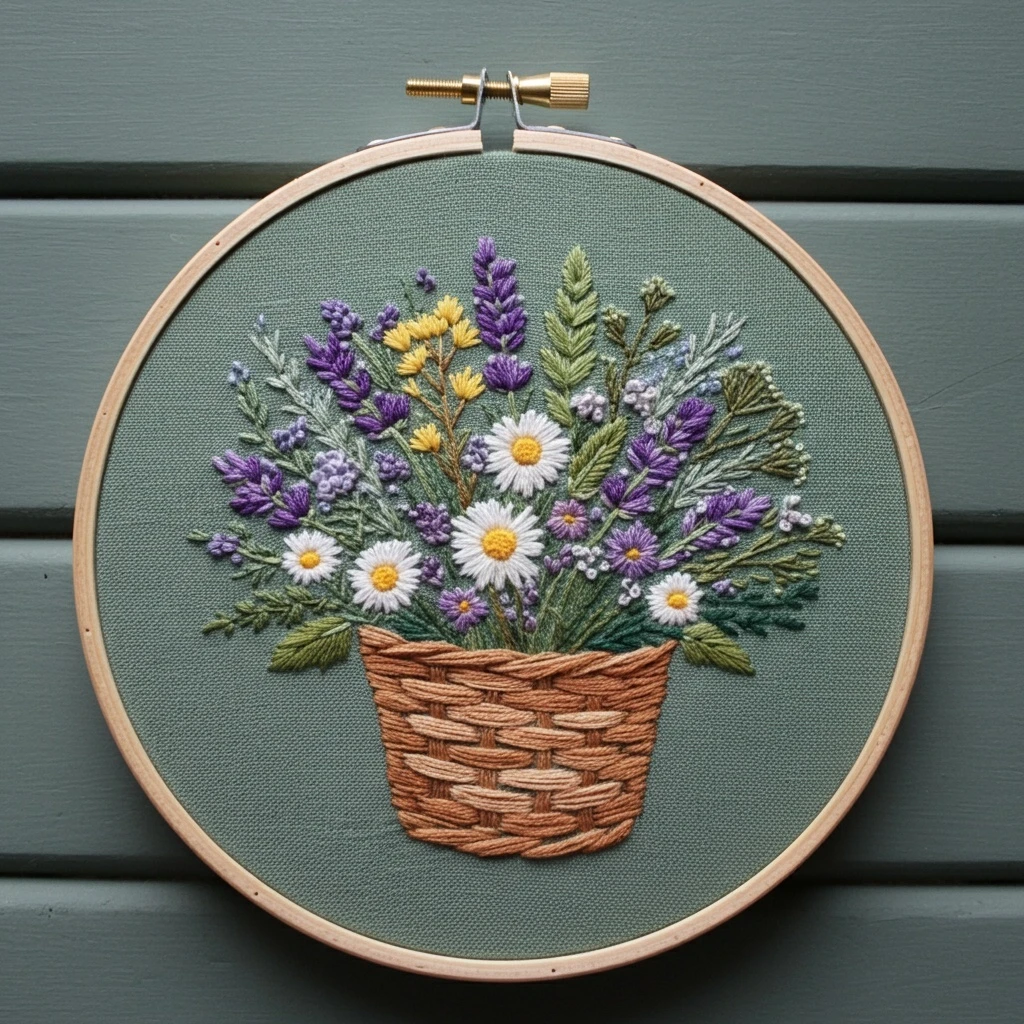
Embroidered Wildflower Basket Hoop Art
A warm woven basket brimming with daisies, purple lavender-like spikes, golden sprigs, pale berries, and layered greenery on muted sage fabric. The design works best with soft botanical shading, raised basket texture, and varied thread counts so the arrangement feels full without becoming bulky.
Color impression
The reference image reads as a rustic cottage bouquet: a tan-brown basket anchors the lower half, while cool greens and purples rise upward in airy stems. White daisy petals and golden centers provide the brightest contrast, and pale blue-lavender berry clusters soften the edges. Keep the overall palette slightly dusty rather than neon so it sits naturally on sage linen.
Stitch plan by design area
| Area | Recommended stitches | Thread guidance |
|---|---|---|
| Basket weave | Long-and-short stitch for the base, then horizontal satin bands and vertical couching to mimic woven reeds. Add a split-stitch outline along the rim and lower curve. | Use 3 strands for the main basket, 2 strands for darker gaps, and 1 strand of DMC 437 for small highlight strokes. |
| Daisy petals | Straight stitches or detached lazy daisies radiating from the center. Keep petal lengths varied, not perfectly even. | Use 2 strands of B5200 with occasional 3865 tucked under petals for dimension. Centers can be French knots in 726 and 783. |
| Purple flower spikes | Stacked lazy daisy stitches, fishbone petals, or short satin stitches angled around a central stem. | Use 2 strands of 552, adding 550 at the lower side of buds and 209 on the lit tips. |
| Berry clusters | French knots, colonial knots, or tiny padded satin circles grouped irregularly. | Use 2 wraps for small berries and 3 wraps for foreground berries. Mix 209, 211, and a few 552 shadow knots. |
| Leaves and ferny stems | Fishbone stitch for broad leaves, fly stitch for fern tips, stem stitch for long stems, and tiny straight stitches for wispy foliage. | Use 1 strand for distant stems, 2 strands for main leaves, and blend 3345 + 3052 in the needle for shaded greenery. |
| Golden sprigs | Lazy daisy petals, straight stitch starbursts, or small closed fly stitches around a fine stem. | Use 2 strands of 726 for petals and one strand of 783 at the base of each yellow flower head. |
Thread-count roadmap
- 1 strand: fine stems, leaf veins, berry highlights, and delicate outlines that should not compete with the flowers.
- 2 strands: most petals, purple buds, small leaves, filler blossoms, and general bouquet stitching.
- 3 strands: basket bands, foreground leaf bodies, and any area where raised texture is desired.
- 4 strands only when needed: padded basket rim or large foreground knots; avoid overusing it so the hoop remains tidy.
Blending ideas
- Blend 3345 + 3052 for realistic olive stems that bridge dark and mid greens.
- Blend 552 + 209 on the needle for soft purple transitions in lavender spikes.
- Blend B5200 + 3865 for daisy petals that look white without appearing flat.
- Blend 919 + 437 for sunlit basket strands; switch to 975 in recessed weave gaps.
Shading, outlining & texture notes
Build depth from back to front
Stitch the longest green stems first, then add rear purple spikes and pale fillers. Work forward into daisies, yellow sprigs, and finally the basket rim. This order lets the basket visually hold the bouquet and hides stem ends neatly.
Outline selectively
Use dark green split stitch only on stems that need definition. Avoid outlining every petal; instead, place a few 3865 shadow stitches under white petals and a few 550 accents at the base of purple blossoms.
Make the basket tactile
After filling the basket shape, couch slightly thicker horizontal strands across it. Stagger the highlights so they look woven rather than striped. A darker vertical stitch between bands gives convincing reed separation.
Keep the bouquet airy
Leave small spaces of sage fabric between stems and flowers. The reference has a natural gathered look, not a solid block of thread, so negative space is part of the design.
Beginner-friendly practical tips
Fabric & hoop setup
- Choose a medium sage cotton or linen with firm weave; the muted ground makes white and yellow stitches pop.
- Keep the fabric drum-tight, especially while working the basket, because dense stitches can pucker the lower section.
- Use a sharp embroidery needle for woven cotton and a slightly larger needle when working 3-strand basket stitches.
Finishing polish
- Trim carried threads behind the white daisies so dark greens do not shadow through pale petals.
- Comb crowded flower heads gently with the needle tip before tightening the final stitches.
- Press from the back on a towel after stitching so raised knots and basket texture stay dimensional.