
DMC Palette & Stitch Guide
Embroidered Winter Penguin And Igloo Hoop Art
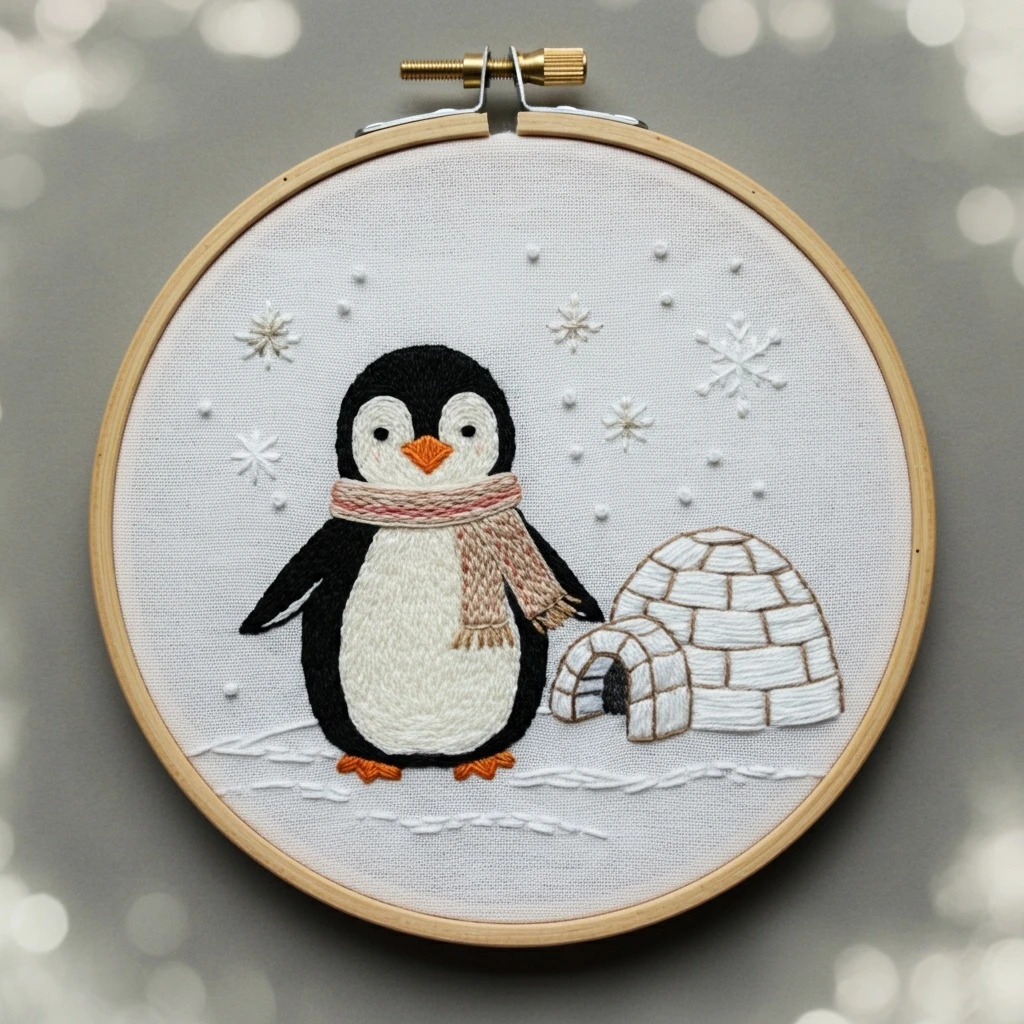
A soft winter hoop with a black-and-cream penguin, orange beak and feet, a rosy beige scarf, snowy ground, falling flakes, and a pale blue-white igloo outlined in warm taupe. The palette below is estimated from the visible preview and matched to practical DMC cotton floss choices.
Likely DMC Color Palette
Use these as close matches for the preview: strong black for the penguin body, creamy whites for snow and belly texture, orange for the beak and feet, muted rose-tan scarf shades, and pale icy blue for igloo block shading.
Penguin head, flippers, side body, tiny eye dots, and deepest igloo doorway shadow. Use neat directional fill so the black silhouette stays crisp.
Main snow, snowflakes, bright igloo blocks, and highlights on the penguin face and belly.
Creamy penguin belly shadows, soft face shaping, and warm snow details where pure white would look flat.
Cool igloo shading, underside of snow ridges, and tiny shadows beneath French-knot snow.
Pale blue cast on igloo ice blocks and subtle cold highlights around the doorway curve.
Igloo mortar lines, scarf fringe, and warmer outline accents that keep the white shapes readable.
Light scarf base, soft igloo side shading, and gentle blending between cream and taupe outlines.
Rosy scarf stripes and warm woven lines. Keep it sparse so the scarf remains delicate.
Darker scarf shadows, folds near the knot, and a few deeper fringe strands for dimension.
Bright beak and penguin feet. Pair with darker orange at the base of each toe.
Beak crease, underside of feet, and tiny warm outline touches on orange areas.
Subtle snowflake centers, light scarf blending, and soft neutral sparkle where white-on-white needs definition.
Stitching Suggestions
| Element | Stitch Type | Practical Notes |
|---|---|---|
| Penguin body | Long and short stitch or satin stitch | Use 2 strands of 310 and follow the curve of the body. Work the head and side panels separately so the round silhouette does not become bulky. |
| Face and belly | Split stitch outline with long and short fill | Blend 3865 with 822. Place stitches vertically through the belly and slightly curved around the cheeks for a soft fluffy look. |
| Eyes | French knots or tiny satin dots | Use 1-2 strands of 310. Keep both eyes the same size; one-wrap French knots are easier to control on small faces. |
| Beak | Satin stitch | Fill the two triangular halves with 970, then add a short center crease in 920. Stitch from the outside edge toward the center point. |
| Feet | Straight stitch and tiny satin stitch | Use 970 for the top strokes and 920 underneath. Separate each toe with a fine dark-orange straight stitch. |
| Scarf wrap | Stem stitch, split stitch, and couching | Build the scarf base in 842, then layer 3722 and 3857 as horizontal woven stripes. Couching a few strands gives the scarf a knitted feel. |
| Scarf fringe | Straight stitch | Use 1 strand each of 842, 841, and 3857. Let the fringe ends vary slightly in length so they look soft rather than stiff. |
| Igloo blocks | Backstitch outlines with satin or split-fill blocks | Outline the block seams with 841 using 1 strand. Add 3865 and 928 fills only lightly so the igloo stays airy and snowy. |
| Doorway | Satin stitch with backstitch edge | Fill the door in 310 or a 310/3799 blend, then define the arch with 841 for a clean entrance shape. |
| Snowflakes | Straight stitch and detached chain | Use 1 strand of 3865 or 613. Keep arms delicate; vary flake sizes to match the open, floating look of the preview. |
| Falling snow | French knots | Use 1 or 2 wraps with 3865. Add a few 762 shadows only if the fabric is very pale and the knots need visibility. |
| Ground snow | Stem stitch, whipped backstitch, and seed stitch | Use loose horizontal curves in 3865, then add small 762 or 822 strokes beneath ridges for gentle snowbank depth. |
Thread Count, Blending & Shading
Use 2 strands for most filled areas: penguin body, belly, scarf, and igloo blocks. Use 1 strand for tiny snowflakes, eye placement, igloo seams, and scarf stripe details.
Do not stitch every snow area in the same white. Alternate 3865 and 822 in the belly, then use 762 or 928 sparingly on the igloo to separate snow, fur, and ice.
For the penguin belly, blend one strand 3865 with one strand 822. For the igloo side shadows, blend one strand 3865 with one strand 928 for a pale frosty blue.
Outline black body edges with split stitch first, then fill inward. For igloo seams, one-strand backstitch in 841 gives definition without overpowering the pale ice blocks.
Use denser, smoother stitches on the penguin silhouette and looser, broken stitches for snowbanks. This contrast makes the bird feel plush and the winter ground feel powdery.
Save French-knot snow and snowflake arms until the end. Raised knots catch easily while filling the penguin and igloo, so add them during the final pass.
Recommended Stitching Order
Beginner-Friendly Practical Tips
- Use a sharp embroidery needle for dense black sections; a dull needle can tug the fabric and make the penguin edge fuzzy.
- Keep black floss lengths shorter than usual, about 12-14 inches, to reduce fraying and lint.
- When stitching white on pale fabric, check progress under daylight or a bright lamp so snowflakes stay balanced.
- Do not pull French knots too tightly; slightly raised knots make falling snow look round and soft.
- If the scarf feels too busy, remove the darkest rosewood from a few rows and let the beige base dominate.
- For cleaner igloo curves, stitch the arch in small backstitches rather than one long line.