
Emerald Gown
A practical color and stitch guide for the hoop preview: a graceful figure in a sweeping dark emerald dress, fine gray-black hair lines, pale open-fabric skin, pearl-like beads, glints of silver thread, and deep folds that make the gown feel dramatic and dimensional.
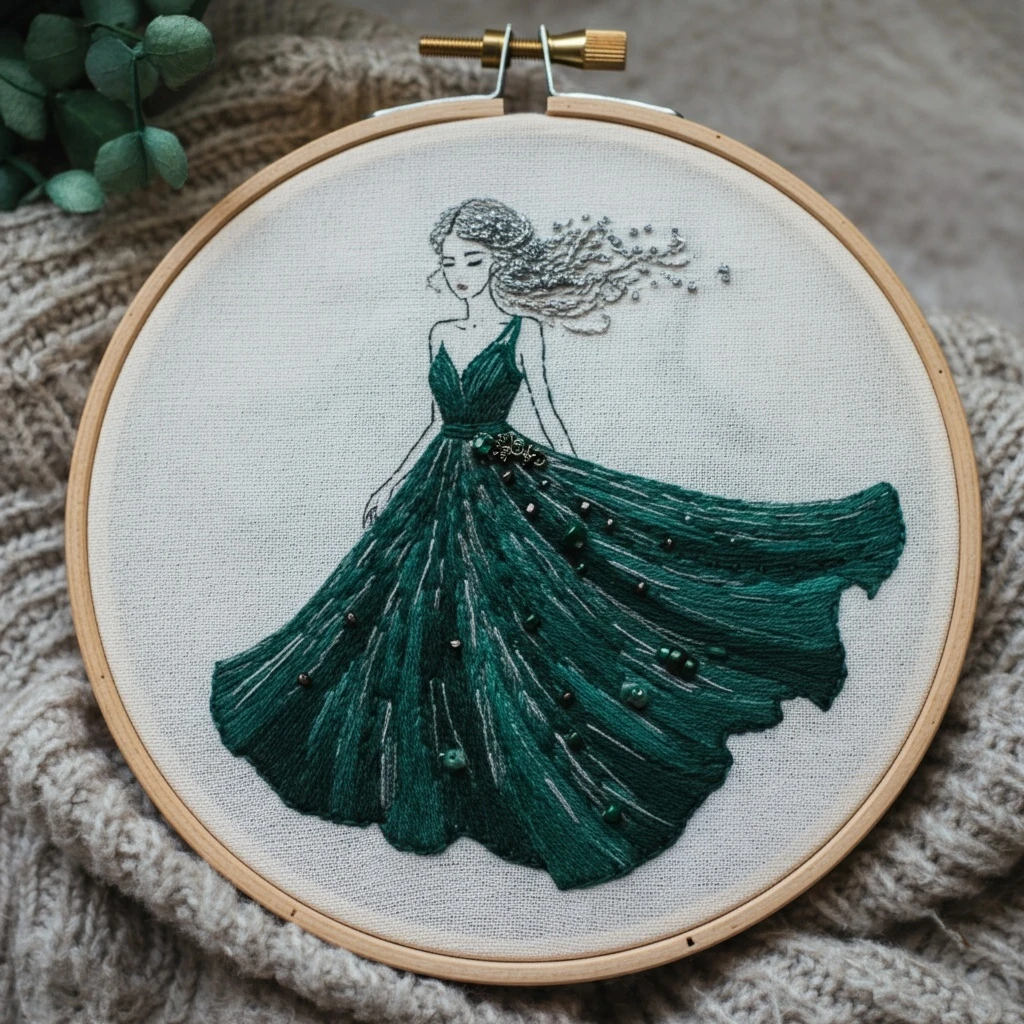
Design read
The composition is driven by the gown: a broad fan of dark teal-green satin-like thread, radiating from the waist into scalloped folds. The upper body stays airy and delicate, while the skirt carries dense stitching, small bead accents, and pale highlight strokes.
For the cleanest finish, map the dress folds first. Stitch from the waist outward so every long stroke follows the natural drape. Keep the face, arms, and hair light, then add beads and sparkle at the very end.
Likely DMC Color Palette
These shades are selected to match the visible preview: deep emerald shadows, blue-green highlights, smoky gray hair, neutral fabric tones, and small bright accents for beads and reflective streaks.
Stitching Suggestions
| Design area | Recommended stitch | Practical notes |
|---|---|---|
| Dress foundation | Long-and-short stitch, satin stitch, directional straight stitch | Work from the waist outward in curved sections. Keep all stitches aligned with the skirt sweep, not straight downward. Use 3–4 strands for dense coverage if the fabric texture shows through too much. |
| Deep skirt folds | Split stitch and long straight stitch | Place 500 and 934 in the darkest fold valleys before adding mid-greens. This gives the gown depth without needing heavy backstitch outlines. |
| Raised highlights | Single-strand straight stitch or couching | Add 3816, 3813, and occasional B5200 after the main skirt is filled. These should look like light catching pleats, so keep them thin and irregular. |
| Bodice | Padded satin stitch with split-stitch border | Outline the V-neck and waistline first with 501 or 500, then fill each bodice panel with short angled satin stitches. Highlight the top edges with 502 or 3816. |
| Scalloped hem | Stem stitch, split stitch, and satin fill | Use 500 for the rim of the lower scallops and 501/502 inside the lobes. Stitch the outline before filling so the hem keeps its wavy silhouette. |
| Hair and wind wisps | Stem stitch, whipped backstitch, seed stitch | Use one strand for hair so it stays airy. Combine 3799 near the head, 413 through most strands, and 318 on the outer wisps. |
| Face, neck, arms | Fine backstitch or split stitch | Use 3799 or one strand of 413 for outlines. Avoid thick stitches on the face; a single over-dark line can change the expression. |
| Bead-like details | French knots, colonial knots, or sewn seed beads | For floss-only beads, use 500, 3816, B5200, and 3799 in varied knot sizes. If adding real beads, sew them last with matching thread and anchor each twice. |
| Waist ornament | French knots, couching, metallic optional | Cluster dark green knots with tiny pale highlights. A very small amount of metallic gold or silver can replace 167/B5200 for a jewelry effect. |
Thread Count, Blending & Shading Guidance
Gown coverage
Use 3 strands for most long skirt fills on medium linen. Use 4 strands only in the darkest lower-left mass, where denser coverage makes the gown look velvety.
Controlled highlights
Highlight strokes should be 1 strand, even over thick fills. This keeps the dress from becoming striped and gives a more hand-painted shimmer.
Emerald blends
For soft transitions, combine one strand 500 + one strand 501 in shadow folds, then one strand 501 + one strand 502 for mid folds. Use 3816 as a top layer, not a full fill.
Hair texture
Stitch the hair after the neckline but before bead details. Let a few gray wisps cross behind the figure; small seed stitches at the ends mimic the scattered knots in the preview.
Pearl and bead placement
Space knots unevenly across the skirt, concentrating them near the waist and along the central sweep. Random spacing looks more natural than a grid.
Open fabric areas
Leave the skin and background mostly unstitched. The negative space makes the emerald fabric feel richer and prevents the figure from looking overworked.
Beginner-Friendly Work Order
Final finishing notes
Block the hoop gently after stitching so the dense skirt does not pull the fabric off grain. If the gown puckers, loosen the hoop, steam from the back without touching beads, and re-tighten evenly. Keep the back threads short around the open arms and face so no dark carries show through the linen.