
Enchanted Forest Fox
A practical color and stitch guide for a woodland fox hoop: russet orange fur, creamy white muzzle and chest, dark paws and facial points, earthy branches, mossy forest greens, and small magical forest accents that keep the design warm, dimensional, and beginner-friendly.
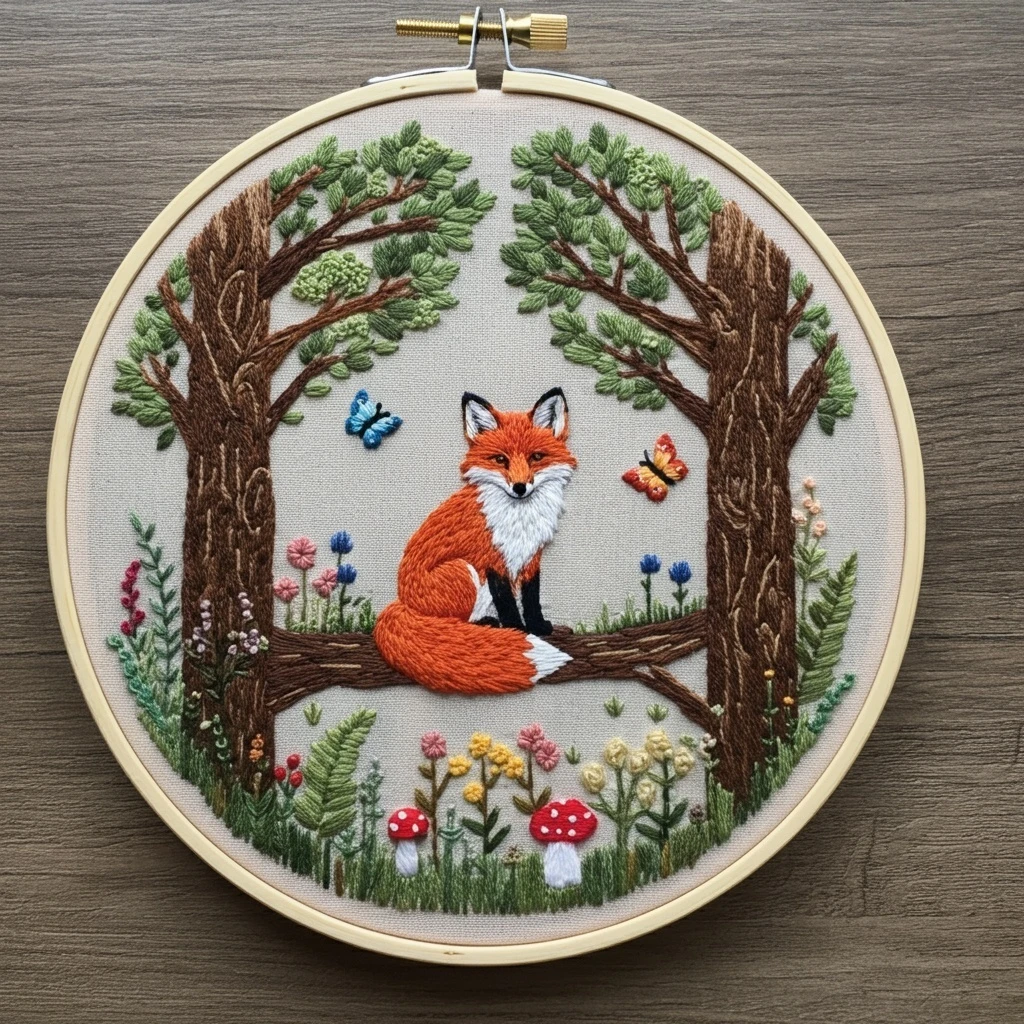
Design read
The design is centered on a fox in an enchanted woodland setting. The strongest visual notes are warm copper, burnt orange, and chestnut fur against quiet greens, browns, and pale cream highlights. The fox needs directional fur texture, while the surrounding forest should stay airy enough to frame the animal rather than compete with it.
For the cleanest finish, build the fox from dark under-shading to bright fur tips. Work the forest details after the fox body is established, then save tiny berries, flower dots, mushrooms, sparkle stitches, and whiskers for the final pass.
Likely DMC Color Palette
These shades are chosen to match an enchanted forest fox: orange-red fur, deeper russet shadows, pale cream markings, dark nose/eyes, bark browns, and soft woodland greens.
Stitching Suggestions
| Design area | Recommended stitch | Practical notes |
|---|---|---|
| Fox body fur | Long-and-short stitch, directional straight stitch | Use 2 strands for most fur. Follow the growth direction: outward from the face, down the chest, and along the curve of the tail. Stagger stitch lengths to avoid stripes. |
| Tail volume | Long-and-short stitch with split-stitch edge | Map the tail curve first with a light split stitch. Shade from 918/920 at the base into 921 and 922 along raised fur ridges. |
| Muzzle and chest | Short satin stitch, long-and-short stitch | Blend 738 into 3865 so pale areas remain soft. Use tiny strokes rather than long satin columns around the muzzle. |
| Eyes, nose, and paws | Fine backstitch, satin stitch, single straight stitch | Use 3371 for most dark details and reserve 310 for the smallest black points. Add one tiny 3865 stitch for an eye glint if the pattern allows. |
| Ears | Split stitch, satin stitch, short fur strokes | Outline with 918 or 3371, then fill with copper shades. Add lighter 922 along the outside rim and tan inside if the ear is visible. |
| Branches and roots | Stem stitch, whipped backstitch, split stitch | Use 801 and 975 for curved wood lines. Whipping a darker backstitch with a lighter brown makes quick bark texture. |
| Leaves and ferns | Fishbone stitch, detached chain, fly stitch | Use 3363 at the base of foliage and 3052/3051 on top. Keep background leaves smaller than the fox’s facial details. |
| Moss and forest floor | French knots, seed stitch, couching | Cluster greens and browns around paws and roots. Vary knot size with one- and two-wrap French knots for natural texture. |
| Magical accents | Seed stitch, French knots, tiny straight stitches | Add small dots in 3865, 738, or 922 for soft glow, berries, or spores. Keep the accents uneven and sparse. |
Thread Count, Blending & Shading Guidance
Fur strand counts
Use 2 strands for most fox fur and 1 strand for the final top hairs, whiskers, facial edges, and fine color corrections. Use 3 strands only for fuller tail sections on loose-weave fabric.
Copper blending
For smooth orange fur, blend one strand 920 + one strand 921 in mid-shadows, then one strand 921 + one strand 922 for lit areas. Add 918 only where the fur truly recedes.
White areas
Pure white can look stark. Lay a few 738 stitches first on the underside of the muzzle, chest, and tail tip, then add 3865 highlights on top.
Forest texture
Keep the foliage looser than the fox. Use detached chain leaves and fly-stitch ferns around the animal so the woodland setting frames the focal point.
Outlining details
Outline the fox with split stitch in 918, 801, or 3371 only on shadowed edges. Avoid heavy black outlines around the entire body; they flatten the fur.
Beginner shortcut
If long-and-short fur feels difficult, divide the fox into small directional sections and fill each with neat straight stitches, changing color at natural fur breaks.
Outlining, Shading & Texture Suggestions
Face focus
- Stitch eyes and nose after the surrounding fur is complete.
- Use one strand for mouth lines and whisker dots.
- Keep the muzzle edge broken with short stitches so it looks furry.
Tail shaping
- Place darker rust in the inside curve and underside.
- Use copper light on the upper sweep.
- Feather the white tail tip into tan before meeting orange fur.
Woodland details
- Use stem stitch for branch curves.
- Add French knots for berries or tiny mushrooms.
- Layer green seed stitches around the paws to ground the fox.
Clean finishing
- Use short thread lengths for copper shades because repeated passes can fuzz.
- Carry dark threads carefully so they do not show behind cream areas.
- Save metallic or sparkle thread, if used, for the final few accents only.
Beginner-Friendly Work Order
Final finishing notes
This design works best when the fox stays crisp and dimensional while the forest remains soft and textural. Press from the back over a folded towel to protect knots and raised stitches. If the tail area becomes dense, loosen and re-tighten the hoop before continuing so the fabric does not pucker around the curved fur.