
Enchanted Forest Night
A moody embroidery guide for a night woodland hoop: deep pine silhouettes, moonlit negative space, glowing warm accents, cool blue shadows, mossy ground texture, and tiny star-like details that make the forest feel quiet, enchanted, and dimensional.
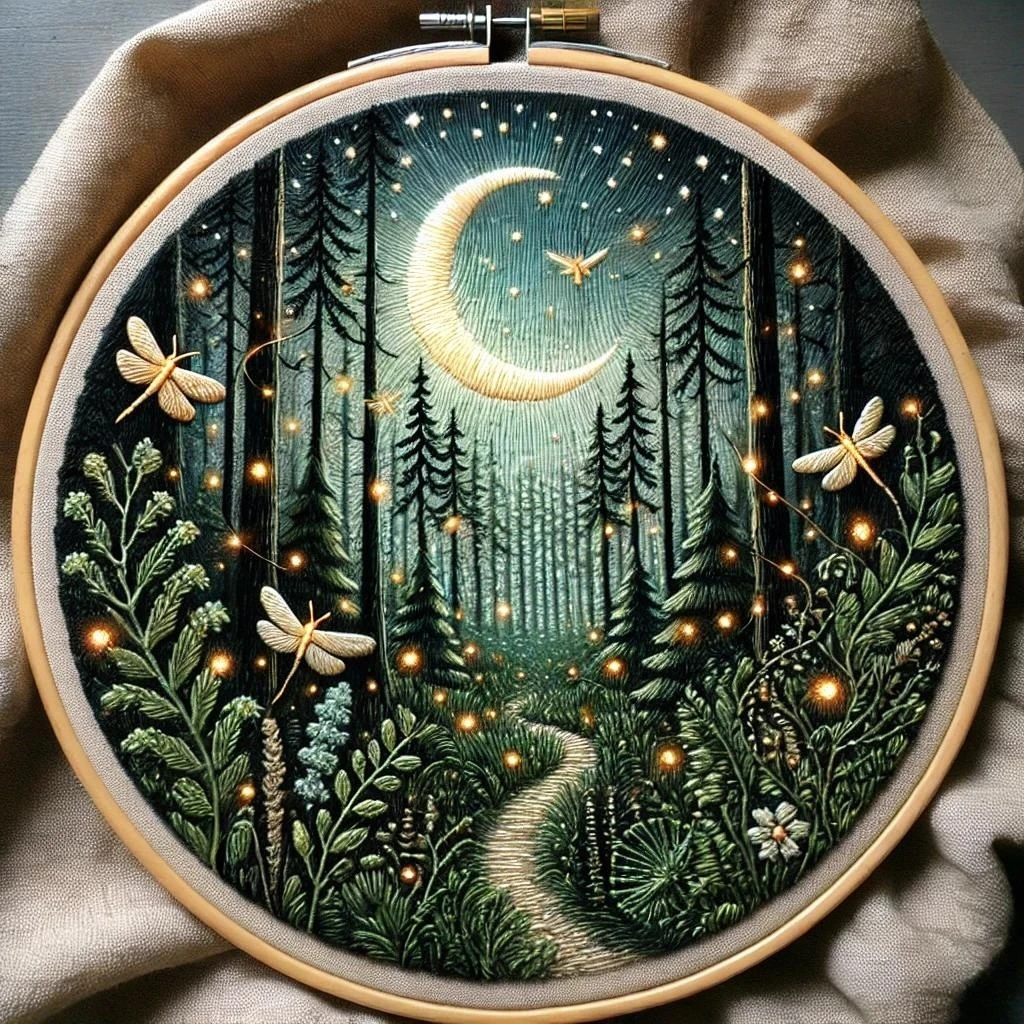
Design read
The night-forest theme calls for strong contrast: very dark trees and background shapes, cooler navy-blue shadow passages, mossy green foliage, and small pale gold or cream highlights that read as moonlight, fireflies, stars, or magical glints.
Keep the dark areas smooth but not flat. Work the forest silhouettes first, then layer the glowing details last so the light sits cleanly on top of the stitching.
Likely DMC Color Palette
These colors are chosen for a moonlit enchanted forest: black-brown tree trunks, blue-black night shadows, pine and moss greens, muted earthy browns, and controlled cream/yellow highlights for luminous accents.
Stitching Suggestions
| Element | Stitch Type | Notes |
|---|---|---|
| Night sky or dark background | Long-and-short stitch, split stitch, seed stitch | Use 939 and 823 as the base, with 310 only in the deepest pockets. Leave tiny breathing spaces if the design relies on linen showing through. |
| Tree trunks and branches | Stem stitch, split stitch, long-and-short stitch | Follow the curve of the trunk. Place 3371 in grooves and 801/838 on raised bark, then add very fine highlight stitches where moonlight hits. |
| Pine silhouettes | Straight stitch, fly stitch, fishbone stitch | Use short angled strokes for needles. Work from branch center outward and vary green values to avoid a flat triangular tree shape. |
| Moonlit foliage and moss | French knots, seed stitch, detached chain, fly stitch | Cluster darker greens first, then add 3052 and 3051 on top for soft illuminated texture. |
| Stars, fireflies, and magical specks | French knots, single straight stitches, tiny cross stitches | Use one strand of 729, 725, or 3865. Scatter unevenly and keep the brightest points small. |
| Moon, path, or pale glow | Satin stitch, split stitch, soft couching | Use 644 underneath and 3865 only for the sharpest bright edge. A broken outline keeps the glow soft. |
| Small mushrooms or flora | Satin stitch, backstitch, French knots | Use browns and muted greens for stems, with 3865 or 725 as tiny cap spots or highlight dots. |
| Final outlines | One-strand backstitch or whipped backstitch | Outline only where shapes disappear into the dark. Too much black outlining can flatten the night effect. |
Thread Count, Blending & Shading Guidance
Night depth
Use 2 strands of 939 and 823 for shadow fills. Add 310 with 1–2 strands only in the deepest crevices so the design stays rich rather than muddy.
Bark blends
Try one strand 3371 plus one strand 801 for shadowed bark, then 801 plus 838 for the mid-brown ridges.
Moonlight control
Keep 3865 minimal. A few bright stitches can look magical; too many will turn the night scene pale and reduce contrast.
Green layering
Start foliage with 3363, fill with 3364, then add 3052/3051 on top as small broken stitches for moonlit texture.
Fine sparkle
Use 1 strand for all stars and fireflies. French knots with one wrap are usually enough; two wraps can become oversized quickly.
Texture balance
Pair smooth long-and-short backgrounds with raised knots in moss and tiny sparkles. The contrast makes the forest feel layered.
Outlining, Shading & Texture Suggestions
Outlining details
- Use 3371 or 939 for tree contours, not always pure black.
- Outline shadow sides first and leave moonlit edges softer.
- Use one strand around tiny mushrooms, stars, and path details.
Shading guidance
- Move from dark sky into trees, then from dark trees into moss.
- Keep the brightest points near the moon, fireflies, or focal clearing.
- Stagger long-and-short stitches to avoid visible color bands.
Texture ideas
- French knots create moss, spores, and fireflies.
- Fly stitch makes quick pine needles and fern shapes.
- Whipped backstitch adds bark ridges without heavy fill.
Beginner-friendly shortcuts
- Use fewer night shades: 939, 823, 3371, 3363, 3052, 3865.
- Fill trees with directional straight stitch instead of complex shading.
- Add sparkles last after stepping back to judge spacing.
Where to Start
Encouraging finish
This night forest will look strongest when contrast is intentional: velvety dark trees, cool blue shadow, and just a handful of bright moonlit stitches. Work slowly with short thread lengths, re-tighten the hoop after dense dark areas, and press from the back over a towel to protect raised moss and sparkle knots.