
DMC palette & hand embroidery notes
Farm Landscape
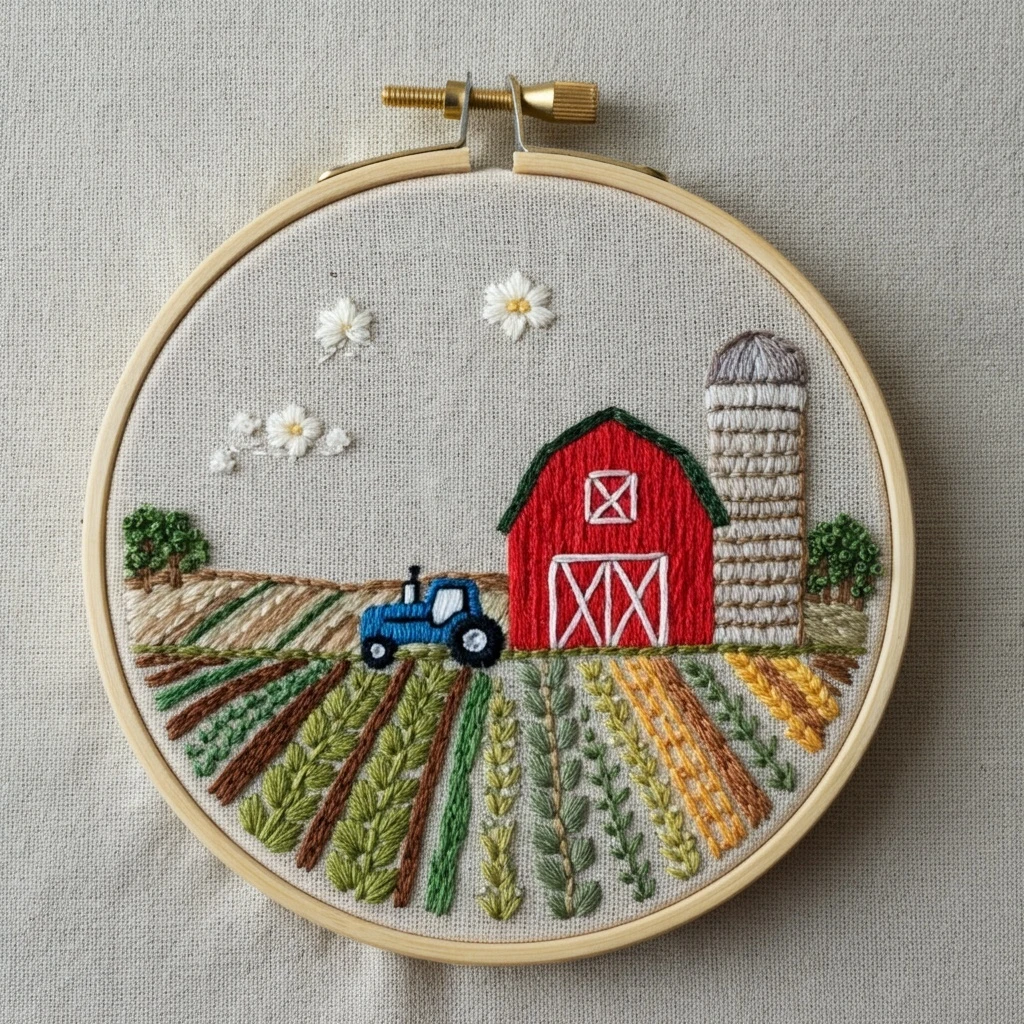
A warm country-hoop scene with a red barn, round silo, blue tractor, wildflowers, tree clusters, and perspective rows of green crops, golden wheat, and brown furrows stitched over natural linen.
Polished DMC Color Palette
The image is built around bright barn red, deep evergreen outlines, weathered gray-beige silo tones, tractor blue, straw gold, olive crop greens, and earthy furrow browns. Use the darker values sparingly for definition so the piece keeps its sunny, open-field feeling.
Main barn siding; stitch vertical satin or long-and-short lines.
Barn side shadows, under roof edge, and door recesses.
Barn trim, flower petals, silo highlights, and crisp small details.
Barn roof outline, tree shadows, and strongest crop accents.
Tree foliage, dark stems, and green field rows.
Olive crop leaves and shaded wheat-green blades.
Mid-tone crop rows and soft transition leaves.
Golden field rows, flower centers, and sunlit hay strokes.
Deeper wheat lines, harvest-row shadows, and warm accents.
Furrow ridges, tree trunks, barn base, and rustic grounding.
Deepest soil lines, tiny wheel shadows, and contrast points.
Tractor body; combine with navy shadows and pale highlights.
Tractor wheels, chassis, and crisp mechanical outlines.
Silo body, pale roof shading, and weathered metal softness.
Silo rib shadows, tire shading, and small metal details.
Daisy centers, bright straw touches, and small sunny highlights.
Design Elements & Stitch Strategy
| Area | Suggested stitches | Thread count and notes |
|---|---|---|
| Red barn | Vertical satin stitch or tightly spaced long-and-short stitch; backstitch for roofline and door boards. | Use 3 strands for filled red siding, 2 strands for dark red shadows, and 1–2 strands of white for clean trim. Keep strokes vertical to echo painted planks. |
| Barn roof | Split stitch along the outer edge, then short angled satin stitches inside the roof shape. | Use 2 strands DMC 890; add a few 1-strand DMC 909 highlights only where the roof catches light. |
| Silo | Whipped backstitch or couching for horizontal bands; stem stitch for the rounded cap. | Use 2 strands DMC 3024 for body ribs, 1 strand DMC 414 for thin shadows, and touch with 3865 on the left/top edges. |
| Tractor | Satin stitch for blue panels, backstitch for body outline, French knots or padded satin for wheels. | Use 2 strands DMC 995; outline with 1 strand 823. Add tiny 3865 highlights in windows and wheel centers. |
| Perspective fields | Straight stitch, fly stitch, detached chain, seed stitch, and couching for varied crop rows. | Use 2 strands for most rows. Switch between greens, wheat, and browns every row to maintain the fan-shaped perspective. |
| Trees and shrubs | French knots, colonial knots, seed stitch, and small detached chains. | Use 2 strands for knots, mixing 890, 909, and 3011. Scatter a few 725 or 783 knots if you want fruit or sunlit tips. |
| Daisies and clouds of blossoms | Lazy daisy petals, tiny straight stitches, and French knot centers. | Use 1–2 strands 3865 for petals and 1 strand 725 or 3821 for centers so the flowers stay delicate. |
Blending & Shading Ideas
Barn body: blend one strand DMC 321 with one strand DMC 816 for the darker right side and lower edge; use pure 321 in the center panels for the brightest red.
Fields: blend DMC 3011 + 3012 for natural olive rows, 3821 + 783 for wheat rows, and 801 + 938 for the deepest soil ridges.
Silo: alternate 3024 and 3865 on the raised bands, then place 414 only below bands or along the right edge to create roundness.
Tractor: use 995 as the bright body, a touch of 823 at the lower wheels and underside, and a single 3865 stitch in the window for shine.
Outlining Details
Use a single strand when outlining small shapes so the piece does not become heavy. Backstitch the barn door X braces in 3865, then add tiny red stitches beside them to prevent the white trim from looking too thick.
For crop rows, outline only every second or third row. Leaving some rows without hard outlines makes the field feel airy and avoids a striped, cartoon-like finish.
Where the field meets the horizon, use broken backstitch in 801 and 3011 rather than one continuous line; this keeps the distant ground soft.
Step-by-Step Stitching Order
- Start with the horizon. Add the distant soil line, tree trunks, and light field marks first so foreground stitches can overlap naturally.
- Fill the barn and silo before the fields. These are the focal structures; completing them early helps balance the brightness of the reds and grays.
- Work field rows from back to front. Begin with shorter, lighter stitches near the barn and lengthen the rows toward the bottom of the hoop for perspective.
- Add texture last. Place knots on the trees, extra wheat stitches, wheel details, and flower centers after the main fills are secure.
- Finish with selective outlines. Use 1 strand for roof, windows, tractor, and barn trim. Avoid outlining every leaf or furrow.