
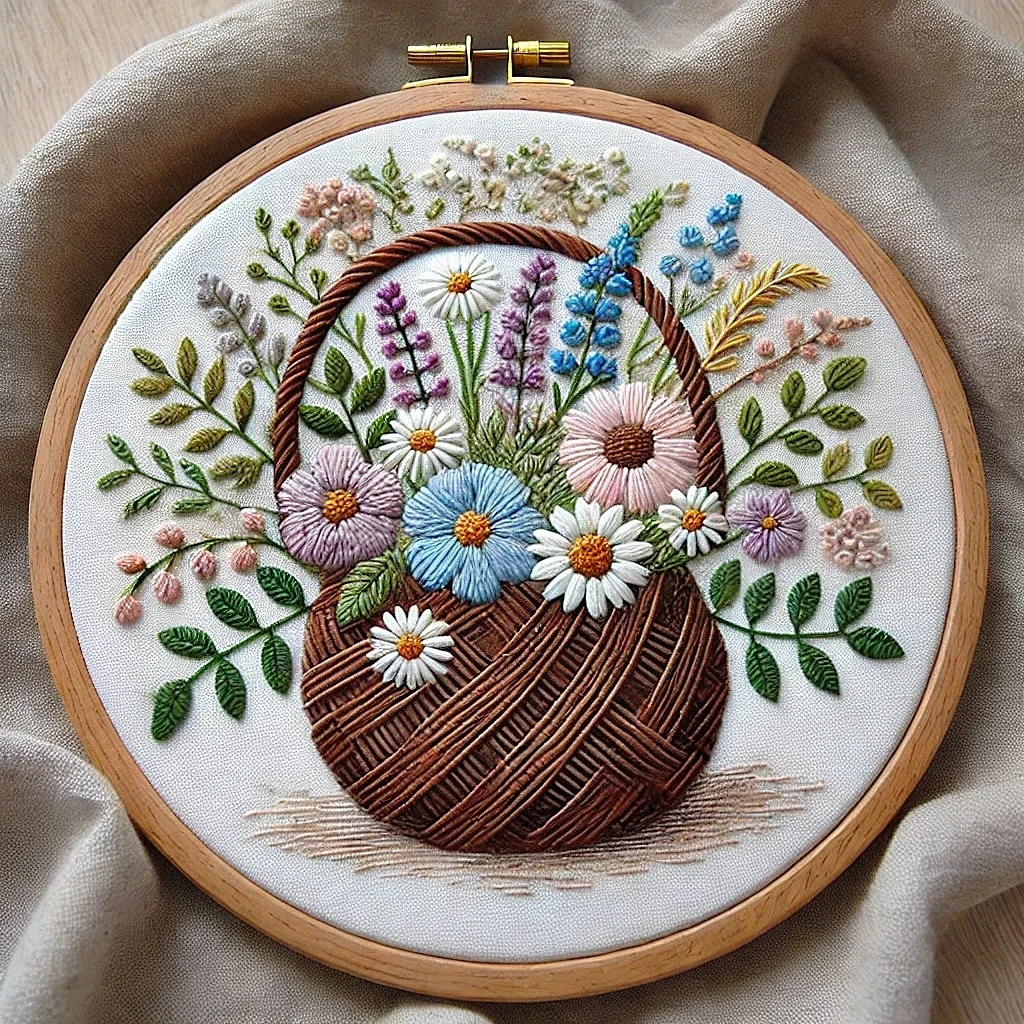
Design #528 · Raised Basket Florals
Floral Basket 3D
A polished DMC palette and stitching guide for the dimensional basket hoop design with a rich woven-brown basket, twisted handle, raised daisies, blue and pink feature flowers, lavender sprigs, airy white clusters, olive foliage, and a soft stitched ground shadow.
Preview
Colors are estimated from the visible hoop preview and matched to close DMC six-strand cotton shades. Exact results may vary with screen color, fabric tone, lighting, strand count, and how much padding is used for raised areas.
Color Story
The design is built around contrast: a deeply textured coffee-brown basket anchors a loose garden bouquet, while pale daisies, a powder-blue central bloom, soft blush-pink flowers, lavender sprigs, turquoise-blue buds, and mixed greens create height and movement above the rim. The visible 3D effect comes from thick basket ribs, padded petals, clustered knots, and directional stitching that makes the handle and basket feel woven.
Likely DMC Color Palette
Use this as a practical working palette rather than an exact thread-usage chart. Percentages are visual estimates from the preview.
DMC 3371 · Black Brown
Use in one strand for crisp groove lines and two strands for the darkest underside of the basket. It gives the woven base its strong carved depth.
DMC 898 · Coffee Brown Very Dark
Use as the primary basket color. Couch or stem-stitch thick diagonal ribs, then add 3371 in the valleys to exaggerate the 3D basket weave.
DMC 801 · Coffee Brown Dark
Layer along the upper side of basket strips and the raised edge of the handle. This shade keeps the basket from becoming flat or overly black.
DMC 433 · Brown Medium
Use sparingly on the top of woven bands, especially where the basket curves forward. A few stitches create a polished, light-catching wicker effect.
DMC B5200 · Snow White
Use for the cleanest daisy tips and raised white blossoms. Keep strand tension even so satin petals stay smooth against the linen background.
DMC 3865 · Winter White
Blend with B5200 in daisy bases and use for the off-white sprays near the top of the bouquet. This prevents white flowers from looking stark.
DMC 742 · Tangerine Light
Work tight French knots or colonial knots in the daisy centers. Mix a few darker brown knots into large centers for realistic texture.
DMC 743 · Yellow Medium
Add final knots on top of 742 centers and use for the smallest golden dots. It brightens the flower centers without overpowering the pastel palette.
DMC 3755 · Baby Blue
Use for the main fill of the blue bloom. Long-and-short stitches radiating from the center give the large flower its soft ribbed texture.
DMC 3846 · Bright Turquoise Light
Add brighter strokes to blue buds on the right and upper bouquet. It also works as a highlight strand mixed with 3755 on the large blue flower.
DMC 3843 · Electric Blue
Place at the base or lower edge of blue buds and in a few central flower grooves. Use lightly so the blue stays airy rather than neon.
DMC 818 · Baby Pink
Use for the large pink flower petals and small blush blossoms. Work from the center outward with two strands, keeping petal lines delicate.
DMC 223 · Shell Pink Light
Add near petal bases, around folded edges, and in the small pink bud clusters at the left and right sides of the bouquet.
DMC 554 · Violet Light
Use lazy daisy stitches or small satin petals up the vertical purple stems. Pair with a darker violet for the shaded side of each floret.
DMC 552 · Violet Medium
Place at the base of purple florets and in a few center lines on the lilac side flower. This gives the lavender stems structure.
DMC 895 · Hunter Green Very Dark
Use for the darkest leaves around the basket rim and lower bouquet. Fishbone stitch makes each leaf look dimensional and veined.
DMC 987 · Forest Green Dark
This is the main green for stems and mid-tone leaves. Use stem stitch for stalks and satin or fishbone stitch for medium leaves.
DMC 469 · Avocado Green
Add vein highlights, upper-leaf strokes, and light fronds. It softens the dark greens and matches the olive sprigs visible in the hoop.
DMC 832 · Golden Olive
Use for the golden feathered sprig on the right side and a few warm leaf tips. Straight stitches angled from a central stem work especially well.
DMC 642 · Beige Gray Dark
Use one strand in loose horizontal straight stitches beneath the basket. Keep the shadow uneven and open so it suggests texture without becoming a filled block.
Stitching Suggestions
| Design element | Recommended stitches | Practical notes |
|---|---|---|
| Woven basket body | Couched satin lines, stem stitch, split stitch, laid work | Build the basket in diagonal bands. Lay 898 or 801 as the raised ribs, couch with matching thread, then add 3371 in the gaps. Alternate diagonal directions to create the wicker pattern. |
| Basket rim and handle | Rope stitch, stem stitch, whipped backstitch, couching | Use thicker lines for the 3D handle: two to three strands of 898, whipped with 801 or 433. Keep the twist direction consistent from one side of the arch to the other. |
| White daisies | Long-and-short stitch, satin stitch, detached chain petals | Work petals from the center outward using B5200 with 3865 at the base. Leave tiny gaps between petals so each daisy remains crisp. |
| Daisy centers | French knots, colonial knots, seed stitch | Pack 742 knots tightly, then add a few 743 highlights and 898/3371 specks for depth. Raise the centers slightly higher than the petals. |
| Large blue flower | Long-and-short stitch, satin stitch, split-stitch spokes | Use 3755 as the main fill, 3846 for light ridges, and a few 3843 stitches near the center. Stitch each petal segment in a radial direction. |
| Large pink bloom | Long-and-short stitch, padded satin stitch, split stitch | Use 818 for the soft petal fill and 223 at the base. A light split-stitch outline helps the pale petals stay visible on cream fabric. |
| Lavender stems | Lazy daisy, detached chain, French knots, stem stitch | Stitch green stems first, then add purple florets upward in small alternating clusters. Use 552 at the lower side of each floret and 554 on top. |
| Blue bud clusters | French knots, tiny satin petals, detached chain | Cluster knots and petal stitches in uneven groups rather than perfect rows. Add 3843 shadows at lower buds and 3846 highlights on upper buds. |
| Foliage and leafy stems | Fishbone stitch, satin stitch, fly stitch, stem stitch | Use 987 for stems, 895 for dark leaves, and 469 for veins. Change stitch direction leaf by leaf to avoid a flat green mass. |
| White filler sprays | French knots, colonial knots, straight stitch stems | Use one strand for fine stems and two strands for knots. Keep clusters loose so they read as airy filler flowers above the basket. |
| Ground shadow | Loose straight stitch, running stitch, seed stitch | Use one strand of 642 or a nearby beige. Vary stitch length and spacing; the shadow should sit behind the basket, not compete with the wicker texture. |
Thread-count guidance
- 3 strands: basket ribs, handle twist, padded flower centers, chunky knot clusters.
- 2 strands: main flower petals, most leaves, blue buds, lavender florets.
- 1 strand: fine stems, basket shadow lines, white filler sprays, leaf veins, final outline accents.
Blending ideas
- Use one strand 898 plus one strand 801 for mid-tone basket ribs with natural variation.
- Blend B5200 and 3865 on daisy petals for soft cream shading without grayness.
- Combine 3755 and 3846 for the blue flower highlights; reserve 3843 for the deepest petal grooves.
- Blend 895 and 987 in large leaves, then add one-strand 469 veins on top.
Outlining details
- Outline the basket with 3371 only in shadowed areas; use 898 or 801 on highlight edges for a softer wicker look.
- Use split stitch around the large blue and pink blooms before filling so pale petal edges stay tidy.
- Avoid outlining every small filler flower. Knots and detached-chain petals look more natural when some edges remain open.
Texture suggestions
- Pad the basket rim with a base row of stem stitch before whipping or couching the final rope layer.
- Use raised knots for flower centers and flatter satin stitches for petals to create clear texture contrast.
- Keep the white sprays airy, the basket dense, and the leaves directional; this balance is what makes the design feel three-dimensional.
Beginner-Friendly Stitch Order
- Prepare the fabric: press the cotton-linen, hoop it firmly, and mark the basket base, handle arch, largest flowers, and main stem directions.
- Map the basket: stitch the outer basket shape and rim first. Add diagonal guide lines lightly so the wicker bands remain even.
- Build the basket weave: work the darkest grooves, then layer warm brown ribs on top. Add highlights only after the main weave is complete.
- Stitch the handle: use rope stitch, whipped backstitch, or couched strands for the twisted arch. Keep it raised enough to visually sit in front of the bouquet.
- Add main stems: use one or two strands of 987 for the structural stems that rise from the basket and guide the bouquet shape.
- Fill the large blooms: complete the blue flower, pink bloom, and daisies before the tiny filler flowers so the focal points stay clean.
- Work leaves and fronds: add dark leaves, olive highlights, and the golden side sprig. Use stitch direction to show which leaves face left, right, or forward.
- Finish with raised details: add daisy centers, blue buds, white filler knots, pink buds, lavender florets, and the soft beige ground shadow last.
Helpful Notes
- For a stronger 3D basket, use a slightly thicker needle and do not pull couched ribs too tight; raised wicker needs gentle loft.
- If the brown basket becomes too heavy, add a few 433 highlight stitches along the upper curve and rim to bring it forward.
- Keep flower centers compact. Large messy knots can hide the delicate petal direction, especially on the daisies.
- Stitch pale flowers with clean hands and short working lengths so B5200 and 3865 stay bright.
- When the bouquet looks crowded, pause before adding more knots. Empty space between stems helps the floral arrangement breathe.
Encouraging Finish
This piece rewards layering: the basket should feel dense and woven, the flowers should feel softly raised, and the stems should remain light enough to show movement. Work from structure to embellishment, checking the hoop from a distance often so the finished basket feels full, balanced, and dimensional.