
DMC palette & stitching notes
Floral Crescent Moon
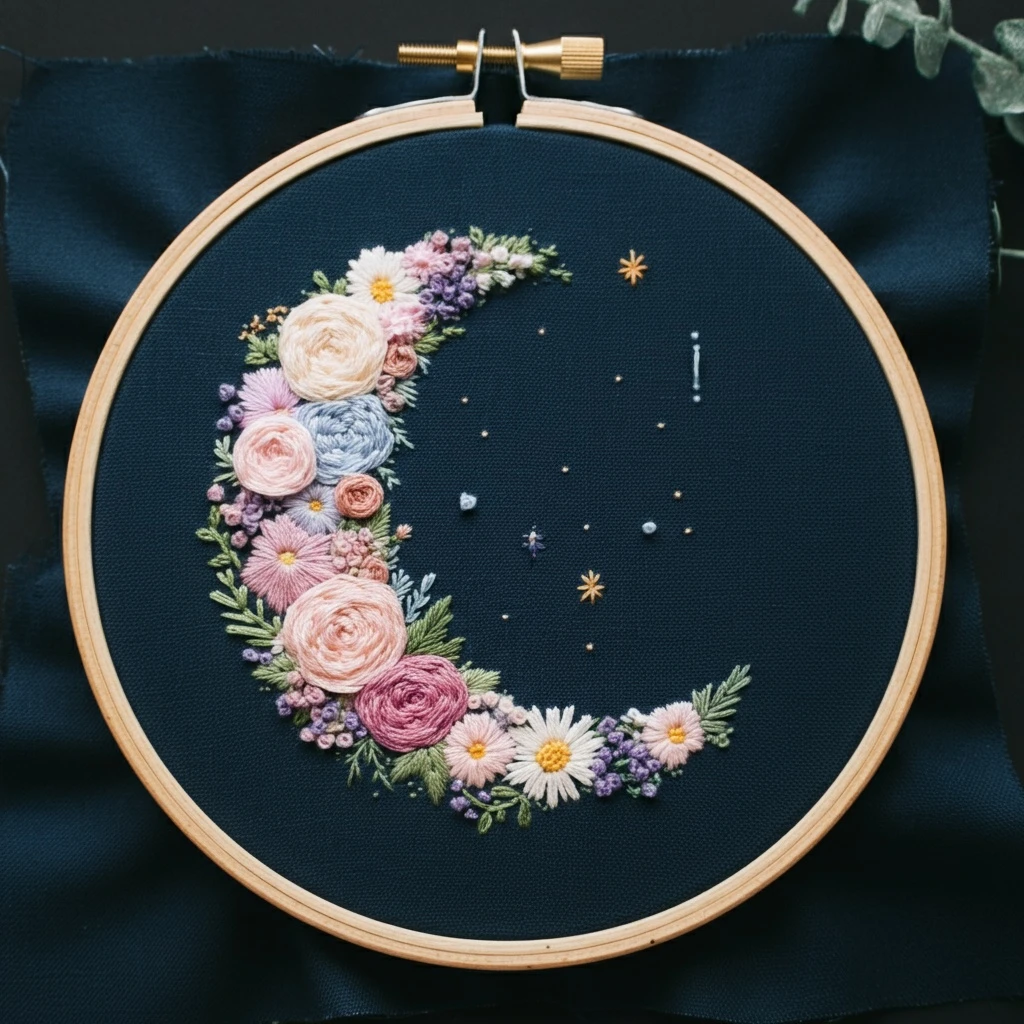
A polished embroidery planning page for the dark-hoop crescent design: a soft floral moon built from dimensional roses, daisies, lavender clusters, ferny greenery, golden stars, and tiny celestial dots on deep midnight fabric.
Palette at a glance
The reference image reads as a high-contrast moon garden: dark navy ground, warm ivory and peach roses, pink daisies, dusty mauve shadows, blue-gray bloom accents, lavender clusters, sage fern leaves, and small ochre-gold celestial details.
Stitch map
Use dimensional stitches for the larger blooms and flatter stitches for stems and stars, so the floral crescent has a raised garden edge while the sky stays delicate.
| Design area | Recommended stitches | Thread count | Practical notes |
|---|---|---|---|
| Large cream and blush roses | Woven wheel, cast-on rose, or loose spiral back stitch | 3-4 strands for wheels; 2 strands for inner spiral outlines | Start with a darker center, then shift to 712 or 761 on the outer wraps. Do not pull too tight; the raised texture is part of the design. |
| Pink daisies and pale star flowers | Lazy daisy, fishbone petal, satin stitch center | 2 strands for petals, 3 strands for centers | Keep petal lengths uneven and angled toward the crescent curve. Add B5200 only on the brightest petals. |
| Lavender and mauve berry clusters | French knots, colonial knots, tiny detached chain | 2 strands with 1-2 wraps for small knots; 3 strands for foreground berries | Alternate 3837, 554, and 316 so clusters look natural instead of dotted in one flat color. |
| Blue-gray rosette | Woven wheel or padded satin spiral | 3 strands, with 2 strands for final highlight lines | Use 932 as the main blue and add a touch of cream or white on the upper-left petal edges. |
| Ferny greenery | Fishbone leaf, fly stitch, straight stitch, stem stitch | 1-2 strands for fine leaves; 2-3 strands for main stems | Place darker 3363 behind flowers, then add 3052 on outer leaf tips to keep the crescent airy. |
| Stars and celestial dots | Straight stitch starburst, French knots, tiny seed stitches | 1 strand for tiny dots; 2 strands for large gold stars | Use 729 first, then place a small 783 center on the larger stars. Space dots irregularly for a hand-scattered sky. |
| Delicate moon edge and filler gaps | Seed stitch, small straight stitch, detached chain | 1 strand for filler; 2 strands for visible petal tips | Fill gaps only where the crescent silhouette breaks. Leave small navy pockets to prevent visual heaviness. |
Layering plan
A simple order of work helps the crescent stay clean, especially on dark fabric where stray fibers and overworked stitches show quickly.
Transfer the crescent lightly
Mark only the main flower centers, crescent edges, and star positions. Avoid heavy transfer lines beneath pale petals because they can show through cream floss.
Stitch stems and greenery first
Use 1-2 strands for fine fern lines. Let some leaves tuck under future roses to create depth without crowding the outer moon curve.
Add large roses and blue bloom
Build the cream, blush, dusty rose, and blue rosettes next. For woven wheels, graduate from darker centers to lighter outer wraps.
Fill with daisies, knots, and buds
Use lazy daisy petals and French knots to bridge the empty spaces. Vary knot size so lavender clusters resemble small blossoms rather than beads.
Finish with sky details
Stitch gold stars after the floral crescent is complete so their spacing feels balanced against the finished moon shape.
Clean and frame carefully
Remove lint from dark cloth with low-tack tape, steam from the back if needed, then tension the fabric evenly in the hoop.
Blending and shading ideas
- Roses: blend one strand 3354 with one strand 761 for mid-petal turns; switch to 712 or B5200 only on outer highlight wraps.
- Lavender clusters: mix 3837 and 554 knots in the same cluster, placing darker knots at the base and lighter knots on the outer edge.
- Greenery: pair 3363 and 3052 in alternating leaf stitches so the foliage reads as layered sage, not a single green outline.
- Gold stars: use 729 for most rays and a single 783 stitch through the center to add warmth without making the stars orange.
Outlining details
- Use one strand of 712 around the lightest cream roses only where petals need separation; do not outline every petal.
- Use one strand of 316 for subtle shadow arcs inside dusty rose blooms.
- Keep navy negative spaces between flower groups visible to preserve the crescent silhouette.
- For very tiny celestial dots, make a single-wrap French knot or one seed stitch rather than a bulky knot.
Texture suggestions
Combine raised woven wheels, soft lazy daisies, and tiny knot clusters. This contrast makes the design feel lush without requiring every element to be complicated.
Beginner-friendly tips
Practice one woven wheel and one French knot cluster on scrap fabric first. Dark fabric can hide small spacing mistakes, but pale floss will show uneven tension.
Thread management
Use shorter floss lengths, about 14-16 inches, for pale colors on dark cloth. This keeps cream and blush threads from looking fuzzy or gray by the end of a strand.