
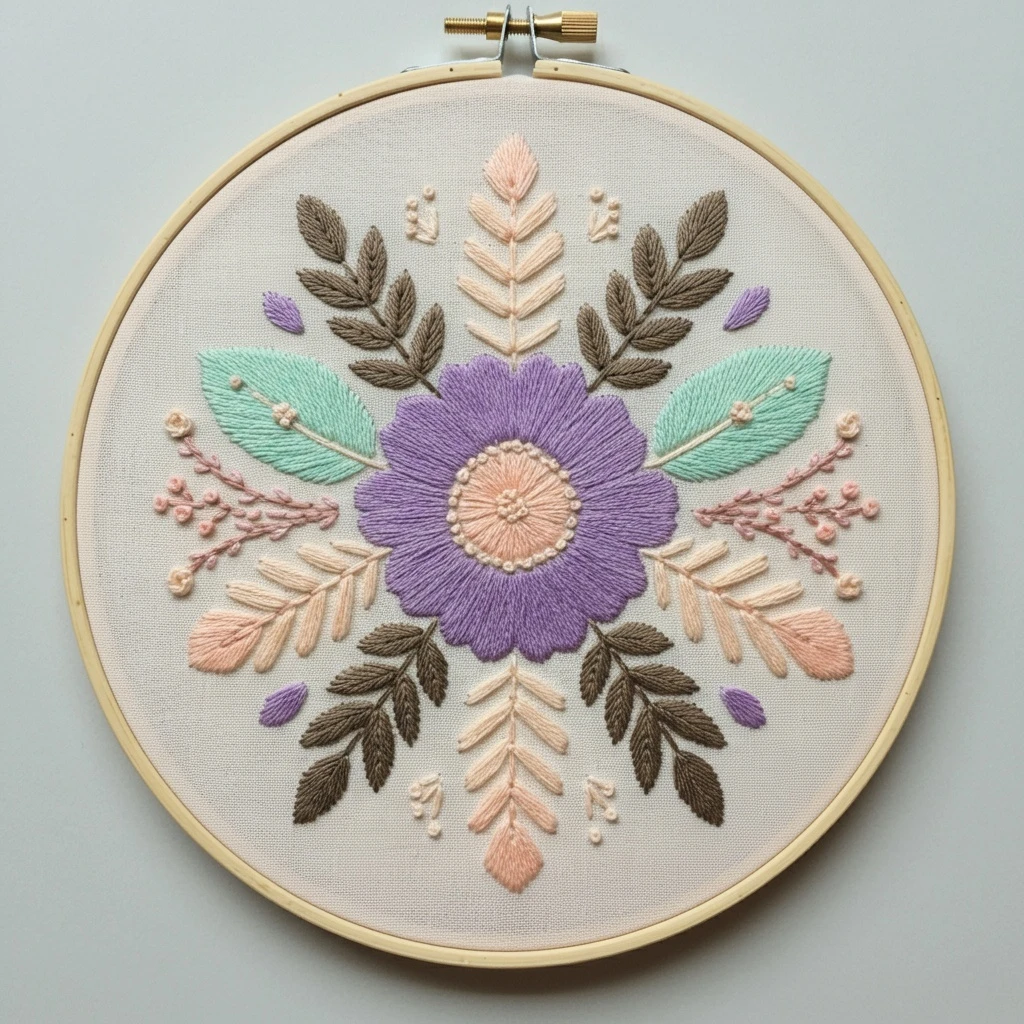
Design #441 · Florals & Botanical Foliage
Floral Foliage
A polished DMC palette and stitching guide for the symmetrical hoop design with a lavender statement flower, peach botanical sprigs, mint leaves, taupe fern foliage, dusty pink branches, and raised knot accents.
Preview
Colors are estimated from the visible hoop preview and matched to close DMC six-strand cotton shades. Exact results may vary with screen color, fabric tone, lighting, and strand count.
Color Story
The design is built around a large lavender-purple flower, a warm peach center, cream French-knot detailing, aqua-mint side leaves, taupe-brown fern sprays, and blush-pink twig florals. Keep the palette soft and slightly muted so the center flower remains the focal point.
Likely DMC Color Palette
Use this as a practical working palette rather than an exact thread-usage chart. Percentages are visual estimates from the preview.
DMC 209 · Lavender Dark
Use for the large central flower. Work satin or long-and-short stitches from the flower center outward, keeping stitch direction radial for a smooth petal fan.
DMC 210 · Lavender Medium
Blend into petal tips or alternate with 209 on outer scallops. Also useful for the tiny purple leaf-shaped accents around the hoop.
DMC 754 · Peach Light
Use in the central disk and peach teardrop leaves at top and bottom. It gives the design warmth without overpowering the lavender flower.
DMC 758 · Terra Cotta Very Light
Add a few darker stitches near the base of peach leaves and inside the central disk to prevent the pale tones from looking flat.
DMC 3865 · Winter White
Use for the ring of raised knots around the flower center, tiny pale buds, and bright tips on cream sprays. Keep knots even and compact.
DMC 738 · Tan Very Light
A good alternative to pure white for botanical stems, leaf veins, and pale peach sprigs. It feels softer against natural fabric.
DMC 964 · Sea Green Light
Use for the two large mint leaves. Satin or fishbone stitch gives the smooth, ribbed look shown in the reference.
DMC 3813 · Blue Green Light
Add along one side of each mint leaf or near the vein to create depth while keeping the leaves fresh and luminous.
DMC 3021 · Brown Gray Very Dark
Use for the darker fern leaves around the flower. This shade provides the earthy contrast that frames the central bloom.
DMC 3032 · Mocha Brown Medium
Blend with 3021 on the upper fern leaves or use for softer leaf tips. It keeps the brown foliage dimensional, not heavy.
DMC 224 · Shell Pink Very Light
Use for the slender side branches and small bud clusters. Pair with one-strand backstitch stems so these details stay delicate.
DMC 225 · Shell Pink Ultra Very Light
Add on top of pink knots, tiny flowers, and pale petals to catch light. Best used sparingly for a clean, airy finish.
Stitching Suggestions
| Design element | Recommended stitches | Practical notes |
|---|---|---|
| Large lavender flower | Long-and-short stitch, satin stitch, split-stitch outline | Outline each scalloped petal first with one strand of DMC 209, then fill with two strands. Angle stitches from the center outward so the bloom reads as one full flower rather than separate blocks. |
| Peach flower center | Satin stitch, seed stitch, French knots | Fill the disk with radiating peach satin stitches. Add small seed stitches in 758 for depth, then place cream knots around the rim after the purple petals are complete. |
| Mint side leaves | Fishbone stitch or split satin stitch | Use two strands of 964 for the main leaf body. Add a center vein in 3813 or 738, then stitch each half diagonally toward the vein for a neat botanical texture. |
| Taupe fern leaves | Fishbone stitch, leaf stitch, stem stitch | Work stems first in one strand of 3021. Fill leaflets with short angled stitches, mixing 3021 and 3032 so the foliage frames the flower without becoming too flat. |
| Peach feather sprigs | Straight stitch, fly stitch, detached chain | Keep these airy. Use 754 for the main strokes and a few 738 highlights along the central ribs. Do not overfill; the negative space is part of the design. |
| Dusty pink twig florals | Backstitch, stem stitch, French knots | Stitch the curved branches with one strand of 224, then add tiny knots in 225 and 754. Place knots irregularly so the branch looks natural. |
| Small purple buds | Lazy daisy stitch, satin stitch | Use DMC 210 for a softer contrast against the large 209 flower. A single detached chain with one straight stitch inside makes quick beginner-friendly buds. |
| Cream accent buds | French knots, colonial knots, tiny straight stitches | Use one or two wraps only. These accents should sit raised and pearl-like, especially near the top and bottom of the composition. |
Thread-count guidance
- 2 strands: central flower, mint leaves, peach leaves, larger fern leaflets.
- 1 strand: outlines, fine stems, branch work, delicate veins, tiny buds.
- 3 strands: optional only for raised French knots or a fuller center ring.
Blending and shading
- Blend one strand of 209 with one strand of 210 for softer lavender petal edges.
- Use 754 plus 758 near the flower center for a warm peach shadow.
- Alternate 3021 and 3032 on fern leaves to create a natural taupe gradient.
Outlining details
- Use split stitch around the main flower before filling; it creates a smooth edge under satin stitches.
- Use one-strand backstitch for branch lines so the side florals stay graceful.
- Use a slightly darker outline only where shapes need separation, not around every pale leaf.
Texture suggestions
- Save French knots for the end so they remain raised and clean.
- Use varied knot sizes on pink branches for a more organic bud cluster.
- Let the mint leaves stay smooth; contrast them with textured fern and knot details.
Beginner-Friendly Stitch Order
- Prepare the hoop: press the fabric, keep it drum-tight, and mark the main center line so the mirrored foliage stays balanced.
- Stitch the central flower outline: use one-strand split stitch around the scalloped edge, then fill petals with two strands.
- Add the center disk: work peach satin stitches from the middle outward. Do not add the cream knot ring until the surrounding petals are finished.
- Build the large leaves: stitch the mint leaves and taupe fern sprays next because they define the design’s symmetry.
- Fill the peach sprigs: use straight stitches and fly stitches with light tension so the pale foliage looks feathery.
- Add branches and buds: stitch pink stems with one strand, then add knots and tiny lazy-daisy buds.
- Finish with raised accents: add cream knots around the flower center and at the outer decorative clusters; trim tails carefully on the back.
Helpful Notes
- Use a sharp embroidery needle for clean pierces through the dense satin-filled flower.
- Keep satin stitches short where possible; very long stitches can snag and loosen over time.
- For tidy symmetry, complete the same element on the left and right before moving to a new color.
- If the purple flower looks too dark, add a few top stitches in DMC 210 near petal tips rather than replacing the whole fill.
- For a softer vintage look, substitute DMC 3865 with DMC 712 on knots and pale highlights.
Encouraging Finish
This design works best when the textures are intentionally contrasted: smooth lavender petals, a warm raised flower center, soft mint leaves, earthy taupe fern foliage, and tiny pink-and-cream knot details. Build it slowly from the center outward, check balance often, and let the pale botanical accents breathe against the fabric.