
DMC palette & stitching suggestions
Floral Heart Wreath
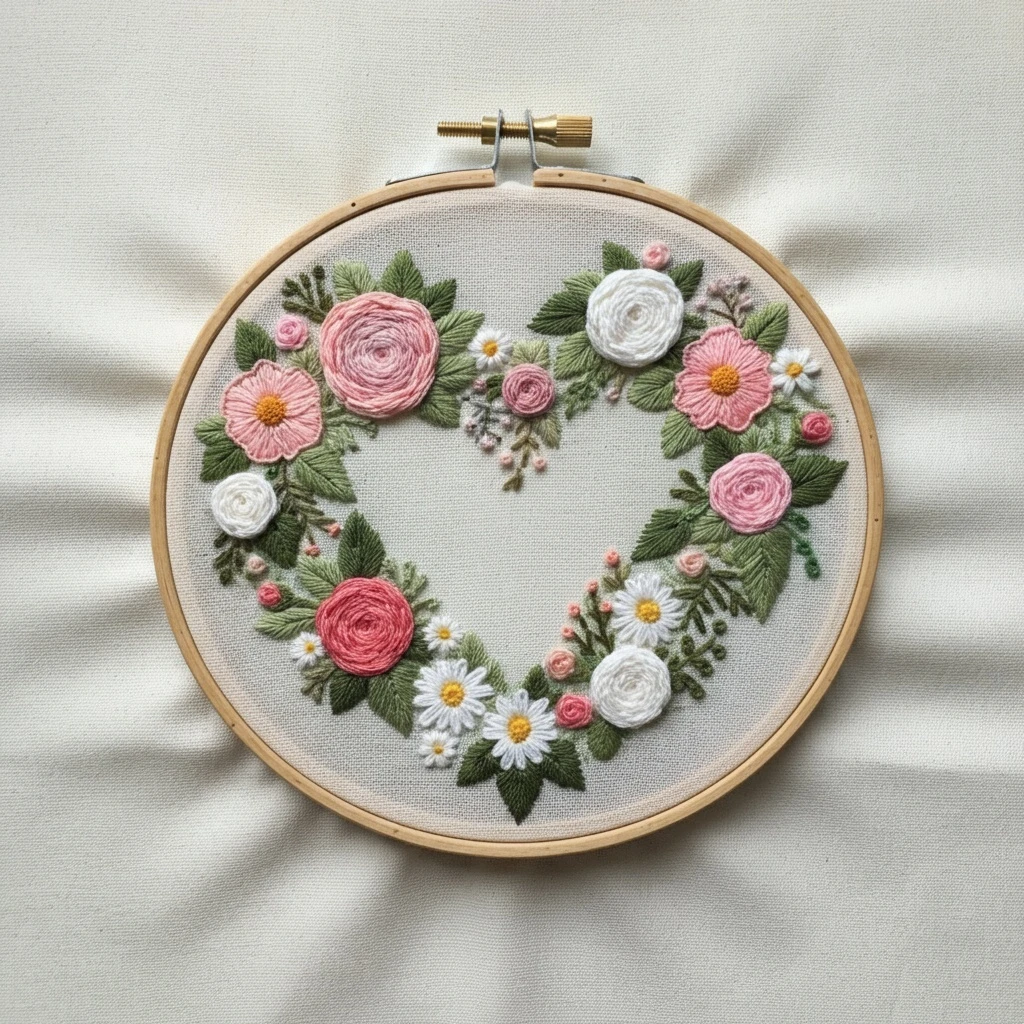
A romantic hoop-art heart built from layered roses, daisy blooms, pink blossoms, fern sprigs, and deep green leaves on natural linen. The palette below keeps the wreath soft and garden-like while preserving enough contrast for petals, veins, and tiny berries to read clearly.
Polished DMC Color Palette
Use the darker shades sparingly for depth, the mid-tones for most stitches, and the palest shades for petal highlights. Two or three strands are enough for most areas; reserve all six strands only for plush rose centers or raised texture.
Pale highlights on the large blush flower petals and tiny buds.
Main soft pink for open blossoms and satin-stitched petal fills.
Rose shadows, curled petal edges, and the deeper lower-left bloom.
Rich pink bud tips and accent rings in woven roses.
Bright daisy petals and crisp highlights on white rosettes.
Creamy body shade for white roses so highlights do not look flat.
Daisy centers, tiny pollen knots, and light on golden flower disks.
Shadow dots in flower centers and warm contrast beside pale petals.
Soft background leaves and lighter fern tips.
Main leaf fill for medium foliage around the wreath.
Leaf veins, shaded sides, and darker stems under flowers.
Deepest fern shadows and tiny anchor stitches near the heart outline.
Needle-like fern sprigs and pointed leaves with firm contrast.
Blend into 3011 for a natural mottled leaf surface.
Fine twig stems, branch shadows, and occasional seed-stalk detail.
Optional hoop-toned warmth or very subtle linen-colored accents.
Design Element Breakdown
Flowers and focal roses
- Large pink rosettes: work from the center outward with woven wheel stitch, alternating 3713, 761, and touches of 3350 for realistic petal rings.
- Open pink daisies: use long-and-short stitch or satin stitch in 3713, then add 761 along petal tips and 3350 near the base.
- White roses: use 3865 as the body shade, add B5200 on raised ridges, and tuck a few 3021 shadow stitches under overlapping curls.
- Daisies: stitch clean white lazy-daisy petals and cluster French knots in 744 and 3852 for textured yellow centers.
Leaves, ferns, and heart shape
- Large leaves: fill with fishbone stitch using 3011; add 3363 on one side of each leaf to make the wreath feel dimensional.
- Fern sprigs: use single-strand straight stitches in 3345 and 934, keeping each frond short and slightly varied.
- Small buds and berries: make compact French knots or colonial knots in 223, 761, and 3350, then anchor with a tiny 3021 stem.
- Heart silhouette: keep the center open. Let leaf tips and flower edges imply the heart instead of outlining it heavily.
Stitch & Thread Guide
| Area | Recommended stitches | Strands | Practical notes |
|---|---|---|---|
| Woven roses | Woven wheel, whipped backstitch, couching | 3–6 | Use 5 foundation spokes. Keep wraps loose so the rose sits raised; blend by switching color every few rounds. |
| Open petals | Long-and-short stitch, satin stitch, split stitch outline | 2–3 | Outline first with one strand, then fill from petal edge toward center. Vary stitch length so shading looks soft. |
| White daisies | Lazy daisy, straight stitch, French knots | 2 for petals, 2–3 for centers | Keep each petal separated by a sliver of linen to preserve the crisp daisy shape. |
| Leaves | Fishbone stitch, satin stitch, fly stitch | 2–3 | Angle stitches toward the center vein. Add one darker side with 3363 or 934 for shadow. |
| Ferns | Stem stitch, straight stitch, detached chain | 1–2 | Use one strand for the smallest fronds so they stay delicate and do not overpower the flowers. |
| Buds & berries | French knots, colonial knots, tiny satin ovals | 2–3 | Wrap knots twice for small buds and three times for larger pink berry clusters. |
| Stems | Stem stitch, backstitch, split backstitch | 1–2 | Use 3021 mixed with 3363 for woody, muted stems that disappear gracefully under blooms. |
Suggested Stitching Order
Blending, Shading & Texture Tips
Soft floral blending
- For blush petals, thread the needle with one strand 3713 + one strand 761 for a gentle transition.
- For deep rose accents, use one strand 3350 + one strand 223 on the inner curl or underside of petals.
- For white roses, avoid pure white everywhere. Let 3865 cover most of the rose, then add B5200 only on top ridges.
Natural greenery
- Blend 3011 + 3012 for soft sage leaves and 3363 + 934 for shaded leaf bases.
- Make fern stitches slightly uneven in length; the organic irregularity matches the wreath’s hand-made look.
- Use 934 only in small touches. Too much deep green can close the airy heart shape.
Beginner-Friendly Practical Tips
- Fabric: natural linen, cotton-linen, or tightly woven cotton in oatmeal, ivory, or warm beige complements the soft garden palette.
- Needles: use an embroidery needle size 7–9 for 1–3 strands and a chenille needle for chunky woven roses.
- Tension: keep satin stitches smooth but not tight. Raised roses need room to puff; pulling too hard flattens the spiral.
- Thread length: cut floss around 14–16 inches. Shorter lengths reduce fuzzing, especially with pale pinks and whites.
- Outlining: outline only where clarity is needed: petal separation, dark leaf veins, and small buds. Avoid outlining every flower because the design should remain soft.
- Final finishing: steam from the back with the hoop face-down on a towel to protect raised knots and woven roses.
Tip: Photograph the hoop before trimming the back. A quick photo makes it easier to spot any empty patches along the heart curve and balance them with a few extra leaves or knots.