
DMC palette & hand embroidery notes
Floral Monogram P
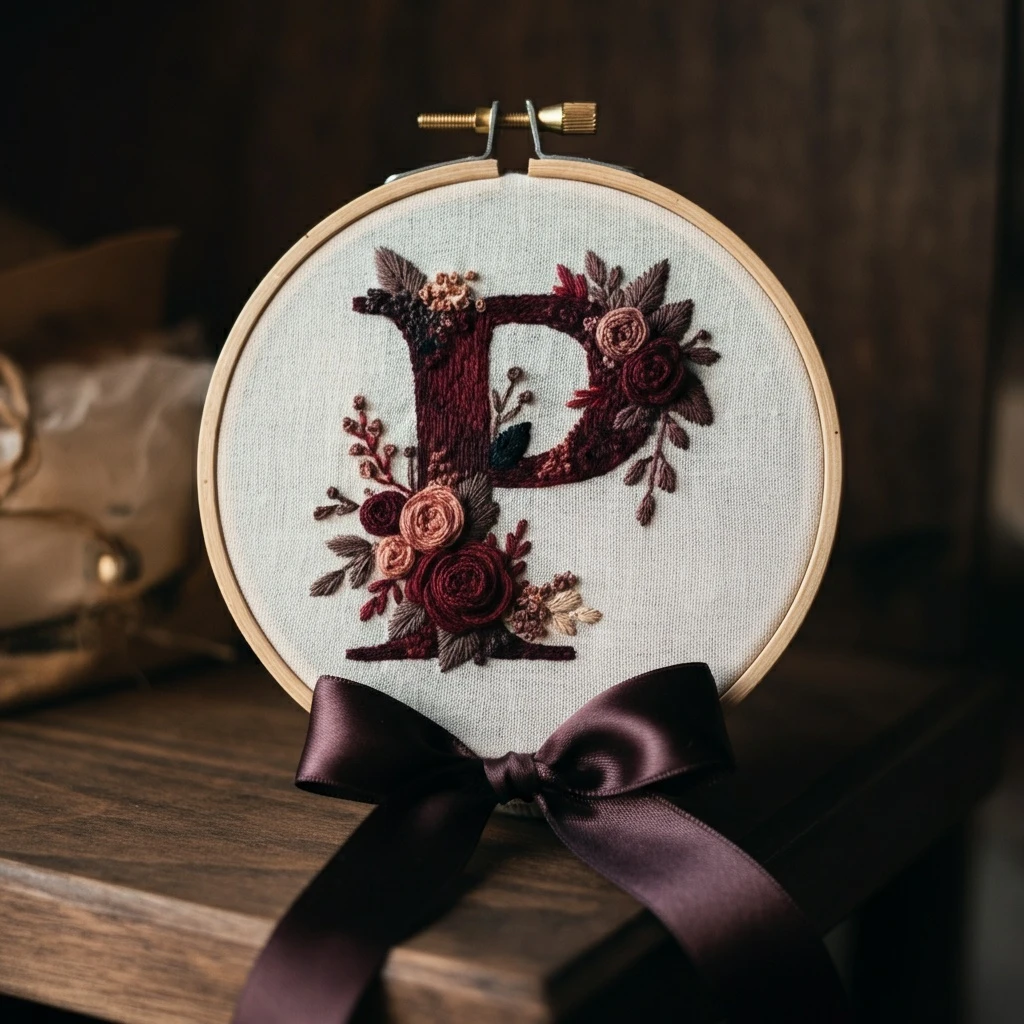
A romantic monogram design with a bold wine-red letter P, dimensional roses, dusty blush blossoms, burgundy berries, and smoky taupe foliage. The palette is moody and heirloom-inspired, so the stitching plan emphasizes velvet depth, soft rose shading, and crisp letter definition.
Design read
The reference artwork shows the letter P centered in a round hoop on pale neutral linen. The monogram itself is dark burgundy with subtle vertical texture, while floral clusters sit at the upper right, lower center, and left side. Large rosette blooms use wine and dusty rose tones; small buds and seed clusters add warm peach-pink highlights; leaves are muted brown, gray-taupe, and deep green-black.
Suggested DMC color palette
These DMC floss choices are selected to match the visible palette: blackberry burgundy for the letter, deep plum for rose shadows, warm dusty pinks for rosettes, muted browns for leaves, and small ivory-peach accents for buds and highlight knots.
Main letter P fill, deepest rose folds, and strong shadow lines.
Monogram mid-tone, lower rose petals, and softened letter texture.
Wine-red rose centers, berry accents, and dark flower outlines.
Muted mauve petals, rose shadows, and transition stitches in blush blooms.
Dusty rose rosettes, soft outer petals, and flower highlights.
Pale petal edges, tiny highlight stitches, and peachy seed clusters.
Warm peach buds, small berry bases, and antique rose undertones.
Lightest bud knots, pale flower centers, and soft glints on rosettes.
Deep leaf shadows, stems tucked under flowers, and anchoring details.
Smoky brown leaves, muted branch stems, and neutral petal shading.
Taupe foliage, long feathered leaves, and soft vintage outlines.
Occasional cool leaf shadows and the single dark teal leaf accent.
Stitch plan by area
| Area | Recommended stitches | Strands |
|---|---|---|
| Letter P body | Long-and-short stitch or split stitch fill following the vertical grain of the letter. Use darker floss at the edges and underside. | 3–4 for fill; 1–2 for edge texture |
| Letter outline | Split back stitch around the full monogram before filling; finish with a neat whipped back stitch if the edge needs polish. | 1–2 |
| Large rosettes | Woven wheel roses, whipped wheels, or bullion roses. Keep the central wraps tight and outer wraps looser. | 2–3 |
| Small buds and berry clusters | French knots, colonial knots, and seed stitch in peach, blush, and burgundy. | 2 |
| Leaves | Fishbone stitch, satin stitch leaves, or paired straight stitches for narrow pointed foliage. | 1–2 |
| Fine stems and sprays | Stem stitch for curves; back stitch for thin branching twigs. | 1 |
Thread-count guidance
The design looks best when the monogram feels rich but the floral sprays remain delicate. Use strand count to separate the heavy letter from the airy botanical details.
- 1 strand: fine outlines, leaf veins, small twig stems, and subtle shadow lines inside the letter.
- 2 strands: most leaves, small petals, French knots, berry clusters, and floral outlines.
- 3 strands: woven roses, bullion roses, and bold flower petals that need dimension.
- 4 strands: only for the broad downstroke of the P if you want a dense, velvet-like fill.
Blending, outlining & shading notes
Velvet letter depth
Use DMC 814 along the left edge, bottom serif, and inner counter of the P. Blend into DMC 815 through the middle, then add a few DMC 902 stitches where the flowers cast shadows.
Dusty rose petals
For pale roses, begin with DMC 3726 in the center or lower folds, wrap with DMC 224, and add tiny DMC 225 highlights only on the outermost petal ridges.
Muted foliage
Use DMC 3860 and 3787 for most brown-gray leaves, then tuck DMC 3031 at bases and DMC 500 in the coolest shadowed leaf for contrast.
Texture suggestions
- Letter texture: work vertical long-and-short stitches rather than flat horizontal satin. The subtle grain makes the P look embroidered rather than printed.
- Rose dimension: woven wheels give soft spirals similar to the reference blooms; bullion knots create a more sculpted heirloom rose.
- Berry clusters: vary French knot size by wrapping once for tiny dots and twice for larger buds.
- Leaves: angle each fishbone stitch toward the leaf tip and leave a faint center ridge for a pressed botanical look.
Beginner-friendly tips
- Transfer the letter outline with extra care. A clean monogram shape makes the whole piece look polished.
- Use short thread lengths, about 12 inches, for dark burgundy floss because it shows fuzz and twist quickly.
- Stitch roses on top of the filled letter only after the letter is complete; otherwise the fill stitches can catch on raised petals.
- When using woven wheels, make an odd number of spokes so the over-under wrapping alternates correctly.
- Step back before adding the final buds. The design should feel full around the floral clusters but still reveal the P clearly.
Practical working sequence
| Step | What to stitch | Why it helps |
|---|---|---|
| 1 | Transfer the full letter P, floral cluster boundaries, and main stems. | Locks in the monogram proportions before raised details are added. |
| 2 | Split-stitch the letter outline in dark garnet. | Creates a clean border that controls the fill stitches. |
| 3 | Fill the P with long-and-short stitches, blending 814, 815, and 902. | Builds the rich wine base and keeps the letter readable under the flowers. |
| 4 | Add the largest roses at the lower center and upper right. | Places the main floral weight where it appears in the reference artwork. |
| 5 | Finish with taupe leaves, burgundy buds, peach knots, and small trailing stems. | Adds romantic texture while preserving the crisp monogram silhouette. |