
DMC palette & embroidery guide
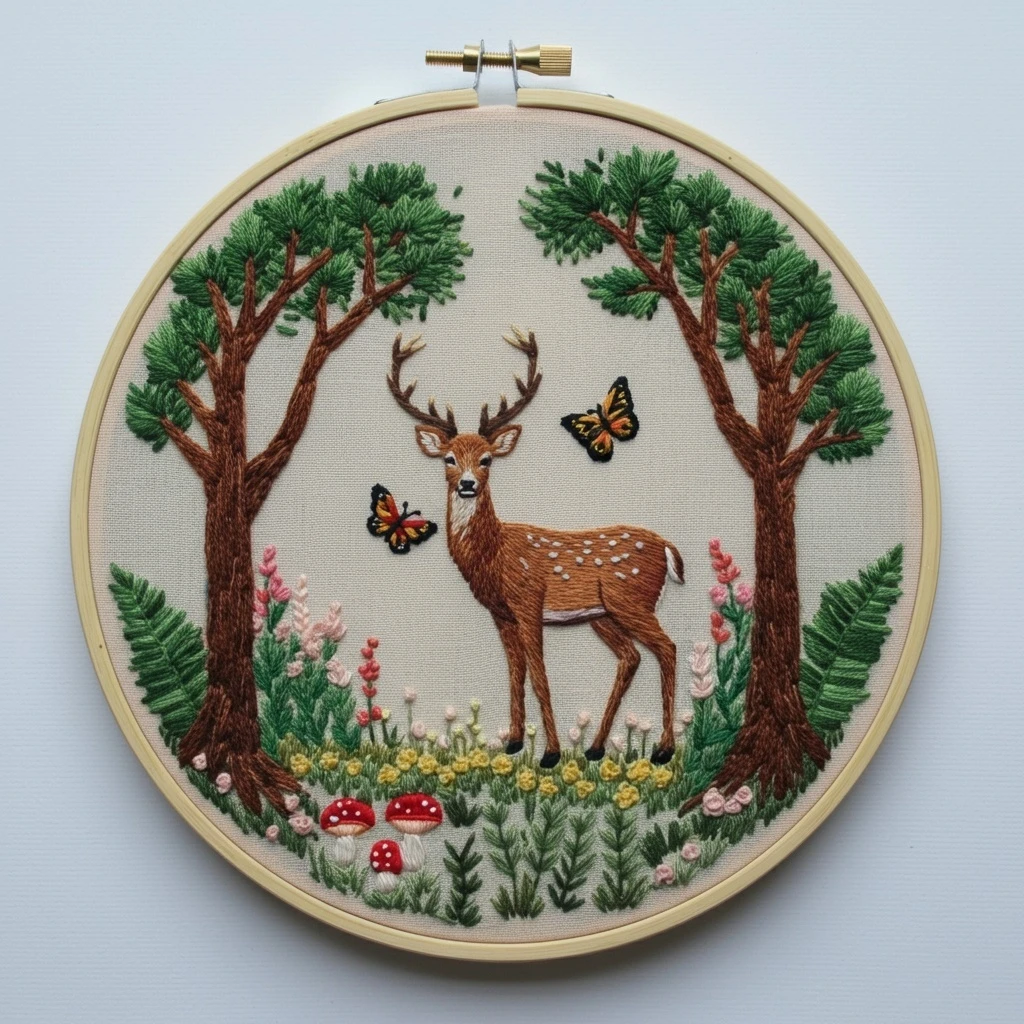
Forest Stag Butterflies
A warm woodland hoop with a russet stag, deep pine trees, soft meadow flowers, red-capped mushrooms, and golden-orange butterflies. The palette leans earthy and natural: bark browns, shaded greens, creamy highlights, berry reds, and small sunny accents.
- Use layered long-and-short stitch for the stag coat and tree bark.
- Build foliage with loose directional satin stitch, fishbone leaves, and scattered straight stitches.
- Keep butterflies crisp with dark outlining and bright orange/yellow fill.
Polished DMC color palette
Choose a warm linen or oatmeal ground so the cream spots, pale flowers, and mushroom stems remain visible. The colors below are organized for practical stitching rather than exact pixel matching: each shade has a clear job in the design.
Thread-count guidance
For a 6-inch hoop, work most filled areas with 2 strands. Switch to 1 strand for the stag face, antler tips, butterfly veins, white spots, and final outline corrections. Use 3 strands only where you want raised texture: mushroom caps, flower knots, and thicker foreground grasses.
Best fabric choice
A neutral beige linen, cotton-linen blend, or tightly woven calico gives the design a forest-floor warmth. Avoid pure white fabric unless you deepen the light tan and flower colors; the reference relies on a soft natural background.
Stitch plan by design element
Blending, shading, and outline notes
| Area | Recommended blend | How to use it |
|---|---|---|
| Stag body | 1 strand DMC 433 + 1 strand DMC 434 | Use as a middle transition between dark belly shading and warm shoulder highlights. |
| Dark bark | 1 strand DMC 938 + 1 strand DMC 898 | Place in the deepest grooves at trunk bases and branch forks for strong depth. |
| Pine tips | 1 strand DMC 3346 + 1 strand DMC 3013 | Add sparingly along the outer edges of the tree canopies to keep them airy. |
| Butterfly glow | 1 strand DMC 741 + 1 strand DMC 742 | Blend in the larger orange wing areas; use 726 as tiny highlight strokes only. |
| Soft flowers | 1 strand DMC 3688 + 1 strand DMC 224 | Useful for flower spikes that need a gentle rosy gradient without too much contrast. |
For outlining, avoid heavy black around the whole stag. Use DMC 898 or 938 around the deer body, reserving DMC 310 for eyes, nose, hooves, and butterfly edges. The softer brown outline makes the animal sit naturally in the forest scene.
Beginner-friendly practical tips
Order of stitching
Begin with the tree trunks and large pine masses, then stitch the stag, foreground plants, mushrooms, and butterflies. Save French knots, white spots, eye glints, and tiny outlines for the very end so they stay clean.
Managing dense areas
Do not fully pack every pine branch. Leave small linen gaps between needles; this prevents the canopy from becoming a solid green block and keeps the handmade texture visible.
Texture suggestions
Use irregular stitch lengths in the bark and fur, consistent satin stitch on mushroom caps, and raised knots for flowers. These contrast changes make the woodland scene feel layered without requiring advanced stitches.
Finishing
After stitching, steam lightly from the back over a towel. Do not press French knots or butterfly wings flat. Trim carry threads behind the pale fabric areas so dark greens and browns do not shadow through.