
DMC Palette & Stitch Guide
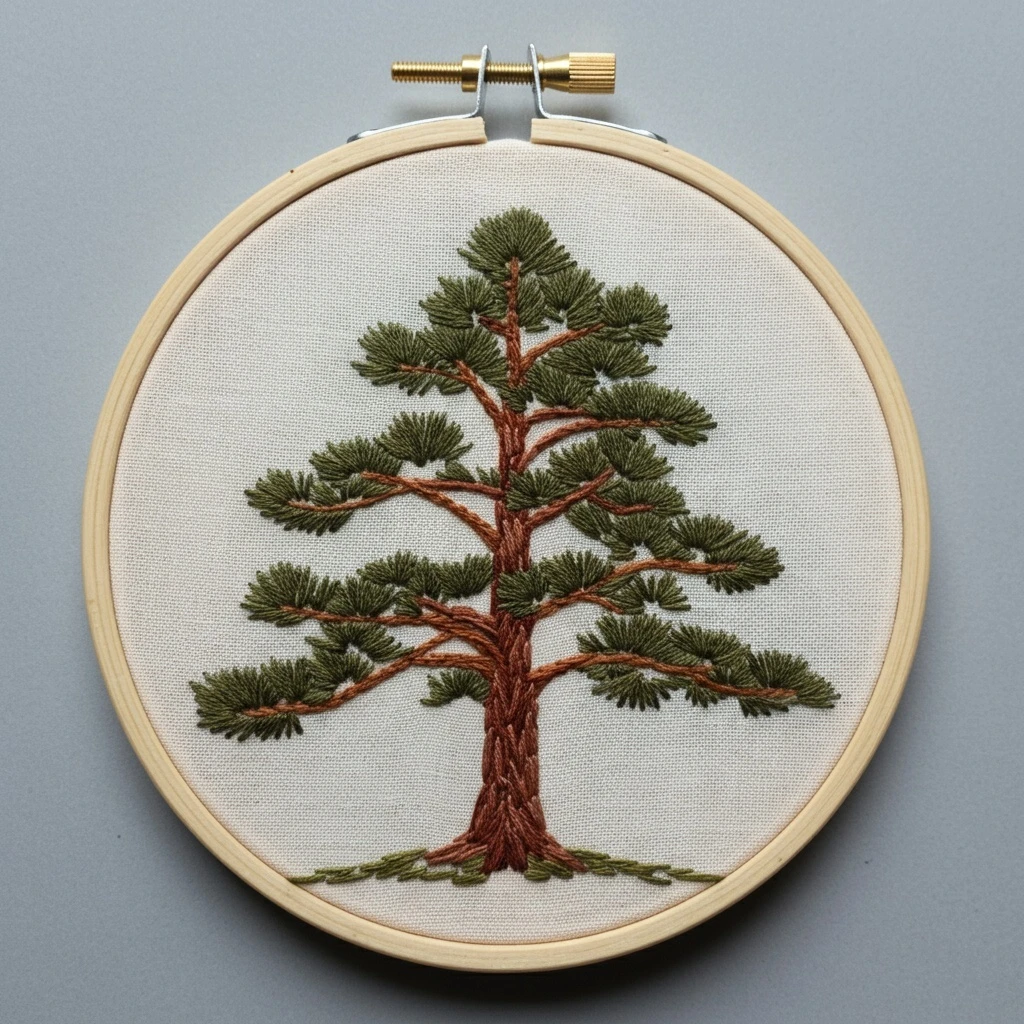
Giant Redwood Pine Tree Hoop Art
A calm woodland study built from deep evergreen needle clusters, reddish-brown bark, exposed branch structure, and a simple mossy ground line. The palette below is estimated from the visible hoop preview and chosen to keep the tree dimensional while remaining approachable for hand embroidery.
Likely DMC Color Palette
Use the darker greens for the shaded underside of pine tufts, warmer coppers for the reddish trunk, and pale neutrals only as tiny highlights. Coverage percentages are visual estimates, not exact thread usage.
30%
DMC 3362 Pine Green Dark
Main evergreen mass, lower shaded needle strokes, and dense inner areas of each pine fan.
18%
DMC 3363 Pine Green Medium
Mid-tone needle layers, branch-top foliage, and feathering between dark and light greens.
9%
DMC 522 Fern Green
Soft outer tips on needle clusters and a few grassy stitches along the base line.
5%
DMC 3012 Khaki Green Medium
Subtle highlights on forward-facing pine needles and moss, used sparingly to avoid a flat look.
15%
DMC 919 Red Copper
Primary redwood bark color for the trunk, major branch arms, and exposed roots.
9%
DMC 898 Coffee Brown Very Dark
Deep bark grooves, shadow side of the trunk, branch undersides, and root separations.
7%
DMC 921 Copper
Warm bark highlights placed in thin vertical streaks to suggest ridged redwood texture.
3%
DMC 3826 Golden Brown
Tiny sunlit bark accents at branch bends and raised root tips; keep this color delicate.
2%
DMC 613 Drab Brown Very Light
Optional fine sparkle on needles or pale knots where branches meet the trunk.
2%
DMC 3865 Winter White
Only for very small glints, fabric corrections, or softening bright gaps near foliage centers.
Stitching Suggestions
The strongest effect comes from stitching the tree as separate textures: fibrous vertical bark, radiating pine needles, thin woody branches, and a quiet ground line.
| Element | Stitch Type | Practical Notes |
|---|---|---|
| Main trunk | Long and short stitch, split stitch | Work vertically with uneven stitch lengths. Alternate 919, 898, and 921 so the bark looks ridged rather than striped. |
| Deep bark grooves | Backstitch or stem stitch | Add the darkest brown after the fill is complete, following the natural twist of the trunk and roots. |
| Exposed branches | Stem stitch, whipped backstitch | Use 2 strands for the larger branches and 1 strand for narrow tips that disappear into foliage. |
| Pine needle clusters | Straight stitch, radiating satin stitch | Stitch outward from the branch line like small fans. Keep the needle stitches slightly uneven for a natural tree silhouette. |
| Foliage shading | Layered straight stitches | Place 3362 first in the densest centers, then 3363 over it, and finish with a few 522 or 3012 tips along the outer edge. |
| Roots and base | Split stitch, couching, detached chain | Let the roots spread into the moss line. Small detached chain stitches in green give the ground texture without making it busy. |
| Fine outlines | One-strand backstitch | Outline only select edges: branch undersides, trunk shadow, and a few foliage silhouettes. Avoid outlining every needle fan. |
Thread Count, Blending & Texture
Thread-count guide
- Use 2 strands for most trunk and branch work.
- Use 1 strand for bark grooves, branch tips, and crisp outlines.
- Use 2 strands for needle clusters, dropping to 1 strand for wispy outer tips.
Blending ideas
- Blend one strand of 919 with one strand of 898 for shaded bark transitions.
- Blend 3362 + 3363 in central foliage fans for depth.
- Blend 3363 + 522 only at the outermost needle edges for soft highlights.
Texture suggestions
- Let the bark stitches twist slightly rather than lying perfectly parallel.
- Make pine fans denser near branch centers and lighter at tips.
- Add moss after the tree so the ground line tucks under the roots.
Where to Start
Stitch the trunk skeleton first. Use red copper for the main trunk and large limbs, keeping the line structure visible before filling any foliage.
Add bark shadows. Work dark coffee-brown grooves into the trunk and roots, then add a few copper highlights on raised ridges.
Build the foliage in layers. Start every pine cluster with dark green radiating stitches, then add medium green and a few lighter tips.
Finish with details. Add one-strand outlines, tiny branch refinements, root separations, and the quiet mossy ground line last.
Beginner-Friendly Practical Tips
- Transfer only the main trunk, branch arms, and outer foliage shapes; the tiny individual needles can be stitched freehand.
- Keep the hoop fabric drum-tight. Long straight needle stitches look cleaner when the fabric does not sag.
- Do not pull pine stitches too tight, or the fabric may pucker around the dense green clusters.
- Rotate the hoop as you work so each fan of needles radiates naturally from its branch.
- Step back often. This design reads best from a little distance, where the stitched fans become a full redwood canopy.