
DMC palette & hand embroidery notes
Golden Retriever Portrait
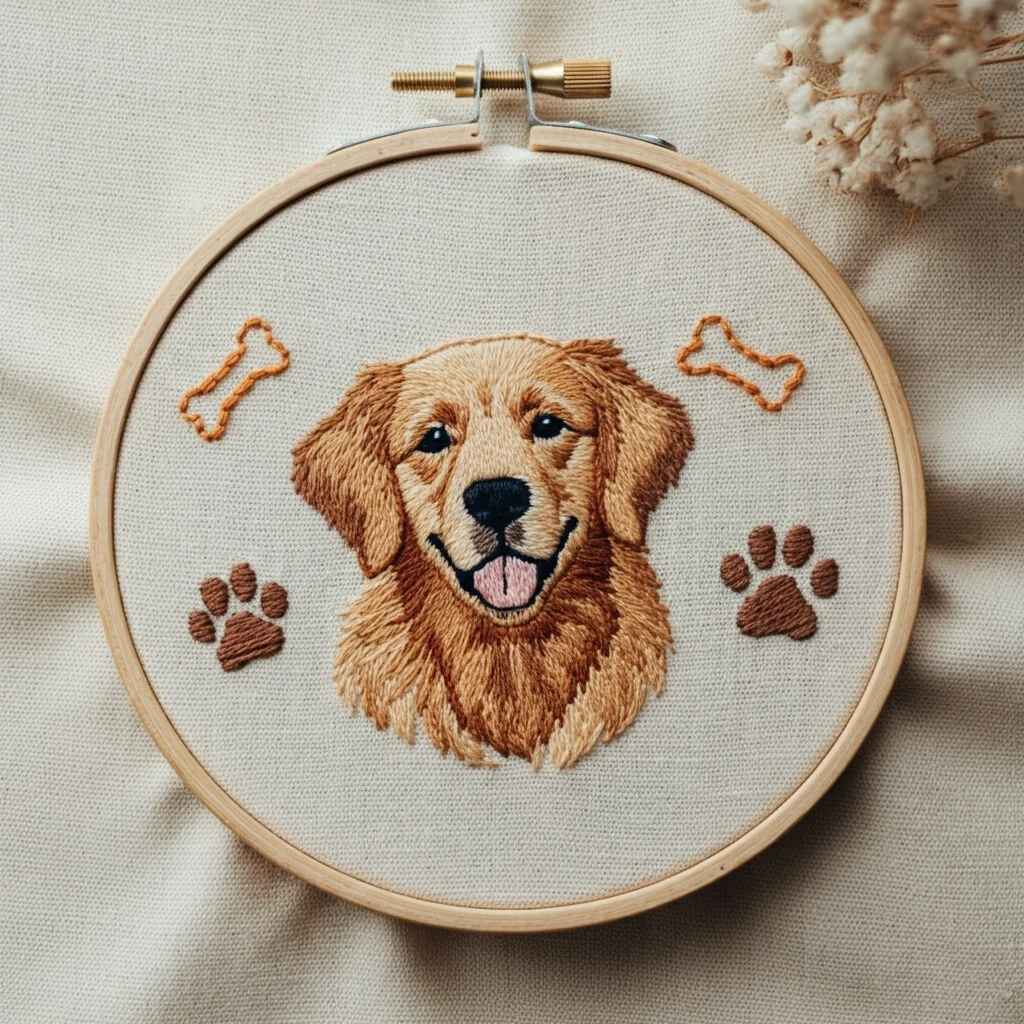
A cheerful hoop portrait built from honey-gold fur, darker caramel ears, glossy black facial features, a soft pink tongue, playful paw prints, and small stitched dog bones. The guidance below keeps the expression friendly while giving the retriever coat soft, directional texture.
Color reading from the design
The reference image centers on a golden retriever face stitched on neutral linen. The body of the coat is a layered range of straw, tan, caramel, and chestnut browns, with the darkest warmth concentrated in the ears, cheek shadows, muzzle sides, and lower ruff. The eyes and nose are nearly black with small white highlights, while the tongue adds a gentle muted pink accent. Bone outlines use bright orange-brown, and the paw prints are medium to dark cocoa.
DMC 3821
Straw
Lightest sunlit fur on forehead, muzzle bridge, and lower chest tips.
DMC 976
Golden Brown Medium
Main golden coat color; use for broad cheek and face fill.
DMC 977
Golden Brown Light
Warm transitions between pale highlights and darker ear areas.
DMC 975
Golden Brown Dark
Ear body, cheek shadows, brow folds, and ruff depth.
DMC 801
Coffee Brown Dark
Deepest fur shadows, mouth corners, under-chin texture, and paw pads.
DMC 898
Coffee Brown Very Dark
Small accents around eyes, nostril edges, and the darkest ear creases.
DMC 310
Black
Nose, pupils, smile line, and the crispest facial outline details.
DMC 3865
Winter White
Tiny catchlights in eyes and nose; a few fur sparkles only.
DMC 761
Salmon Light
Base tongue color, especially near the center.
DMC 760
Salmon
Tongue side shadows and the stitched center crease.
DMC 921
Copper
Outlined dog bones and playful accent lines.
DMC 400
Mahogany Dark
Paw-print pads, warm shadow strokes, and optional bone-outline depth.
Suggested stitch map
| Area | Best stitches | Practical notes |
|---|---|---|
| Golden face fur | Long-and-short stitch, split stitch guide lines, directional straight stitch | Follow the natural fur growth: outward from the nose bridge, down the cheeks, and slightly curved over the brow. Keep stitches short near the eyes and longer in the chest ruff. |
| Ears | Long-and-short stitch, fishbone-style tapered rows | Use 975 and 801 as the main ear shades. Let stitches angle downward and outward so the ears look soft and floppy rather than flat. |
| Nose | Padded satin stitch, satin stitch, tiny straight highlight | Pad the nose with a few horizontal base stitches, then cover with smooth satin in 310. Add one or two 3865 highlights after the black is complete. |
| Eyes | Satin stitch, split stitch rim, single highlight stitch | Work the pupil in 310, rim with 898 or 801, and place the white catchlight last. The catchlight is what gives the portrait its friendly expression. |
| Mouth and smile | Back stitch, whipped back stitch, tiny satin accents | Use 310 for the deepest smile line, but switch to 898 for softer corners so the muzzle does not look overly harsh. |
| Tongue | Satin stitch, long-and-short shading, split stitch center line | Fill with 761, shade edges with 760, and add a single soft vertical crease. Avoid too many dark lines so it stays cute and simple. |
| Paw prints and bones | Satin stitch, padded satin stitch, back stitch, whipped back stitch | Paw pads look charming when slightly raised with padding. Bone shapes can be clean 2-strand back stitch in 921, whipped for extra polish. |
Thread-count, blending & shading guidance
Thread counts
- Fur fill: 1 strand for realistic fine texture; 2 strands for a quicker, softer illustrative look.
- Ears and chest ruff: 2 strands for visible fluffy strokes, with 1-strand finishing wisps at the edges.
- Nose and paw pads: 2 strands for satin coverage; add padding underneath only where you want raised texture.
- Bone outlines: 2 strands of 921, whipped with the same color for a rounded cord effect.
Blending ideas
- Blend one strand DMC 3821 with one strand DMC 976 for bright forehead and muzzle strokes.
- Blend DMC 976 with DMC 975 for natural mid-tone fur over the cheeks and between the eyes.
- Blend DMC 975 with DMC 801 for ear shadows and the darker ruff under the chin.
- Use DMC 761 with a touch of 760 on the tongue edges to keep the pink soft but dimensional.
Outlining details
- Outline the face lightly with split stitch in 975 or 801 before filling, then cover parts of the outline with fur stitches for a softer edge.
- Reserve black for the nose, pupils, and smile; use 898 or 801 for most brown facial definition.
- Add the final eye highlights only after all surrounding fur is complete to prevent smudgy-looking eyes.
Texture suggestions
- Use slightly uneven stitch lengths in the ruff to suggest fluffy, layered neck fur.
- Keep the muzzle shorter and smoother than the ears; this contrast makes the portrait more readable.
- For paw prints, padded satin stitch gives a soft stamped look that pairs well with the dog theme.
Beginner-friendly stitching order
1. Transfer the main shapes. Mark the head outline, ears, nose, eyes, tongue, paw prints, and bone outlines. Add only a few internal fur direction arrows rather than drawing every strand.
2. Secure the facial anchors. Stitch eyes and nose outlines first, but save the white highlights until the end. These anchors help keep the expression symmetrical.
3. Fill the light fur. Work 3821 and 976 around the muzzle, forehead, and chest tips with short directional stitches.
4. Layer mid and dark fur. Add 977, 975, 801, and 898 in the ears, brow shadows, cheek edges, and under the chin, always following fur direction.
5. Stitch tongue and smile. Fill the tongue softly, then add the smile line with controlled back stitch so the face stays cheerful.
6. Finish playful accents. Add paw prints and bones last so they stay clean and do not catch extra fur threads while you work the portrait.
Practical tips for a clean pet portrait
Keep the eyes lively: in a dog portrait, tiny placement changes matter. Place both black pupils first, compare them from arm’s length, then add the 3865 catchlights in the same upper corner of each eye for a bright, friendly gaze.
- Use a 6–7 inch hoop with fabric held drum-tight; loose fabric makes long-and-short fur look wavy.
- Work with 12–16 inch thread lengths for browns and golds so the floss stays smooth and does not fuzz.
- Step back often while shading the ears; if both ears become equally dark, add a few 976 or 977 strokes to one side for balance.
- Do not over-outline the fluffy outer fur. A few loose single-strand wisps look more natural than a continuous hard border.
- Press finished work from the back on a folded towel so padded paw pads and the satin nose remain raised.