
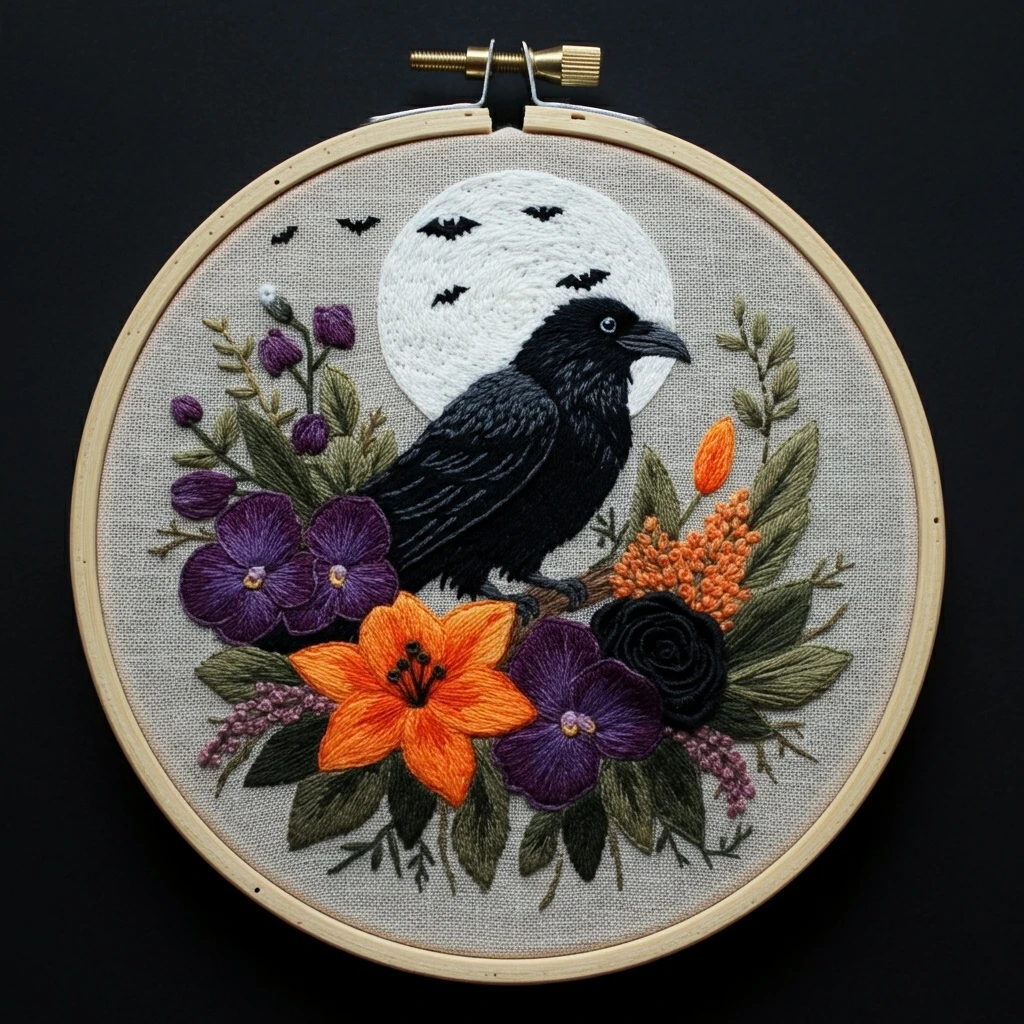
Gothic Bloom Crow & Moonlight
A moody hand-embroidery palette built around an inky crow, luminous moon, purple gothic flowers, orange lily petals, sage foliage, berries, and tiny black bats. The suggestions below translate the visual reference into practical DMC floss choices, stitch direction, strand counts, blending options, and finishing details.
Color Story From the Reference
The design balances a soft linen ground and pale moon against a dramatic near-black crow. Color accents are concentrated in the floral crescent: smoky purples, fiery oranges, olive greens, warm ochres, and dusty rose-pink sprigs.
Suggested DMC Floss Palette
| Design area | DMC colors | Use & notes |
|---|---|---|
| Crow body, bats, black rose | 310 Black 3799 Very Dark Pewter Gray 844 Ultra Dark Beaver Gray | Use 310 for the deepest silhouettes, 3799 for feather grooves, and 844 for soft edge transitions on the wing and tail. |
| Feather highlights | 413 Dark Pewter Gray 414 Steel Gray 317 Pewter Gray | Keep these sparse. Small directional strokes will make the crow read glossy without becoming silver. |
| Moon | B5200 Snow White Blanc White 762 Very Light Pearl Gray 415 Pearl Gray | Layer whites and pale grays in curved stitch paths to suggest moon craters and soft glow. |
| Purple flowers & buds | 154 Very Dark Grape 550 Very Dark Violet 3837 Ultra Dark Lavender 552 Medium Violet 209 Dark Lavender | Use the darkest tones at petal bases and folds, then pull lighter lavender toward the petal tips. |
| Orange lily | 900 Very Dark Burnt Orange 947 Burnt Orange 740 Tangerine 741 Medium Tangerine 742 Light Tangerine | Build strong petal veining with 900/947, midtones with 740/741, and bright ridges with 742. |
| Leaves, ferns, foliage | 934 Black Avocado Green 936 Very Dark Avocado Green 937 Medium Avocado Green 3011 Dark Khaki Green 469 Avocado Green | A muted green family keeps the bouquet gothic rather than spring-bright. |
| Orange berries & flower centers | 921 Copper 922 Light Copper 3826 Golden Brown 780 Topaz | French knots and colonial knots in mixed oranges give the berry cluster a raised, beaded look. |
| Dusty mauve sprigs | 315 Medium Dark Antique Mauve 316 Medium Antique Mauve 3726 Dark Antique Mauve | Use as a quieter accent around the lower bouquet to bridge purple flowers and green leaves. |
| Branches, stems, hoop-like warmth | 839 Dark Beige Brown 840 Medium Beige Brown 611 Drab Brown Ecru | Good for the branch under the crow, fine twigs, and any warm neutral accents. |
| Optional linen shading | 642 Dark Beige Gray 644 Medium Beige Gray 822 Light Beige Gray | Only add if you want a stitched shadow behind the crow or at the moon edge; keep it very light. |
Stitch Types by Design Element
Crow
- Long-and-short stitch: primary fill for body, wing, and tail, following feather direction.
- Split stitch: fine feather contour lines in 3799, 844, and occasional 413.
- Satin stitch: beak sections, tiny feet, and the cleanest parts of the silhouette.
- Backstitch: final outer edge in 1 strand of 310 for a crisp gothic profile.
Moon & Bats
- Curved split stitch or chain stitch: work the moon in circular arcs rather than straight rows.
- Long-and-short stitch: blend B5200, Blanc, 762, and 415 for cloudy crater texture.
- Tiny satin stitches: fill the bat silhouettes with 310.
- Single-strand backstitch: sharpen bat wing points after filling.
Flowers
- Needle painting: best for the orange lily and purple pansy-like blooms.
- Satin stitch: small buds and compact petals.
- French knots: yellow-orange centers using 3826, 780, or 742.
- Stem stitch: curved veins inside petals, especially the orange lily.
Leaves, Berries & Branches
- Fishbone stitch: broad leaves, using darker green on one side and lighter green on the other.
- Fly stitch: fern-like sprigs and slender leaf clusters.
- Colonial/French knots: raised orange berry cluster, varied between 2 and 3 wraps.
- Whipped backstitch: the branch under the crow for a rounded twig effect.
Thread Counts & Blending Ideas
1 strand Fine detail
Use for crow feather lines, bat outlines, moon crater marks, tiny flower veins, and final facial details. One strand keeps the gothic features sharp rather than bulky.
2 strands Main fills
Use for most needle painting, satin stitch petals, leaf fills, and the moon surface. Two strands give enough coverage while preserving painterly direction.
3-6 strands Raised texture
Use 3 strands for bold flower centers and 4-6 strands for chunky berries or padded areas. Keep raised knots away from the crow’s face so the focal point stays clean.
| Blend | Where to use it | Effect |
|---|---|---|
| 1 strand 310 + 1 strand 3799 | Crow body midtone | Softens solid black while keeping the bird dark. |
| 1 strand 3799 + 1 strand 413 | Wing and neck highlights | Creates a charcoal sheen that reads like glossy feathers. |
| 1 strand Blanc + 1 strand 762 | Moon fill | Makes the moon luminous but not flat white. |
| 1 strand 550 + 1 strand 3837 | Purple petal shadows | Deep jewel-toned folds for gothic blooms. |
| 1 strand 947 + 1 strand 740 | Orange lily body | Warm saturated petal fill with natural variation. |
| 1 strand 936 + 1 strand 3011 | Leaves behind flowers | Muted olive depth without looking too bright. |
Outlining, Shading & Direction
Outlining Details
- Outline the crow last with 1 strand of 310 in split stitch or backstitch. Keep the line especially crisp around the beak, head, chest, and tail tips.
- For the moon, avoid a hard black outline. Use 762 or 415 in tiny broken stitches at the lower edge where it meets the crow.
- Use 936 or 934 to outline leaves instead of black; this keeps the foliage natural and layered.
- Use 154 for the deepest purple petal separations, then soften inward with 550 and 3837.
Shading Guidance
- Place the darkest crow stitches under the wing, under the beak, and at the belly; reserve gray strokes for the upper wing and neck.
- Shade the orange lily from red-orange at the center and vein lines to golden orange at the petal edges.
- Let purple flowers fade from 154 or 550 at the center to 552 or 209 near the tips.
- Vary leaf direction: stitch each leaf from base to tip, but change the angle leaf by leaf so the bouquet does not look striped.
Practical Embroidery Tips
Recommended Work Order
- Transfer the main shapes lightly: moon, crow silhouette, large flowers, branch, and leaf masses.
- Stitch background elements first: moon, distant bats, rear leaves, and twig lines.
- Work the crow from tail and wing toward the head so feather strokes overlap naturally.
- Stitch large flowers, then smaller buds, berry clusters, and final flower centers.
- Add final outlines, eye highlight, beak line, and stray feather strokes at the very end.
Fabric & Finish Notes
- A natural linen or linen-look cotton in warm beige will match the sample mood and contrast well with black floss.
- Use a sharp embroidery needle for dense needle painting, then switch to a slightly larger needle for French knots.
- Keep thread lengths short when using 310; black floss shows fuzz and wear quickly.
- For a polished hoop finish, lightly steam from the back, avoid pressing raised knots, and lace the fabric evenly behind the hoop.