
DMC palette & hand embroidery tips
Hand Embroidered Pug Portrait in Hoop
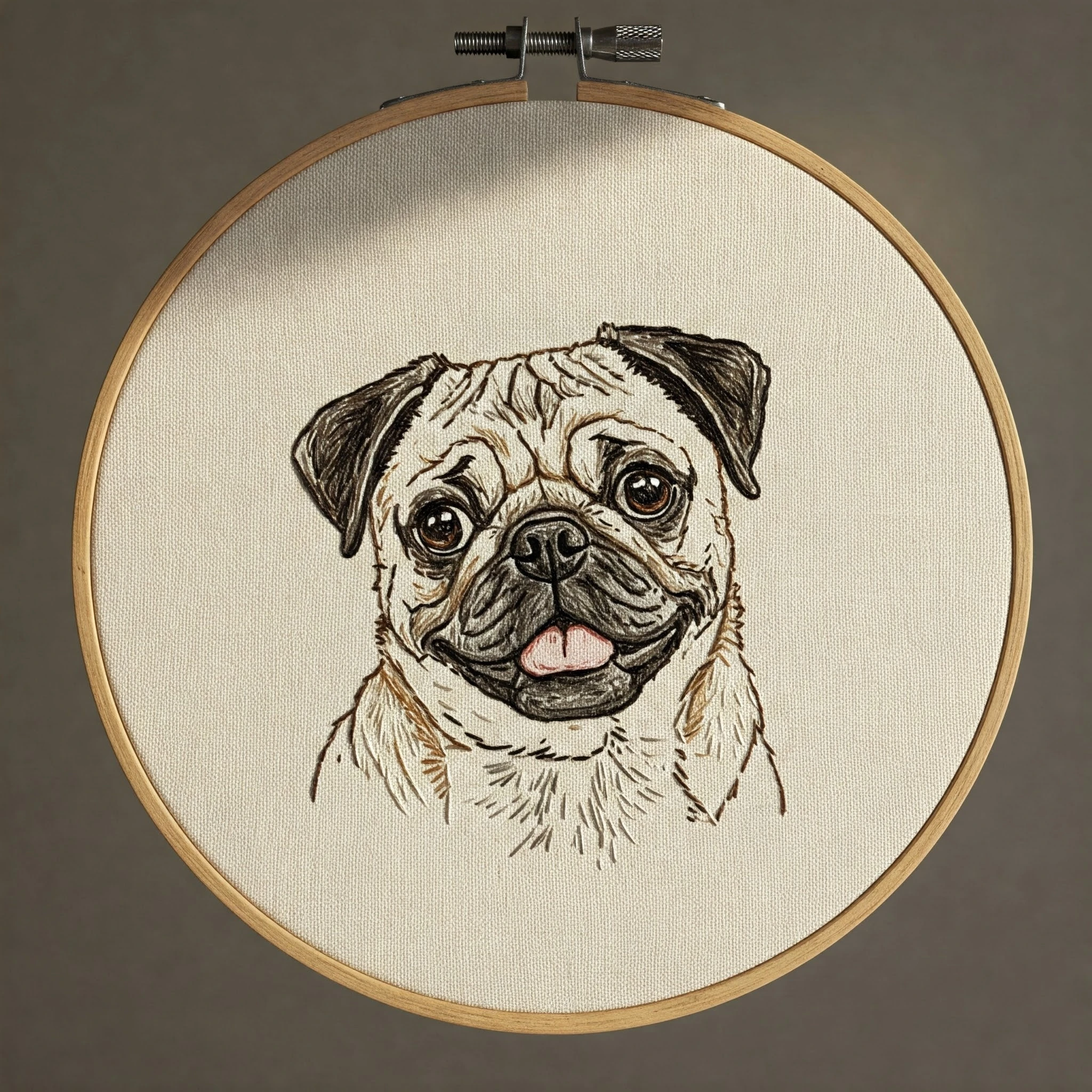
A warm pet-portrait guide for a fawn pug in a wooden hoop: rounded wrinkled face, dark mask, glossy eyes, soft cream muzzle, folded ears, small rosy tongue details, and delicate botanical accents that keep the portrait friendly and handmade.
Color story observed from the artwork
The reference design centers a sweet pug portrait on a natural fabric background. The key contrasts are the creamy fawn coat against the deep charcoal face mask, dark folded ears, black nose and mouth, moist brown eyes, and soft beige highlights around the forehead, cheeks, chest, and muzzle.
This palette is designed for a realistic but beginner-manageable embroidered portrait. Keep most filling in one strand, then reserve two strands for tiny flowers, bold nose accents, or outer hoop details that need extra visibility.
Stitch map by design area
| Area | Recommended stitches | How to work it |
|---|---|---|
| Outer head and ears | Split stitch, back stitch, short straight stitches | Outline with one strand of 310 or 3799. Fill ears with 3799 and 413, then feather 3031 at the base so the ear folds into the tan fur. |
| Forehead wrinkles | Long-and-short stitch, stem stitch, tiny back stitch | Use 3863 as the base, stitch 433/3862 into wrinkle valleys, then add 842 on raised folds. Curve the stitches with the round pug brow. |
| Dark face mask | Long-and-short stitch, split stitch, satin accents | Build the mask from 413 to 3799, using 310 only in the deepest nostrils, under the nose, and inside mouth lines. This keeps the expression dimensional. |
| Eyes | Padded satin, tiny back stitch, single highlight stitch | Work the iris in 801 with 3031 at the top shadow. Ring with 310 and add one angled B5200 catchlight so the pug looks lively. |
| Nose | Padded satin stitch, seed stitch, small straight highlights | Pad lightly with 3799, cover with 310, and place a few 413 or 3024 stitches where the light catches the upper nose texture. |
| Cream muzzle and chest | Long-and-short stitch, contour stitch | Use 712 for the base, 3024 where the muzzle turns under, and B5200 sparingly on the top ridge and chest glints. |
| Tongue or pink details | Satin stitch, split stitch edge | Use 3688 for the light area and 3716 at the lower edge. Keep stitches short so the tongue stays rounded rather than blocky. |
| Flowers and leaves | Lazy daisy, French knots, fly stitch, stem stitch | Use 934/3345 for leaves, 972 for centers, B5200 for pale petals, and 3688/3716 for rosy accents framing the portrait. |
Blending and shading notes
Build the pug face in layers
Start with the mid fawn color, DMC 3863, then add darker strokes only where folds naturally sit: under the brow, around the cheeks, and below the chin. Finish with 842 and 712 highlights instead of filling large light blocks first.
Keep the black mask readable
The pug’s mask should feel velvety, not flat. Work 413 near the tan transition, 3799 in the center shadow, and 310 only for the nostrils, pupils, mouth, and strongest creases.
Blend without muddying
For delicate transitions, alternate single strands in adjacent stitches rather than combining two colors in the needle. This gives the portrait a fur-like texture and makes corrections easier for beginners.
Outlining details
- Use a one-strand split stitch for the face outline; it creates a smooth line that will not overpower the small eyes.
- Switch to 3799 instead of 310 where the cheek or ear outline should look soft.
- Outline the muzzle after filling it, so the cream shape remains clean against the dark mask.
- Keep wrinkle lines broken and slightly uneven. Perfect parallel lines can make the pug look cartoon-flat.
- Add whisker dots last with single wrap French knots or tiny seed stitches in 310.
Texture suggestions for a lifelike finish
Beginner-friendly working order
- Transfer only essential facial lines clearly: eye placement, nose, mouth, mask boundary, ears, and main wrinkle arcs.
- Stitch the light muzzle and chest first, then the fawn coat, then the dark mask and ears.
- Complete the eyes and nose near the end so your hands do not dull the shine stitches while filling larger areas.
- Add flowers, leaves, and decorative hoop details last as a fresh frame around the portrait.
- Step back often. Pet portraits read best from normal viewing distance, not from two inches away.
Practical embroidery tips
- Use a sharp embroidery needle for portrait filling; it parts the fabric cleanly and supports precise fur direction.
- Keep thread lengths around 14–16 inches to reduce fuzzing, especially with dark colors like 310 and 3799.
- When stitching dense areas, avoid bulky knots on the back; weave tails under existing stitches instead.
- If the face starts looking too dark, add a few 842 or 712 stitches beside the wrinkles rather than removing all shadow stitches.
- For a smaller hoop, simplify the palette by using 310, 3799, 3863, 842, 712, 3024, 801, 3688, 934, and 972.