
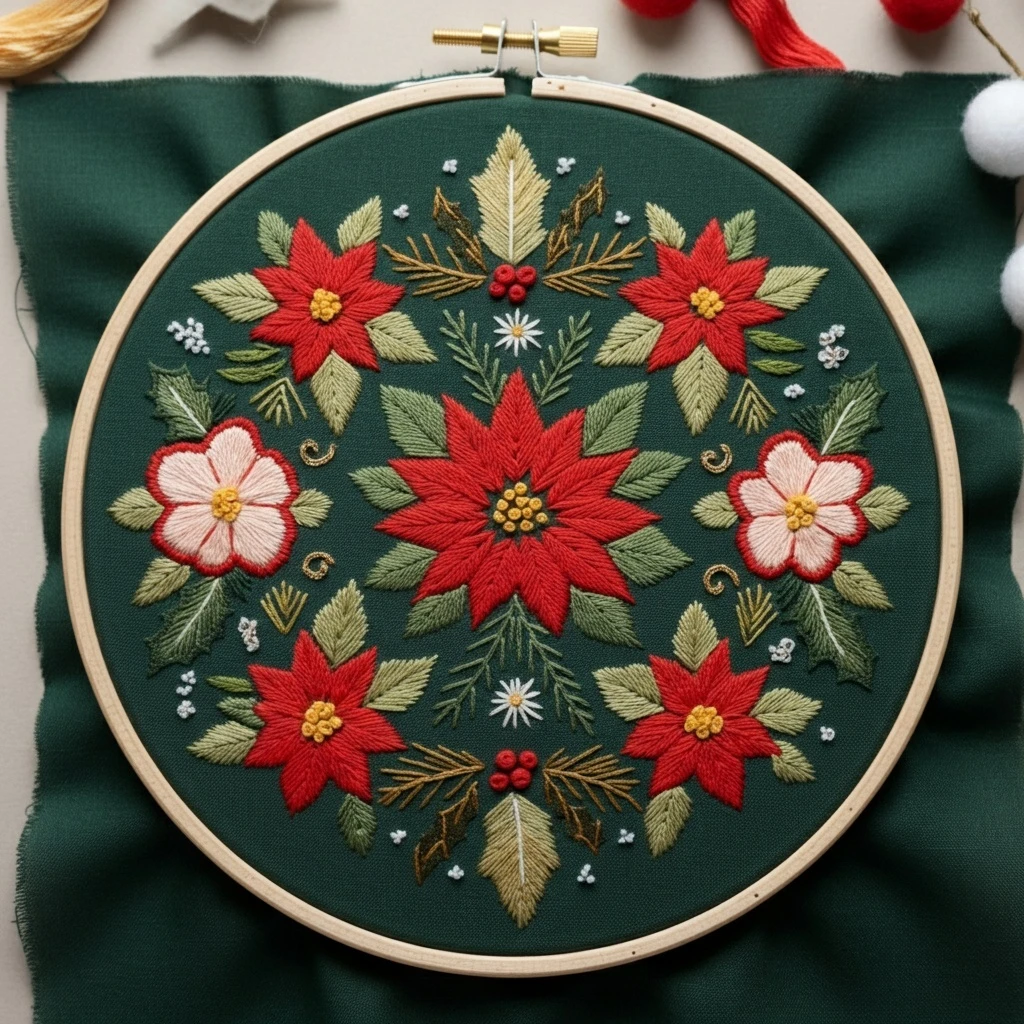
Holiday Floral Wreath
A festive circular hoop design with red poinsettia-style blooms, creamy white blossoms, sage leaves, pine sprigs, golden centers, red berries, tiny snow flowers, and warm metallic-looking branch details on deep evergreen fabric.
The image is built around a balanced wreath: one large red flower in the center, four smaller red poinsettias around the ring, two white flowers outlined in red, olive and sage leaves radiating outward, and delicate gold-brown needles and curls filling the negative space. Keep the red petals bold and satin-like, then let the greens and tiny white accents create the crisp winter-garden texture.
Deep Christmas red, creamy white, old gold, dusty sage, pine green, olive leaf shadows, and warm brown twig lines.
Suggested DMC Palette
Use these as practical floss matches for the visible design colors. On dark green fabric, slightly lighter greens and whites often read cleaner than they do on the skein.
Main poinsettia red
Use for the large center bloom and most red petals. Work long-and-short or satin stitches from the petal base outward so the flower has a strong radial direction.
Petal highlights
Add sparingly along petal centers and upper edges. Blending one strand 321 with one strand 498 gives a lively holiday red without turning too orange.
Petal shadows and red outlines
Use at the base of red petals and around the cream flowers where the sample shows a stitched red rim. One strand is enough for a neat outline.
Cream flowers and snow dots
Choose this softer white for the two pale blossoms and tiny white filler flowers. It looks warmer and more natural than stark white against evergreen fabric.
White-flower glow
Blend with 3865 for the inside of the white petals, especially near the center, to keep them dimensional instead of flat.
Flower centers
Use for French knots in red and white blossoms. Mix knot sizes so the centers look like clustered pollen rather than uniform beads.
Golden depth
Add a few knots or tiny straight stitches between 3820 knots for deeper yellow centers and warm branch accents.
Soft sage leaves
Best for the pale pointed leaves behind the flowers. A fishbone stitch with a center vein captures the ribbed leaf texture in the reference.
Leaf shadows
Use at one side or lower half of sage leaves to separate overlapping shapes. Alternate with 3052 in long-and-short rows.
Olive filler leaves
Useful for the medium green sprigs near red blooms. Stitch with detached chain or small satin leaves for quick texture.
Deep leaf bases
Add to the base of holly-like leaves and under overlapping petals. It keeps the wreath grounded on dark green cloth.
Evergreen sprigs
Use for fine pine needles and darker veins. On very dark fabric, keep stitches slightly separated so the lines remain visible.
Pale central leaves
Matches the beige-green vertical leaves at top and bottom. Add a single 3865 or 3052 vein for a frosted finish.
Twigs and curls
Use for the golden-brown branch lines and curled tendrils. Couching one strand over a slightly darker strand makes the line look raised.
Stitch Map for the Wreath
The sample relies on clean directional filling and small raised details. Keep the wreath symmetrical, but do not worry if the filler sprigs vary slightly; that handmade variation suits the holiday botanical style.
Use long-and-short stitch for the large central poinsettia and satin stitch for smaller petals. Angle each stitch from the petal point toward the flower center.
Fill petals with padded satin or long-and-short in 3865/746. Outline with back stitch or stem stitch in 815 so the scalloped red edge stays crisp.
Fishbone stitch is the easiest way to create the ribbed sage leaves. Use 3052 on one side, 3051 or 3011 on the other for gentle shading.
Work each sprig with a stem stitch spine, then add single straight stitches for needles. Vary needle length so the evergreen pieces do not look comb-like.
Use padded satin circles or clustered French knots in 498 and 815. A tiny 321 highlight stitch on one side makes the berries look rounded.
Tiny French knots, colonial knots, and small detached chains in 3865 create the scattered white flowers and snowflake dots between branches.
Thread Count & Blending Guidance
Use 2 strands for poinsettia petals, cream flowers, and large sage leaves. This gives enough coverage on dark fabric without bulky ridges.
Use 1 strand for pine needles, veins, curls, and small outlines. It keeps the gold-brown branch work delicate and elegant.
Use 2 strands wrapped twice for French knots; use 3 strands for the largest yellow center knots if the fabric weave is loose.
Use 2 strands of 815 for red rims around white flowers; switch to 1 strand near tight curves to avoid lumpy scallops.
Blending idea: For red petals, thread the needle with one strand DMC 498 and one strand DMC 321 for bright upper petals, then one strand DMC 498 and one strand DMC 815 near the bases. For leaves, blend 3052 + 3051 for muted sage and 3012 + 3364 for deeper evergreen sprigs.
Shading & Texture Notes
- Petal direction: Keep all red petal stitches radiating toward each flower center. Direction is more important than perfect stitch length.
- Central bloom: Work the biggest flower in layers, starting with darker red at the inner bases, then brighter red on top-facing petal tips.
- Leaf dimension: Place the darker green on the side that tucks under a red petal; place 3052 on exposed leaf tips.
- Gold branches: Stem stitch looks smooth for the long twig stems; use small straight stitches for the short needles.
- White blossoms: A thin red outline after filling hides uneven edges and makes the cream petals pop against green cloth.
Outlining Details
- Outline red flowers only where petal edges disappear into the dark background; too much outline can flatten the poinsettias.
- Use one strand of 3364 or 3011 for leaf veins, especially on the pale top and bottom leaves.
- Use 420 or 783 for the decorative curls, but keep the stitch tension relaxed so the curves do not pucker.
- Add tiny white knots last so they stay clean and sit on top of the surrounding greenery.
- For a polished hoop finish, keep the outermost wreath elements at least 1/2 inch from the hoop edge.
Beginner-Friendly Stitching Tips
Start with the largest red center flower, then stitch the four outer red flowers, cream flowers, leaves, branch lines, berries, and finally the tiny white filler dots.
Dark green fabric shows lint and hoop marks. Wash hands before stitching, keep spare thread in a bag, and avoid dragging pale floss across the front.
Use a taut hoop but do not pull satin stitches too tightly. Over-tight stitches can pucker the fabric around the circular wreath.
A size 7 or 8 embroidery needle works well for 1–2 strands. Use a slightly larger needle for 3-strand knots so the thread passes cleanly.
Because the design has separated motifs, finish threads often rather than carrying floss across open dark fabric. Long carries can shadow through or snag.
For a subtle heirloom touch, replace a few 783 twig stitches with DMC Light Effects gold, but keep metallic thread short and use a conditioner if needed.