

DMC palette & hand embroidery guide
Kawaii Space
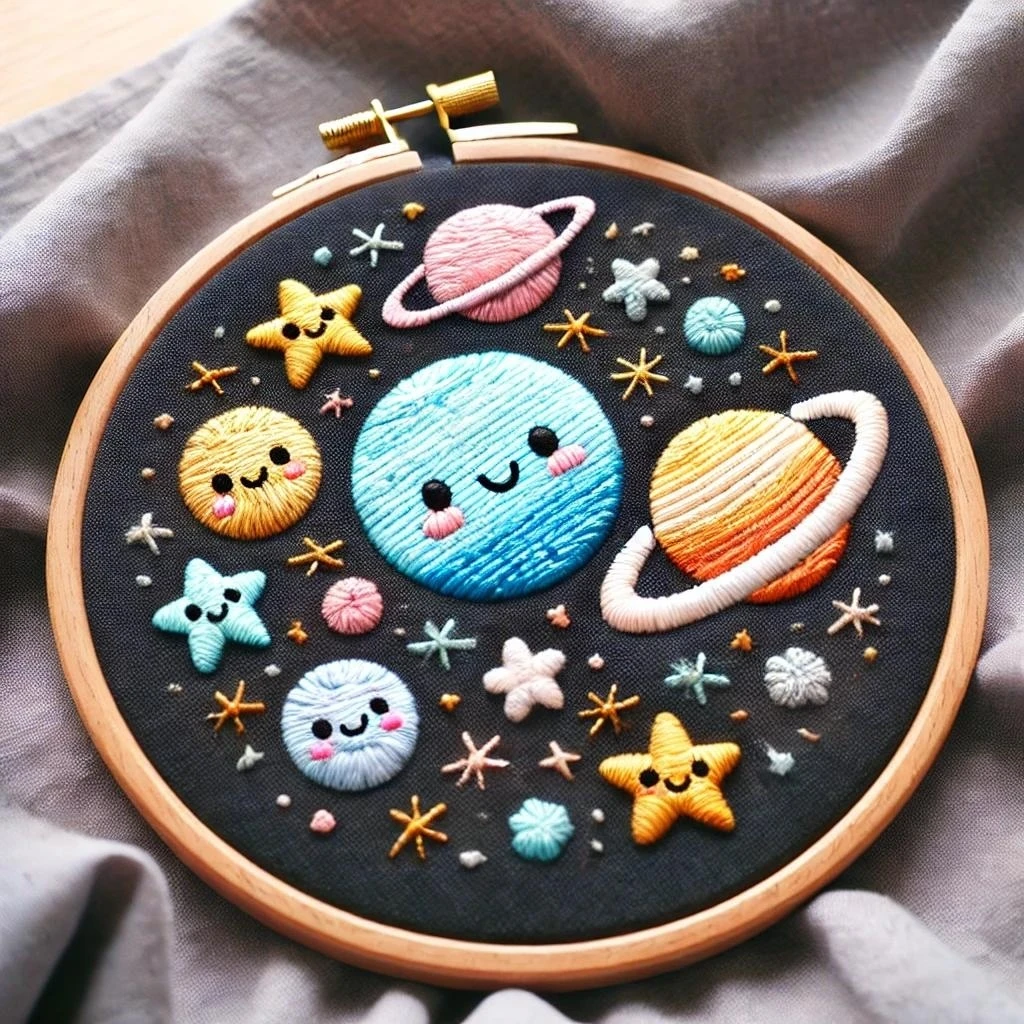
A cheerful cosmic hoop stitched on black fabric, filled with smiling planets, star friends, tiny moons, and scattered sparkle dots. The design is playful and beginner-friendly: a large turquoise planet anchors the center, an orange-yellow ringed planet glows on the right, a soft pink Saturn floats above, and small mint, blue, yellow, white, and blush motifs create the sweet kawaii galaxy around them.
Design color read
The reference image uses a dark, nearly black ground fabric that makes every pastel and candy-bright shade pop. The largest shape is a turquoise-blue kawaii planet with darker aqua shading along the lower edge and black stitched facial features. Around it are a warm yellow smiling moon or sun, a pale blue moon, mint star shapes, gold starbursts, tiny white constellations, pink cheeks, and two ringed planets: one blush pink at the top and one larger yellow-to-orange Saturn on the right.
Keep the palette clean and high contrast. The black fabric supplies most outlines naturally, so the embroidery should focus on bright fills, soft gradients, and raised starry texture.
Thread-count snapshot
- Large planets: 2 strands for satin or long-and-short fill; 3 strands only for padded ring ridges.
- Faces: 1 strand of black for mouths and small backstitch curves; 2 strands for solid eye satin dots.
- Stars & starbursts: 2 strands for medium straight stitches; 1 strand for tiny sparkle marks.
- French knots: 1-2 strands with one wrap for background dots so they stay rounded but not bulky.
- Cheeks: 1 strand for delicate blush ovals, or 2 strands if the black fabric is showing through.
Suggested DMC palette
Stitch suggestions
Best order of work
Blending & shading guidance
Central turquoise planet
Use 3846 on the upper-left highlight area, 3845 through the middle, and 3844 or 3843 along the lower edge. To soften the transition, thread one strand of 3846 with one strand of 3845 for the light-middle band, then one strand of 3845 with one strand of 3844 for the shaded lower band. Keep the stitch direction gently curved so the planet reads round.
Warm Saturn planet
Build the right planet from 743 at the lightest top, through 725 and 972, into 741 and 947 at the bottom. Short horizontal or diagonal satin rows mimic the striped texture visible in the reference. Work the ring after the body so it sits clearly on top, using 746 with touches of 818 or 3716 for the soft pink-white edge.
Pink Saturn, moons, and stars
For the top pink planet, keep 818 on the lit edge, 3716 as the body, and 604 in the underside shadow. For pale moons, use 3756 and 800, adding a little 318 only where the curve needs definition. Yellow stars look best when 743 sits on the points and 725 or 972 is tucked near the center.
Texture suggestions
- Let the satin rows show slightly on planets; the visible stitch ridges match the plush handmade look.
- Pad only the large shapes and rings. Tiny stars become bulky if padded too much.
- Alternate star sizes: large straight-stitch starbursts, small cross stars, and tiny French-knot dots.
- Use a few mint motifs to cool down the strong yellow and orange areas.
- Leave some black fabric showing between stars so the composition still feels like outer space.
Outlining details
On black fabric, heavy outlines are rarely needed. Use a split-stitch outline in a darker version of each object before filling: 3844 for the aqua planet, 947 for the orange Saturn, 604 for pink areas, 972 for yellow stars, and 964 for mint shapes. Use DMC 310 mainly for eyes and smiles. If a pale object needs definition, add a one-strand 318 shadow on the lower side instead of a black border.
Beginner-friendly practical tips
- Use a white water-soluble pencil, chalk pencil, or dark-fabric transfer paper for the pattern lines.
- Keep the fabric drum-tight in the hoop; satin planets look smoother when the ground fabric does not shift.
- Use short floss lengths, especially with white and pale blue, because lint shows easily on black fabric.
- Stitch facial features last, and check expression placement before knotting off. A tiny mouth curve changes the whole character.
- When satin filling circles, stitch across the widest section first, then fill each side with gradually shorter stitches.
- Roll or cover finished satin areas with clean tissue while working nearby stars to prevent fuzzing from your hand.
Black-fabric handling
Use clean hands and lint-roll the fabric before framing, because pale stitches pick up dark lint quickly. Avoid long thread carries behind white, mint, or pink areas if the fabric is thin; even on black fabric, carried threads can create bumps that show through padded satin. For the neatest back, anchor under nearby stitches and travel only behind filled shapes.
Motif-by-motif stitch map
- Big blue planet: padded satin or long-and-short fill; black satin eyes; backstitch smile; pink satin cheeks.
- Right Saturn: long-and-short bands for the planet body; padded whipped backstitch or satin for the ring.
- Top pink Saturn: small satin fill with a narrow whipped ring; keep shadows subtle so it stays pastel.
- Yellow sun and stars: padded satin for smiling shapes, straight stitch for starbursts, and tone-on-tone gold shading.
- Space dust: French knots, seed stitch, tiny crosses, and short straight stitches in white, gray, mint, gold, and blush.
Compact stitch plan
Large planets: split-stitch outline, light padding, then satin or long-and-short fill in turquoise, pink, yellow, and orange gradients. Rings: padded stem stitch, whipped backstitch, or narrow satin in 746, 818, and 3716. Faces: DMC 310 satin dots and backstitch smiles with 3716 or 604 cheeks. Stars: straight stitch, cross stitch, French knots, and seed stitch in 743, 725, 972, 955, 964, B5200, and 318. Finishing: add final white sparkle and trim any lint from the black fabric before framing.