
Lavender Bloom
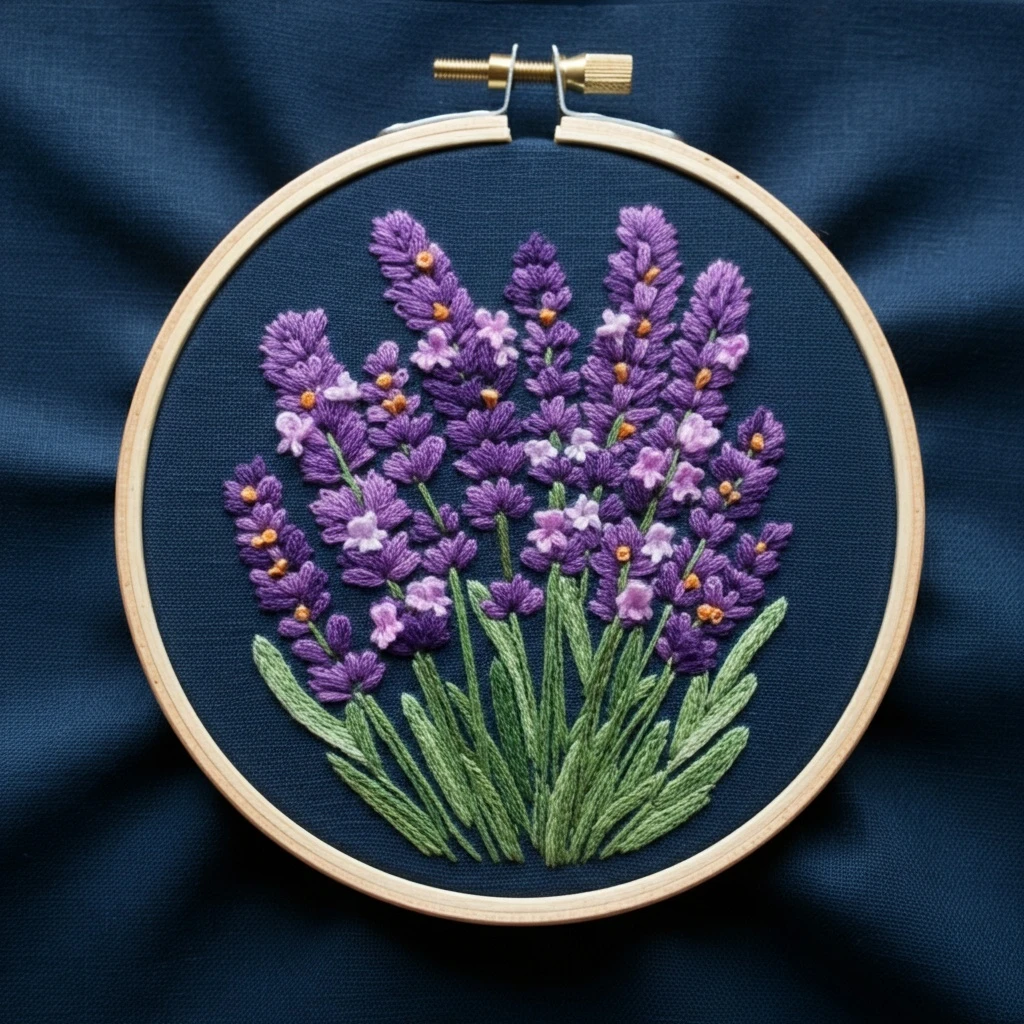
A calm botanical design built around upright lavender flower spikes, soft violet buds, muted sage leaves, and warm natural-linen space. The stitching should feel airy and fragrant: narrow green stems, clustered purple buds, a few pale highlights, and gentle texture rather than heavy filled blocks.
Recommended DMC palette
This palette keeps the lavender believable: deep violet for tucked buds, clear lavender for the main bloom, pale lilac for sunlit tips, and gray-green foliage that supports the purple without competing with it.
Stitch plan by design area
- Lavender spikes: Work the main stems first in stem stitch with 1–2 strands of 3051. Add buds as detached chain, lazy daisy, or small straight stitches angled outward from the stem.
- Dense flower tips: Use clusters of French knots in 340, 341, and 211. Place darker knots low and pale knots at the very top to make the spikes feel sunlit.
- Open side buds: Stitch small detached chains with 2 strands. Anchor the chain toward the stem so each bud points naturally upward.
- Slender leaves: Use fishbone stitch for larger leaves and simple straight stitches for narrow ones. Blend 3363 at the base into 3051 and 3052 toward the tip.
- Fine outlines: Add one-strand split stitch only where the stems cross or a bud needs definition. Lavender should look soft, not cartoon-bold.
- Background texture: A few scattered seed stitches in 822 or 211 can suggest pollen and light without cluttering the clean botanical style.
Thread-count guidance
| Area | Strands | Why it works |
|---|---|---|
| Main stems | 1–2 | Keeps stems narrow and graceful, especially on small hoops. |
| Lavender buds | 2 | Creates visible petals without overwhelming the fine sprig shape. |
| French knots | 2–3 | Adds raised texture for dense flower heads and bud clusters. |
| Leaves | 2 | Gives smooth coverage while preserving pointed leaf edges. |
| Highlights | 1 | Places delicate light on tips without turning them white or bulky. |
Blending, shading & texture suggestions
Lavender gradient
For soft transitions, thread one strand of DMC 340 with one strand of 341. Use 333 + 340 only at the lower, tucked side of the spike.
Fragrant texture
Alternate detached chains with French knots so the bloom does not look like a row of identical beads. Vary spacing and tilt slightly.
Airy highlights
Reserve DMC 211 and 3747 for the last pass. Add just a few stitches to the top right of buds to create light without washing out the purple.
Stem movement
Curve stem stitch gently instead of forcing straight lines. Lavender looks more natural when the stalks lean slightly in different directions.
Leaf shading
Begin the central vein with 3363, fill one side with 3051, then add a single 3052 line along the outer edge for a folded leaf effect.
Clean back
Because pale linen can show dark tails, travel under existing purple stitches and trim deep-violet thread ends close after securing.
Beginner-friendly workflow
- Transfer the design lightly with a removable pen; fine lavender stems do not hide thick marks well.
- Stitch all stems in 3051, then add leaf veins in 3363 so the structure is clear.
- Fill leaves before adding buds, keeping points sharp with short directional stitches.
- Add lavender buds from dark to light: 333/340 low on the spike, 341/3747 higher, and 211 only at the tips.
- Use French knots after the detached-chain petals so raised knots sit cleanly on top.
- Finish with one-strand accents and steam/press from the back on a towel to protect raised knots.
Practical embroidery tips
- Use a size 7–9 embroidery needle for two-strand flower work and a smaller needle for one-strand details.
- Separate floss strands before recombining; lavender shades look smoother when the strands lie parallel.
- Keep hoop tension firm, especially for long stems, to prevent puckering.
- Test French knot wraps on scrap fabric first: one wrap is tiny and delicate, two wraps are rounder and more textured.