
DMC color palette & embroidery notes
Lavender Hyssop
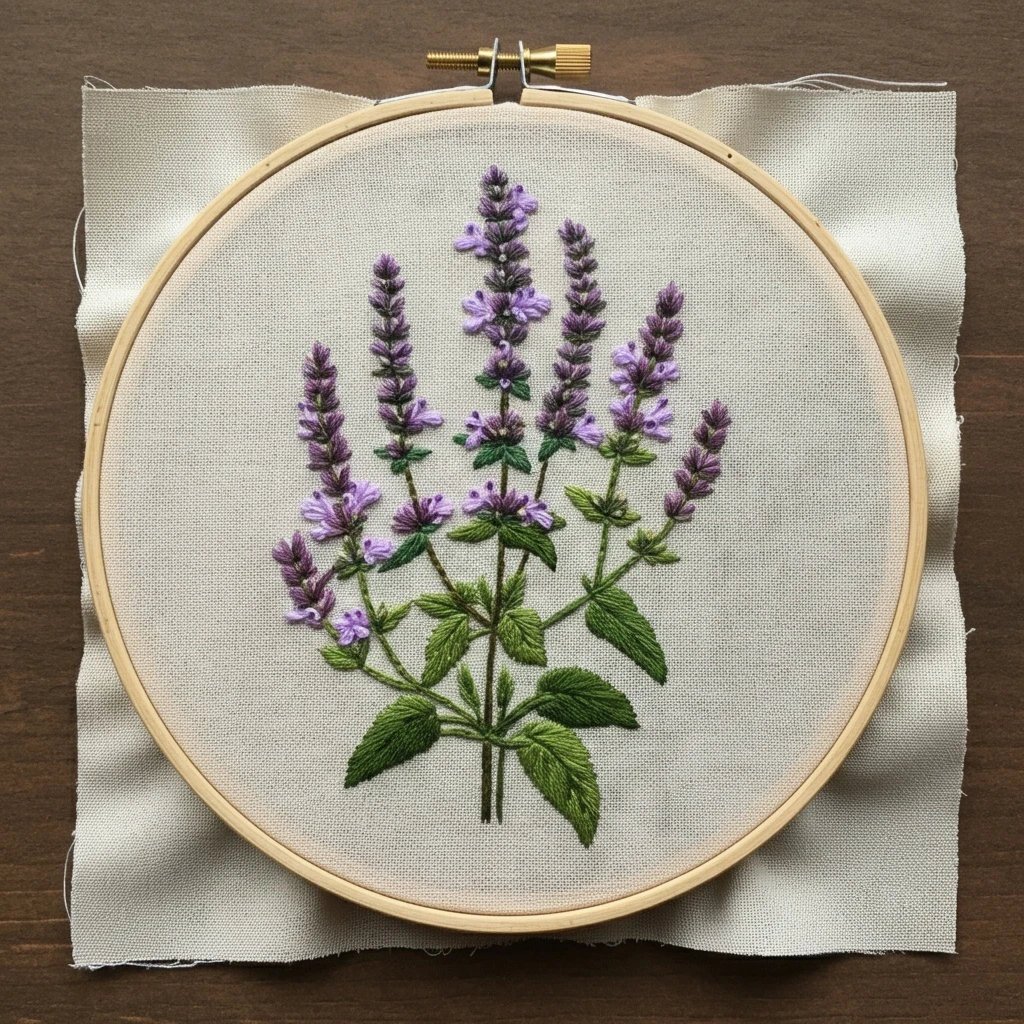
A botanical hoop with upright purple flower spikes, soft lilac blossoms, textured green leaves, and slender olive stems on warm natural linen. This guide keeps the look delicate, dimensional, and beginner friendly while preserving the airy herb-garden character of the design.
Recommended DMC Palette
The image reads as a restrained herb palette: deep smoky purple at the flower tips, brighter lavender petals around the mid-spikes, moss and fern greens in the leaves, and muted brown-green stems. Use the darker shades sparingly so the flowers stay light and lively.
Stitch Map & Texture Plan
Flower spikes
- Detached chain / lazy daisy: Use for the small lavender petals that flare out from the central spikes.
- Fishbone or short straight stitches: Build dark plum bud stacks along each upright flower head.
- French knots: Place 1-wrap knots at blossom centers and on the very top buds for seed-like texture.
- Thread direction: Angle stitches upward and inward so each spike looks compact rather than fuzzy.
Leaves & stems
- Stem stitch: Work the main stalks with 2 strands in DMC 3051 or 3011 for a soft botanical line.
- Long-and-short stitch: Fill larger leaves from center vein outward, alternating DMC 3345 and 3347.
- Back stitch: Add fine serrations and final vein accents with one strand of DMC 895.
- Straight stitch sprays: Use for tiny calyx points below blossoms and branching side stems.
| Area | Suggested strands | Best stitches | Practical note |
|---|---|---|---|
| Central stems | 2 strands | Stem stitch, split stitch | Keep the lines slim; thicker stems can make the bouquet look heavy. |
| Dark flower tips | 1–2 strands | Short straight stitch, French knots | Use 1 strand for distant or tiny tips, 2 strands only on the largest blooms. |
| Open lilac petals | 2 strands | Lazy daisy, detached chain | Anchor each petal with a tiny couching stitch so the loops sit neatly. |
| Large leaves | 2–3 strands | Long-and-short, fishbone | Use 3 strands for the lowest leaves if you want a fuller raised texture. |
| Veins and outlines | 1 strand | Back stitch, tiny straight stitch | Single-strand details keep the botanical linework clean and refined. |
Blending & Shading Guidance
Lavender blend
For fuller petals, thread one strand DMC 552 with one strand DMC 554. This gives the blossoms a hand-dyed look without needing variegated floss.
Bud depth
Start each spike with DMC 154 or 550 in the center, then place DMC 552 to the outer edges. Add DMC 210 only as final tiny highlight stitches.
Leaf dimension
Work dark green near the vein, medium green through the body, and yellow green along the leaf tips. Follow the leaf growth direction for a natural finish.
Outlining details
Avoid heavy black outlines. The sample’s charm comes from soft thread-built edges: use one strand of DMC 895 for leaf definition and one strand of DMC 550 for only the darkest flower contours. Let the linen show between small blossoms so the stems remain airy.
Beginner-Friendly Stitching Order
Fabric, Needle & Finishing Tips
Fabric choice
Natural linen or linen-cotton in oatmeal, cream, or warm beige best matches the reference. Stabilize lightweight fabric with a second backing layer if your stitches pull or pucker.
Needle & tension
Use a size 7–9 embroidery needle. Keep lazy daisy loops relaxed and avoid tugging French knots too tightly, especially on the open upper flower spikes.
Hoop handling
Because the design has open negative space, keep the fabric drum-tight while stitching and loosen the hoop between sessions to prevent ring marks.
Texture control
Reserve 3 strands for the lowest leaves only. Keeping most of the flowers at 1–2 strands creates the delicate herb silhouette seen in the artwork.