
DMC color palette & embroidery notes
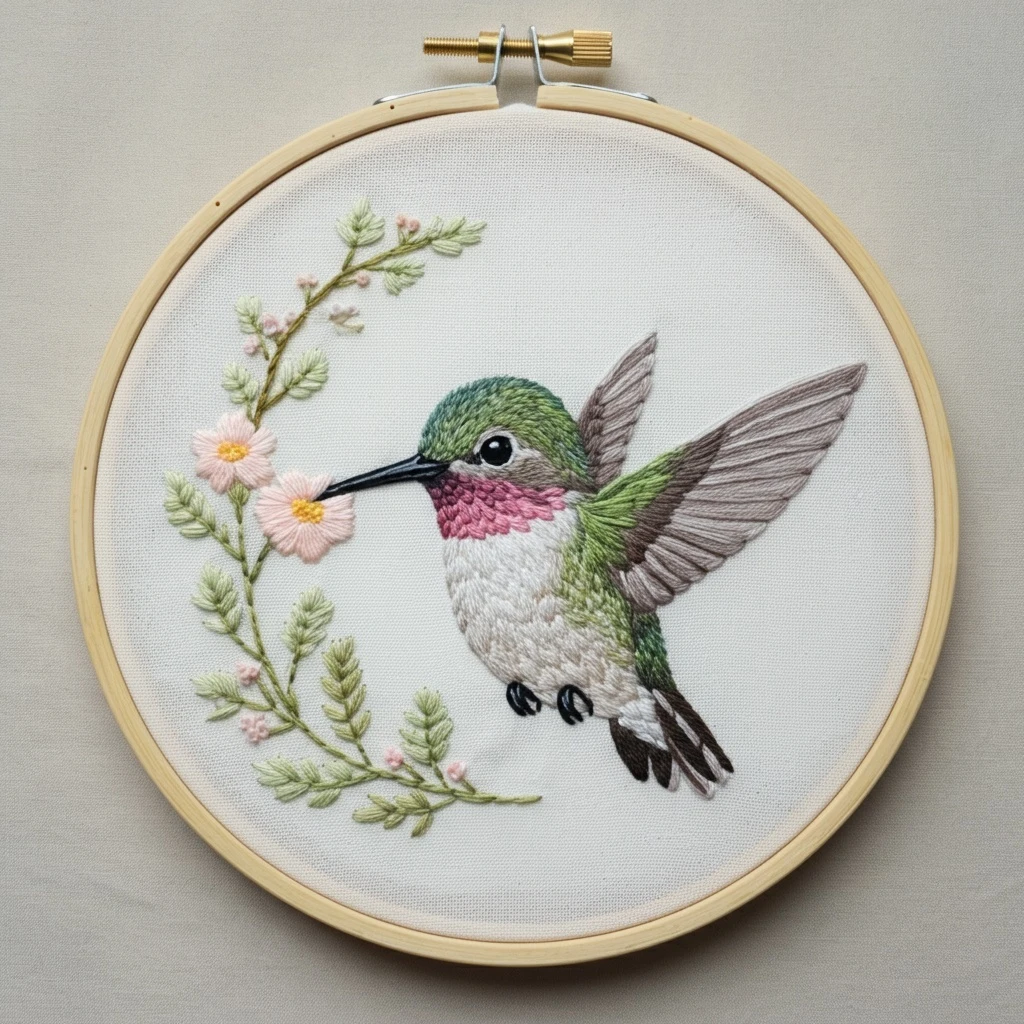
Lifelike Hummingbird Blossom Hoop
A dimensional nature hoop with a jewel-toned hummingbird hovering beside soft blossoms, leafy stems, and airy negative space. The palette balances iridescent teal wing feathers, emerald shadows, warm throat accents, rosy petals, and gentle linen-friendly outlines.
Recommended DMC Palette
For a lifelike hummingbird, keep the body rich but not flat: layer blue-green, turquoise, and dark teal in narrow directional strokes. Let the blossoms stay softer and warmer so the bird remains the focal point.
Stitch Map & Texture Plan
Hummingbird body & wings
- Long-and-short stitch: Best for the chest, head, and wing gradients; stitch in the direction feathers grow.
- Split stitch padding: Outline the bird first with one strand, then fill over it for crisp contours.
- Satin stitch: Use only on small bright turquoise flashes, not on broad wing areas.
- Single-strand back stitch: Add feather divisions after the fill so the bird remains lifelike.
Blossoms, leaves & stems
- Fishbone stitch: Lovely for individual leaves, with darker green at the center vein and lighter green at tips.
- Lazy daisy: Use for small petals, buds, and soft open blossom shapes.
- French knots: Place 1-wrap knots in DMC 3821 or 817 for pollen and tiny flower centers.
- Stem stitch: Keep branching stems graceful with 1–2 strands in green or hazelnut brown.
| Area | Suggested strands | Best stitches | Practical note |
|---|---|---|---|
| Bird outline and beak | 1 strand | Split stitch, back stitch | Use dark brown instead of black for a softer realistic edge, reserving the darkest point for the eye. |
| Head and chest | 1–2 strands | Long-and-short stitch | Short, curved strokes create roundness; blend turquoise with green rather than making stripes. |
| Wings and tail | 1 strand for detail, 2 for fill | Long-and-short, straight stitch | Feathers should taper outward; leave tiny slivers of fabric between some tail stitches for motion. |
| Blossom petals | 2 strands | Lazy daisy, satin stitch, split stitch | Work darker coral at the base and pale rose or peach at the outer petal edge. |
| Leaves and stems | 1–2 strands | Fishbone, stem stitch | Vary green shades from leaf to leaf so the bouquet looks organic, not flat. |
Blending & Shading Guidance
Iridescent feather mix
Thread one strand DMC 3810 with one strand DMC 3846 for bright body areas. For darker wing curves, pair DMC 3808 with DMC 3810.
Soft blossom blend
Blend one strand DMC 3716 with one strand DMC 948 for petal tips. Add DMC 352 at the flower base to create a gentle cupped shape.
Natural leaf depth
Use DMC 986 near the stem and DMC 989 at the outer leaf edge. A few DMC 420 stitches can warm the branch without overpowering the greens.
Outlining details
Keep all realism lines light: one strand of DMC 3371 for the eye, beak, and the most important wing separations is enough. On the blossoms, outline with a matching darker petal color rather than brown; this preserves the soft floral look.
Beginner-Friendly Stitching Order
Fabric, Needle & Finishing Tips
Fabric choice
Warm white, cream, or natural linen makes the turquoise feathers and pink blossoms glow. Use a backing layer if the fabric is thin, because dense feather stitching can pull.
Needle & tension
A size 8 embroidery needle works well for most two-strand areas; switch to size 9 or 10 for one-strand feather and eye details. Keep tension relaxed so satin and long-and-short stitches stay smooth.
Texture control
Use the greatest texture in the bird and flower centers. Keep stems flatter so they recede, and reserve French knots for pollen, throat sparkle, and a few botanical accents.
Realism check
Step back often. If the wing looks too striped, add a few short intermediate stitches in a blended thread. If the flowers look too heavy, add pale edge stitches and leave more linen showing.