
DMC palette & embroidery notes
Lush Peony Pansy Bouquet 3D
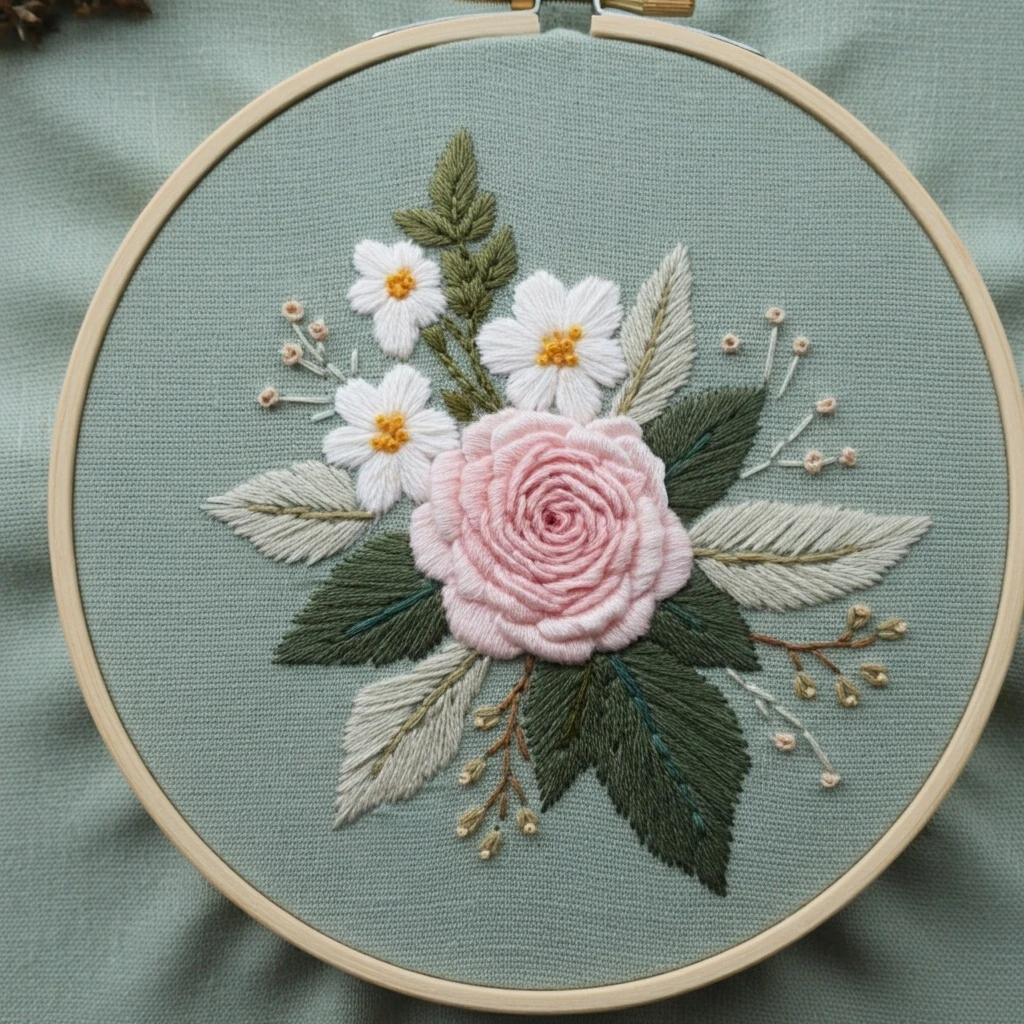
A soft dimensional bouquet built around a pale blush peony, white daisy-like accent blooms, deep forest leaves, silvery sage foliage, golden centers, tan seed sprays, and a muted sage cloth background. The stitch plan below keeps the raised flower lush while the supporting greenery stays crisp and beginner-friendly.
Design color reading
The reference has a calm, garden-hoop look: a plush blush peony forms the focal point, surrounded by white petals with ochre centers, layered dark green leaves, pale sage feather leaves, thin twig sprays, and small beige seed knots. The palette should feel dimensional rather than overly bright, with high contrast between the pale flowers and the deep foliage.
Stitch plan by area
Raised peony or 3D rose center
- Use woven wheel, cast-on stitch, or bullion loops for the central spiral.
- Work outer petals in padded satin or close long-and-short stitch with 3 strands of 819/225.
- Add 224 and a pinprick of 315 only inside folds so the flower keeps its soft blush look.
White blossoms and pansy-like accents
- Use fishbone or satin stitch from the petal tip toward the center.
- Blend B5200 with 3865 for petal depth; keep edges bright and inner bases warmer.
- Centers work well as clusters of French knots in 725 and 783.
Dark foliage
- Use closed fishbone stitch for pointed leaves so the vein forms naturally.
- Alternate 934, 3362, and 3052 on each side of the leaf for dimensional shading.
- Add single-strand 3768 lines on selected dark leaves for the cool stitched veins seen in the artwork.
Pale sage feather leaves
- Use long-and-short stitch with 927 and 926, angling each stitch toward the center vein.
- Use 1 strand for the center vein; 2 strands for the leaf body.
- Keep stitch lengths irregular to mimic the soft, embroidered feather texture.
Sprays, twigs, and seed pods
- Work stems in stem stitch or split stitch with one strand of 839.
- Use French knots, colonial knots, or tiny detached chains in 842 for seed tips.
- For airy sprays, leave small gaps between stitches so the lines do not overpower the bouquet.
Outlining and final polish
- Outline only key petal separations with 1 strand of 224 or 315; avoid heavy dark outlines on the peony.
- Use a fine back stitch around selected leaves where they overlap the flower.
- Finish with a few B5200 highlights on petal tips and 725 knots in the brightest centers.
Thread-count and blending guide
| Area | Recommended strands | Practical guidance |
|---|---|---|
| Peony body | 2–3 strands | Use 3 strands for padded outer petals and 2 strands for curled inner details. For softer shading, blend one strand 819 + one strand 225. |
| Peony shadows | 1 strand | Place 224 or 315 in short curved stitches inside folds only. Too much shadow will make the flower look heavy. |
| White petals | 2 strands | Use 3865 near the center and B5200 at the petal tips. Long smooth stitches create a clean daisy/pansy finish. |
| Large leaves | 2 strands | Use fishbone stitch in alternating greens; switch direction at the center vein so the leaves look dimensional. |
| Fine veins and sprays | 1 strand | Single-strand stem stitch and back stitch keep twig lines elegant and prevent bulk. |
| Knots and seed heads | 2 strands | Wrap French knots twice for small seed pods; three wraps for flower centers that need more lift. |
Suggested stitching order
Stitch stems, twig sprays, and the palest leaves first. This keeps later raised petals from catching on your thread.
Work from the outside toward the peony, using fishbone stitch and varying greens so each leaf has a visible direction.
Complete the petals before adding knots in the centers; this prevents yellow knots from snagging while you work smooth satin stitches.
Pad the outer petal areas, then work the woven or cast-on center. Keep the rose spiral compact and gently raised.
Add seed knots, cool blue-green veins, and final single-strand outlines only where they improve separation.
Beginner-friendly practical tips
Fabric and hoop tension
Use a stable cotton or linen in a muted sage, oatmeal, or pale gray-green. Tighten the hoop until the surface feels drum-like, especially before making padded petals and knots.
Keep raised stitches neat
For bullion or cast-on petals, use a milliner needle if available. Pull slowly, support the wraps with a fingertip, and make fewer larger petals rather than many crowded loops.
Control bulk
Do not carry dark green threads behind white petals or pale peony sections. End and restart thread when jumping between distant leaves to avoid show-through.
Shade one element at a time
Finish one flower or leaf before moving on. Comparing each finished part to the next helps maintain the soft light source and prevents the bouquet from becoming patchy.