
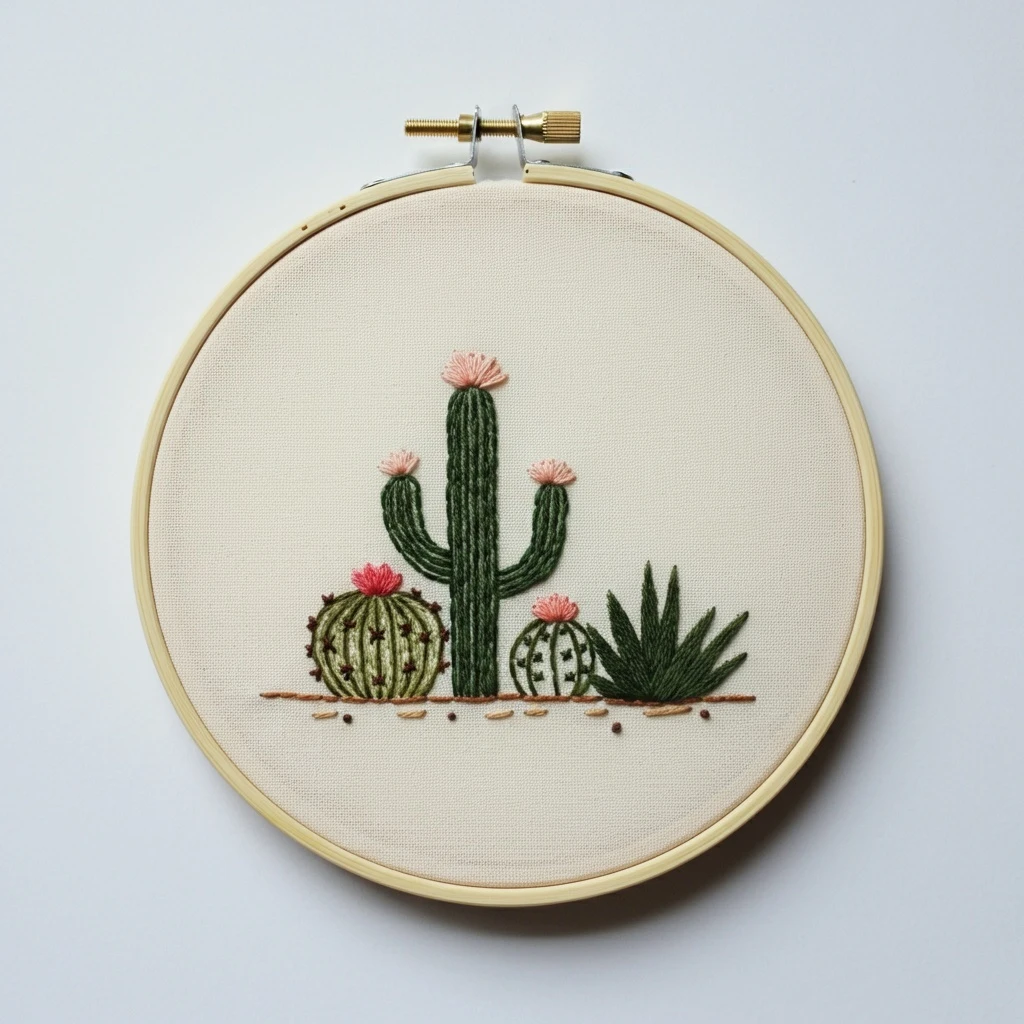
Minimalist Cactus And Succulent
A clean botanical hoop with rounded cactus forms, compact succulent leaves, earthy pot tones, and small linework details. The palette stays calm and modern: dusty greens, olive shadows, soft sage highlights, terracotta warmth, and tiny pale spine accents.
Suggested DMC Color Palette
Use these shades as a practical stitching palette for the cactus pads, succulent rosette, soil, pots, outlines, and small light details. For a softer minimalist result, reduce the dark outline to selected edges only.
Stitch Map
| Area | Recommended stitches | Thread count |
|---|---|---|
| Cactus pads | Split stitch or back stitch for clean contours; satin stitch or long-and-short stitch for filled pads. Work ribs with curved stem stitch. | 2 strands for outlines, 2–3 strands for fills, 1 strand for rib details. |
| Succulent leaves | Fishbone stitch gives each leaf a center vein and tidy pointed tip. Use satin stitch on very small leaves. | 2 strands; switch to 1 strand for tiny inner rosette leaves. |
| Pots and soil | Satin stitch across the pot body, split stitch around rims, and seed stitch or French knots for sandy soil texture. | 3 strands for pot fills, 2 strands for rims, 1–2 strands for soil speckles. |
| Spines and dots | Tiny straight stitches, single-wrap French knots, or small detached stitches in winter white or pale sage. | 1 strand only for a delicate, non-bulky finish. |
| Modern outline | Back stitch, whipped back stitch, or very fine stem stitch in dark green-gray instead of harsh black. | 1–2 strands depending on hoop size. |
Blending & Shading
Texture Suggestions
Keep the minimalist look clean
Use fewer strands and short, even stitches. Avoid overfilling the open spaces between plant shapes; the quiet fabric background is part of the design.
Add botanical character
Place tiny French knots along cactus edges for spine clusters, but keep them sparse. Too many knots can make a simple cactus look heavy.
Leaf direction matters
Stitch every succulent leaf from base to tip so the thread sheen follows the natural growth direction. This gives the rosette a polished dimensional effect.
Outline selectively
For a modern hoop, outline the outer silhouette and pot rims, then leave some interior edges defined only by color changes.
Beginner-Friendly Stitching Order
Transfer lightly
Use a fine removable pen and mark only major outlines, pot rims, leaf centers, and cactus ribs.
Outline first
Back stitch the main silhouettes with 1–2 strands so the design stays neat while you fill.
Fill big shapes
Work cactus pads and pots before the tiny details. Keep satin stitches short by dividing large areas into sections.
Add details last
Finish with spines, dots, soil knots, and highlights after all green and terracotta fills are complete.