
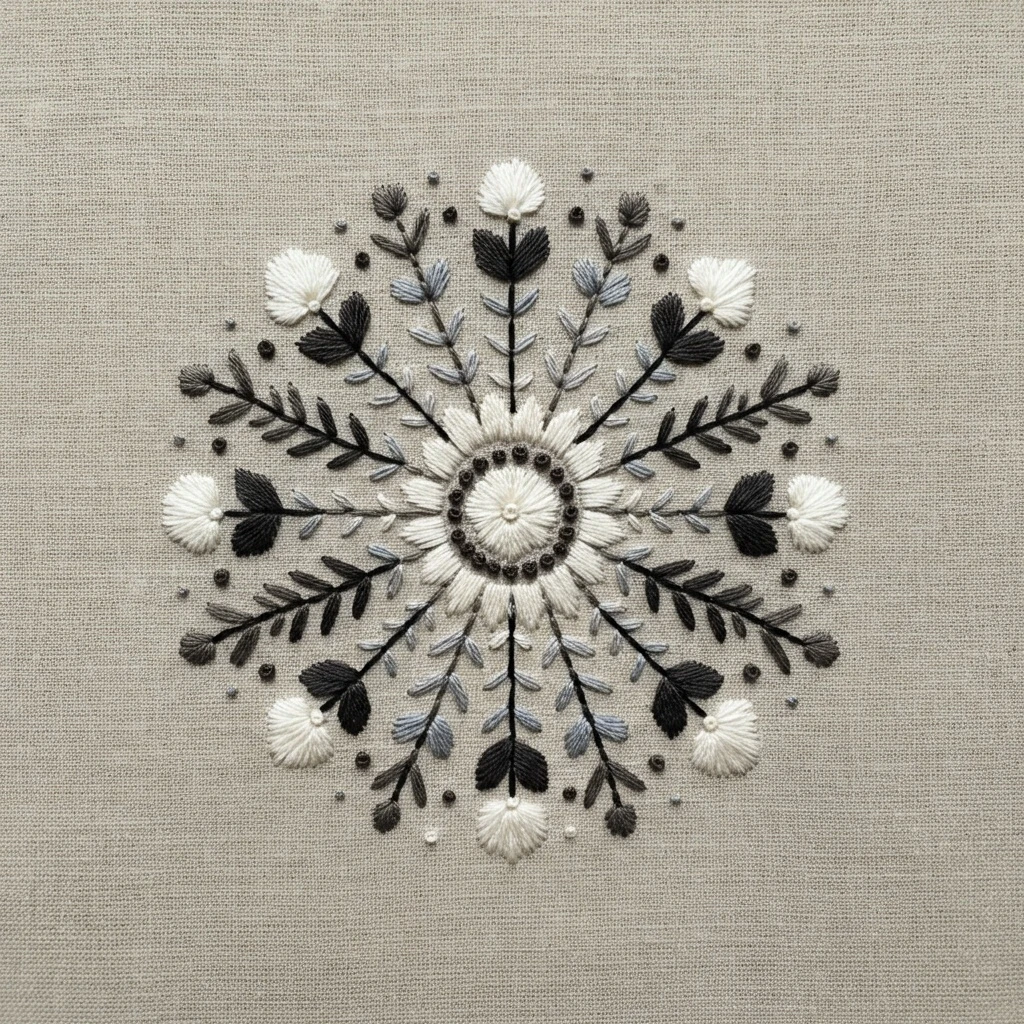
Monochromatic Floral Mandala
A refined stitching plan for a circular floral mandala built from layered petals, repeated leaf forms, delicate linework, small dot accents, and quiet tonal contrast. The goal is elegant one-color harmony with enough depth to keep every ring readable.
Color story
For this design, think in values rather than many hues: deep blue-gray for anchors and outer definition, mid antique blues for petal bodies, pale blue and pearl gray for highlights, and a tiny touch of very dark pewter only where the drawing needs sharper contrast.
Stitch map by design area
The design’s polish comes from repeated stitch direction and consistent strand count. Work matching motifs in pairs across the circle so the value placement stays balanced.
Central rosette
Use satin stitch or a small woven wheel in 930 and 931. Add one or two 3752 highlights at the top edge, then place tiny French knots in 3750 for the center dots.
Main petal ring
Use long-and-short stitch with 930, 931, and 932. Keep stitches angled toward the center so every petal radiates evenly from the rosette.
Outer floral points
Use satin stitch in 931 and 932 with a fine one-strand outline in 3750. Leave a sliver of fabric between close shapes to keep the pattern airy.
Fine mandala outlines
Back stitch or split stitch with one strand of 3750 for crisp dark lines. Use 930 for inner outlines where the line should be softer.
Leaf-like shapes
Work fishbone stitch with 931 on the spine and 932 or 3752 on the light side. If using the optional gray-green pair, reserve it only for these botanical forms.
Dots and flourishes
Use French knots, colonial knots, or single seed stitches in 3752, 762, or 3865. Repeat the same wrap count around each ring for a calm beaded rhythm.
Thread-count guidance
Outlines & tiny curves
Use 1 strand for back stitch, split stitch, and small ornamental curls. This keeps the mandala crisp and prevents bulky intersections.
Petal and leaf fills
Use 2 strands for satin stitch, fishbone stitch, and long-and-short shading. Two strands give smooth coverage while preserving fine printed edges.
Raised dots
Use 2 strands with two wraps for most French knots. Use three wraps only in the center or the largest repeated dots, then keep that choice consistent.
Blending & shading plan
Monochromatic embroidery looks best when the shade transitions are deliberate. Use darker values at bases, medium tones through the body of the shape, and pale stitches at tips or outer-facing edges.
| Area | Suggested blend | How to use it |
|---|---|---|
| Main flower petals | 930, 931, 932 | Place 930 closest to the center, 931 through the middle, and 932 at the petal tip. Repeat the same placement on every matching petal. |
| Bright tips and tiny highlights | 932 with 3752 | Add just a few 3752 stitches over 932, especially at petal tips and dot clusters that should catch light. |
| Dark structural outlines | 3750 with 930 | Use 3750 for the outer contour and 930 for secondary internal lines. This creates depth without a harsh black outline. |
| Center depth | 3750, 930, 317 | Use 317 sparingly in the center if you want a smoky shadow. Keep it inside the rosette so the cool blue family remains dominant. |
| Optional botanical contrast | 924 and 927 | Use the gray-green pair only on leaf motifs or alternate outer shapes for a subtle botanical shift within the monochrome palette. |
Beginner-friendly stitching order
Transfer lightly
Use a fine water-soluble pen or very light pencil marks. Monochrome designs show heavy transfer lines more easily than colorful designs.
Start with the center
Complete the rosette and central dots first. This gives you a visual anchor for all later stitch direction and ring spacing.
Work in opposite pairs
Stitch one petal or leaf, then stitch the matching shape across the circle with the same colors and stitch angle. This protects the mandala symmetry.
Fill before outlining
Complete satin, fishbone, and long-and-short fills first, then add one-strand outlines to neaten edges and sharpen the floral geometry.
Add knots last
Finish with French knots and tiny seed stitches so they sit raised on top and do not snag while you rotate the hoop.
Practical tips for a clean finish
Fabric & hoop
- Use white, ivory, pale gray, or natural linen to emphasize the blue-gray tonal range.
- Keep the hoop drum-tight; satin stitches in a mandala reveal puckering quickly.
- A size 7 or 8 embroidery needle is ideal for 1–2 strand work.
Keeping it monochrome
- Limit the darkest color to outlines, centers, and anchor dots.
- Use pale colors as accents, not full replacements, so the pattern does not become washed out.
- Repeat the same shade sequence in every matching motif for a professional look.
Texture suggestions
- Use satin stitch for polished petals, fishbone stitch for leaf forms, and French knots for bead-like dot rings.
- Try split stitch instead of back stitch on curves for a smoother, corded outline.
- Leave tiny fabric gaps between neighboring petals to keep the mandala lace-like and readable.
Common fixes
- If outlines look heavy, switch from 3750 to 930 for the inner rings.
- If petals look flat, add a few 932 or 3752 stitches at the tips.
- If the circle feels uneven, check opposite motifs first; small inconsistencies are easiest to correct in paired areas.