
DMC Palette & Hand Embroidery Notes
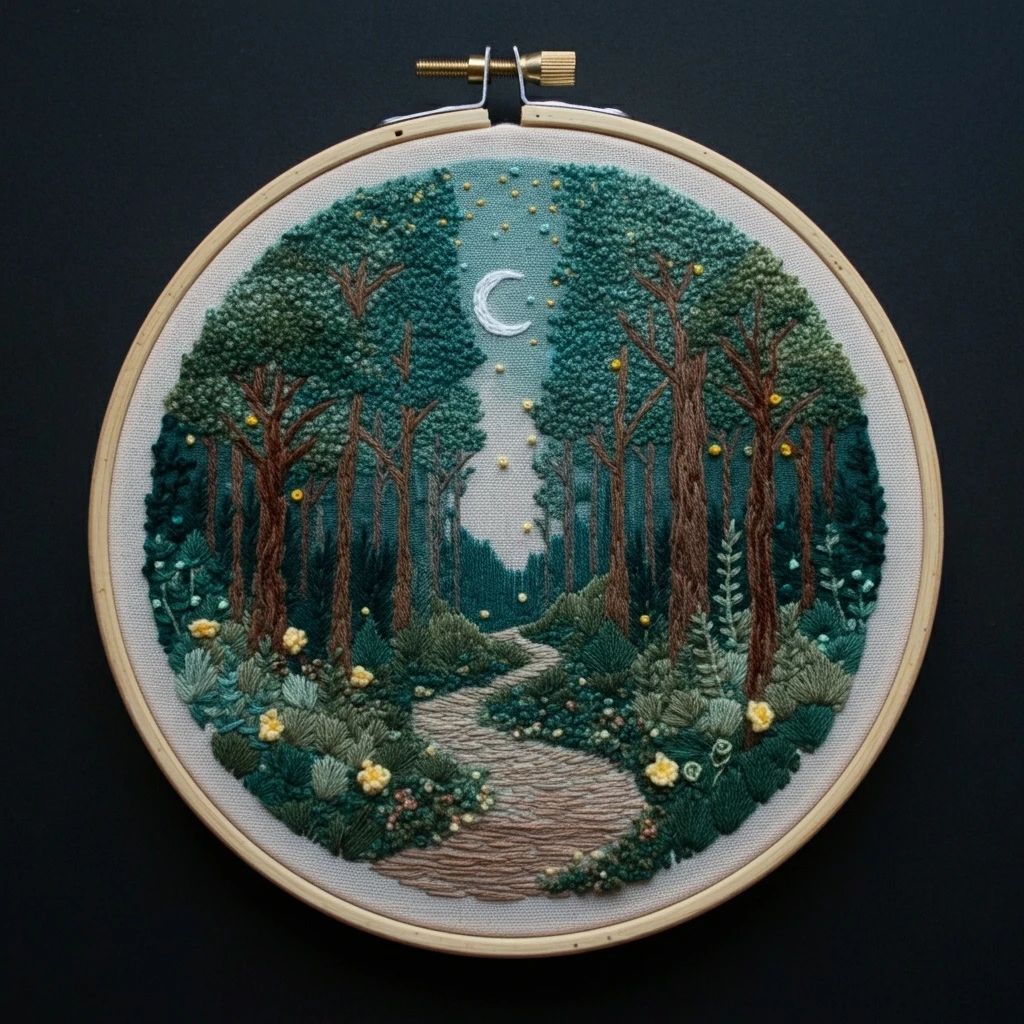
Moonlit Enchanted Forest Path
A woodland hoop design with tall tree trunks, deep evergreen foliage, a winding stitched path, tiny golden lights, and a soft crescent moon glowing above the clearing.
Preview
This design appears to show a magical forest scene inside a round hoop: a pale winding path leads into a shadowy tree tunnel, with full textured treetops, layered ferns and shrubs, tiny light-colored flowers, golden dots, and a crescent moon in the open sky.
The design/category line is moonlit woodland landscape hoop art: atmospheric, textured, and slightly storybook-like, with the most visual depth coming from the contrast between dark forest edges, warm brown trunks, and the pale central pathway.
The DMC colors and coverage percentages below are visual estimates from the preview image only. They are intended for floss planning and substitution ideas, not exact measurements of thread usage.
Likely DMC Color Palette
These are close visual DMC matches for the shades visible in the preview. Adjust one step lighter or darker if your fabric, lighting, or preferred mood changes the look of the design.
| DMC | Approx. Hex | Official-style Thread Name | Est. Coverage | Where This Shade Appears |
|---|---|---|---|---|
| 500 | #1d4b43 |
Blue Green - Very Dark | 20% | Deep forest edge, shadowed background trees, darkest lower greenery, and the cool shaded sides of the woodland scene. |
| 501 | #2f6d5f |
Blue Green - Dark | 17% | Mid-dark treetop clusters, central forest depth, rounded shrub masses, and transitions between the darkest green and brighter foliage. |
| 890 | #4d8061 |
Pistachio Green - Ultra Dark | 12% | Olive-green foliage on the right side, mossy tree masses, background canopy shading, and some lower plant layers. |
| 503 | #7c9c86 |
Blue Green - Medium | 9% | Soft fern highlights, pale leafy sprigs, foreground grasses, and cool green accents near the path and flowers. |
| 927 | #a7b9a0 |
Gray Green - Light | 7% | Lightest fern tips, silvery grasses, small leaves, and cool highlights across the foreground planting. |
| 938 | #6f4b3a |
Coffee Brown - Ultra Dark | 11% | Main tree trunks, branch outlines, bark texture, and darker lines following the winding path. |
| 3862 | #9b6a50 |
Mocha Beige - Dark | 6% | Warm highlights in tree bark, path ridges, and softer brown texture where the pathway comes forward. |
| 613 | #d8cbb7 |
Drab Brown - Very Light | 5% | Light stitches in the winding path and pale ground highlights that separate the walkway from surrounding greenery. |
| 747 | #b9ddd5 |
Sky Blue - Very Light | 5% | Misty blue-green sky opening, light glow behind the crescent moon, and a few cool atmospheric highlights. |
| B5200 | #eef4f2 |
Snow White | 3% | Crescent moon, brightest sky glints, and small pale flower centers or light-catching stitches. |
| 3821 | #e0c03b |
Straw - Light | 3% | Tiny golden dots, firefly-like accents, flower centers, and warm specks scattered through the upper trees. |
| 3078 | #f3da72 |
Golden Yellow - Very Light | 2% | Pale yellow flower petals and the softest glowing highlights around small blossoms and lights. |
Stitching Suggestions
Tree trunks and branches
Use stem stitch, split stitch, or whipped back stitch for the long vertical trunks. Work the main trunk lines first, then add branch forks and a few uneven bark strands in a second brown for natural texture.
Dense forest canopy
French knots, colonial knots, or tiny seed stitches will suit the rounded, nubby treetop texture. Vary dark teal, blue-green, and olive shades in small patches rather than forming perfectly even rows.
Winding path
Short long-and-short stitches, split stitch rows, or slightly curved back stitches can follow the path direction. Keep the center lighter and let darker brown lines define the curves and foreground ridges.
Ferns, shrubs, and grasses
Use fishbone stitch for fern leaves, lazy daisy for small leaf clusters, and straight stitches for fine grass blades. Layer the darker greenery first, then add pale gray-green accents on top.
Moon and sky opening
Satin stitch or closely packed split stitch will make the crescent moon smooth. Use a pale blue-green shade sparingly around it so the moon remains crisp and luminous.
Golden lights and flowers
French knots are ideal for the tiny gold dots. For the small yellow flowers, use lazy daisy petals with a French knot center, keeping them slightly irregular so they feel tucked naturally into the forest floor.
Where to Start
- Transfer the main shapes first: mark the hoop circle, central path, tree trunks, moon, and the largest foliage masses before adding tiny flowers or dots.
- Stitch the background greens: begin with the darkest forest edges and upper canopy so the whole scene has depth from the start.
- Add trunks over the greenery: place the warm brown tree lines after the background texture, letting the trunks sit clearly in front of the canopy.
- Build the path from back to front: use lighter stitches near the center opening and warmer browns as the path widens toward the foreground.
- Finish with highlights: save the crescent moon, golden knots, pale fern tips, and flower centers for the end so they stay clean and bright.
Helpful Notes
Thread and texture
- Use 1 strand for delicate distant trunks, tiny sky dots, and fine plant stems.
- Use 2 strands for most tree trunks, path texture, and foreground foliage.
- Use 2 to 3 strands for French knots if you want the canopy and golden lights to look raised and dimensional.
Color planning
- Keep the darkest teal-green shades around the outer edge to preserve the tunnel-like forest effect.
- Blend olive and gray-green accents into the lower plants so the foreground does not become one flat color.
- Test the moon white on your fabric; if it looks too stark, soften it with a very pale blue or gray-white stitch nearby.
Because this palette is estimated from a preview image, treat the percentages as a visual balance guide. Actual floss usage will depend on hoop size, fabric count, strand count, stitch density, and how heavily you fill the canopy and path.
Encouraging Finish
This is the kind of woodland design that rewards slow layering. The trees do not need to be perfectly identical, and the foliage will look more natural if the knots and seed stitches vary a little in spacing and shade.
When the final gold dots and pale moon are added, the whole scene should begin to feel quietly illuminated. Work from dark to light, keep the path softly curved, and let the tiny highlights bring the enchanted forest to life.