
DMC Palette & Stitch Guide
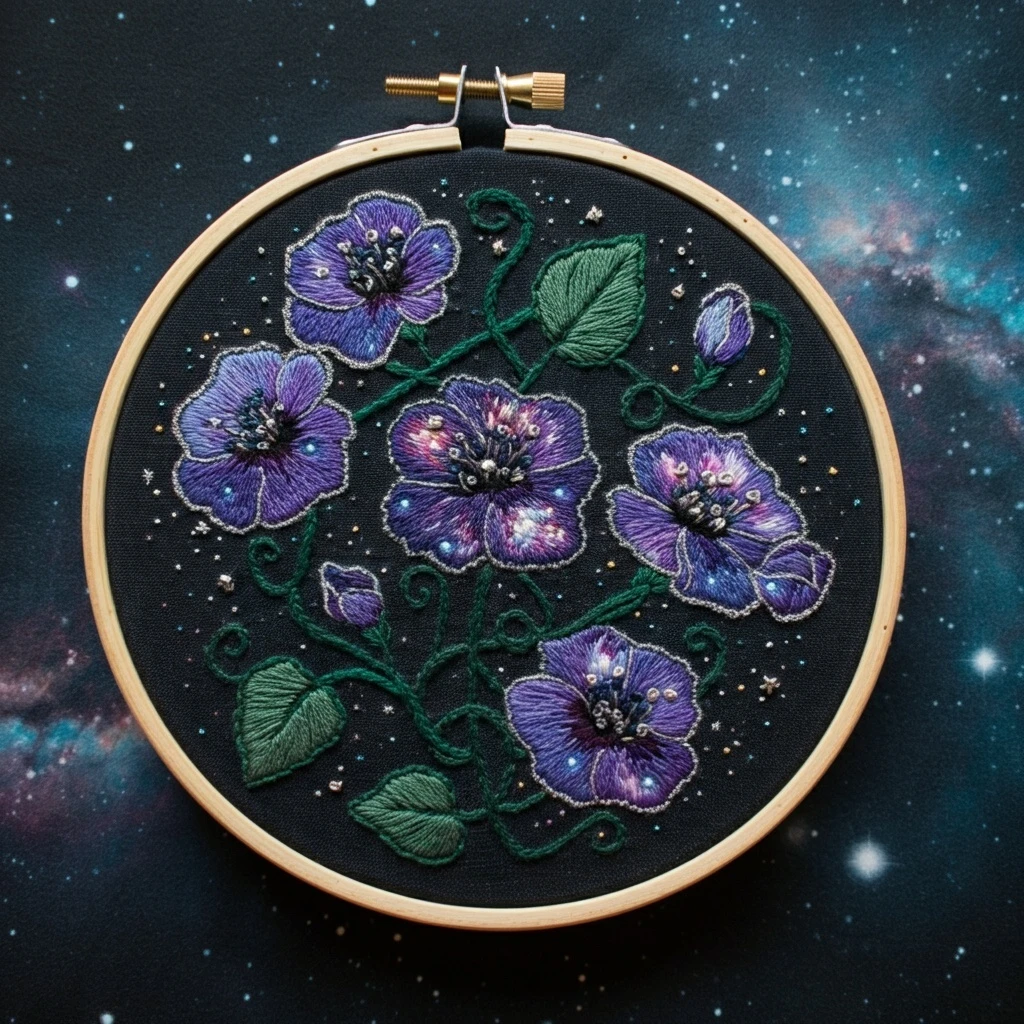
Night Sky Morning Glories
A polished floss palette and practical embroidery plan for deep black fabric, blue-violet morning glory petals, emerald curling vines, soft green leaves, silver outlines, tiny stars, and galaxy-bright accents.
Likely DMC Color Palette
Colors are matched to the visible preview: luminous blue-purple flowers, dark centers, silver edging, cool green vines, leaf shading, starry speckles, and warm golden pinpoints. Percentages are visual estimates, not exact thread usage.
Stitching Suggestions
Build the design from the broad flower shapes outward, then finish with outlines and stars. This keeps the delicate sparkles clean and prevents over-handling the pale stitches.
| Element | Stitch Type | Practical Notes |
|---|---|---|
| Morning glory petals | Long and short stitch, satin stitch accents | Use 2 strands for the base. Start with 939/820 near the throat, move into 333, then feather in 3746 and 554 toward the petal edge. Keep stitch direction radiating from the center. |
| Petal veins | Single-strand straight stitch or split stitch | Add veins after the fill with 554, 3746, or a 333+554 blend. Make the lines uneven and slightly curved so the flowers look natural. |
| Silver petal edges | Split stitch, backstitch, or whipped backstitch | Use 1 strand of 415 for most outlines. Add tiny touches of 3865 only on the brightest rim sections to mimic moonlight. |
| Flower centers | French knots, seed stitch, short straight stitches | Cluster 3371, 939, 415, and 3865. Vary knot wraps from one to two so the stamens feel dimensional without becoming bulky. |
| Vines and tendrils | Stem stitch, whipped stem stitch, couching | Use 2 strands of 500 or 986 for main vines. For tight curls, switch to 1 strand and keep the tension relaxed to avoid angular spirals. |
| Leaves | Fishbone stitch, long and short stitch, split-stitch veins | Shade from 500 at the leaf base to 986, then 3816 on the raised side. Work each leaf half separately so the central rib stays clean. |
| Buds | Satin stitch and short directional stitches | Use the same petal blend as the open flowers, but keep highlights on one side only. Outline the bud with 415 and tuck a dark green calyx underneath. |
| Stars and sky dust | French knots, seed stitch, tiny cross stitches | Scatter 3865, 415, 3846, and a few 729 knots. Use mostly 1 strand; place the largest knots near the flowers and smaller seed stitches toward the edges. |
| Galaxy glints on petals | Tiny straight stitches, single knots | Add a very small number of 3846 and 3865 accents after petal shading. Treat them like reflected starlight rather than polka dots. |
Thread Count, Blending & Texture Plan
These suggestions are designed for a hoop-sized hand embroidery piece on dark cotton or linen.
Thread-count guidance
- Use 2 strands for most filled petals, leaves, and main vine lines.
- Use 1 strand for fine petal veins, tiny stars, delicate outlines, and tight tendril curls.
- Use 3 strands only for bolder foreground vine sections or larger French-knot flower centers.
- Keep the needle size comfortable for black fabric; a sharp embroidery needle helps maintain clean entry points.
Blending ideas
- For dimensional petals, try one strand 333 + one strand 3746 for midtone areas.
- For cool shadow, blend one strand 820 + one strand 333 near the flower throat.
- For violet-pink glow, use one strand 333 + one strand 3608 in short highlight patches.
- For moonlit outlines, whip 415 backstitch with a few short 3865 segments instead of outlining the whole flower in white.
Shading order
- Stitch dark petal centers first, then add midtones, then pale edge highlights.
- Complete green vines before nearby star knots so the stars remain bright and undisturbed.
- Shade leaves from the central vein outward, changing green values as the stitch direction turns.
- Add the brightest turquoise and white glints last.
Texture suggestions
- Use dense long-and-short stitching for velvety morning glory petals.
- Make centers raised with mixed French knots and short stamen strokes.
- Keep vines smoother with stem stitch so they contrast against textured flowers.
- Use sparse, varied star stitches to avoid making the background look patterned.
Beginner-Friendly Working Path
A simple sequence helps prevent tangles, smudged pale thread, and crowded details.
Where to start
Begin with the largest central flower because it sets the color balance. Stitch the other open blooms next, then buds, leaves, vines, outlines, centers, and finally the stars.
Practical tips
- Wash hands before using pale gray, white, or turquoise floss on black fabric.
- Use a good lamp; dark fabric hides stitch holes and makes tension harder to judge.
- Shorten floss lengths to about 14–16 inches to reduce fuzzing and knots.
- Do not carry white thread across the back of dark open areas; it may show through.
- Check the hoop tension often so satin and long-and-short stitches stay smooth.
Finishing Notes
The charm of this design is contrast: velvety flowers against a deep sky, silver rim-light, and tiny star texture.
For the cleanest finish, leave the background fabric mostly visible. The black cloth acts as the night sky, so the embroidery should feel like luminous botanical shapes floating over it. Avoid overfilling the empty space; a few well-placed 3865, 415, 3846, and 729 stitches will create a more convincing celestial sparkle than heavy all-over speckling.